
01 · Sexuality & Boundaries
Introduction
By keeping your attention to yourself and never losing sight of the person behind the feet. Looking is human. Harassment begins where others have to feel your attention without wanting to, for example through staring, comments, photos, messages or touch. A few simple principles will keep you on the safe side.
02 · Sexuality & Boundaries
Feet belong to people
I have lived with my fetish for over forty years, and in public it is present everywhere. In summer, you see bare feet in sandals; in the city, high heels click across the pavement; in a café, a boot bobs beneath the table. I cannot simply switch off my gaze, and presumably neither can you.
What helps me is a simple thought: These feet belong to a person who is going about their everyday life. They are not part of my fantasy, and they have offered me nothing. Anyone who internalizes this behaves respectfully almost automatically. After all, objectification begins precisely where a person becomes a body part. In addition, many women already view their feet critically. When a stranger stares at them, they quickly feel judged and watched, and rightly so.
03 · Sexuality & Boundaries
Three areas where it matters
04 · Sexuality & Boundaries
Looks
A glance is not yet a boundary violation. Staring can become one. If someone notices your attention and visibly feels uncomfortable, look away. Do not change your position in order to see better, and do not follow anyone around the room with your eyes. Your fantasy is yours. Your gaze should not make anyone feel watched.
05 · Sexuality & Boundaries
Words
Speaking to strangers about their feet is almost always a boundary violation, even if it is meant as a compliment. What may be an innocuous “Nice shoes!” among friends can quickly come across as intrusive when it comes from a stranger.
Particular caution is called for in places where feet are already the focus, such as shoe stores or foot-care studios. The people who work there are doing their job. Do not use such situations for your fetish, for example by asking female sales assistants to try on shoes for you or steering conversations in an erotic direction.
06 · Sexuality & Boundaries
Clicks
Online, boundaries blur particularly easily. A few rules help:
- No unsolicited messages. Do not write to anyone to ask for pictures of feet if that person does not explicitly offer them.
- No suggestive comments beneath everyday photos in which feet happen to be visible.
- Do not distribute other people’s pictures. Other people’s photos do not belong in fetish collections or forums.
- Respect what is offered. If someone deliberately offers content, exactly what is offered applies, and no more.
- Minors are without exception off limits, in every form.
07 · Sexuality & Boundaries
Not everything that arouses is allowed
I consider this sentence one of the most important of all. The red line is always crossed when our behavior imposes something on others to which they have not consented. This applies to a foot fetish just as it does to all other sexual preferences. The World Health Organization also draws a clear line precisely at this point: patterns of sexual arousal directed at people who have not consented form a separate category in ICD-11.
08 · Sexuality & Boundaries
Where your fetish has a place
For decades, my fetish had plenty of room—in relationships, in photo shoots, in video productions. All of that took place with people who participated voluntarily. That is precisely the difference. Anyone who gives their fetish a consensual framework, in a relationship or with people who consciously take part, does not need to act it out in public. There are also communities and events where people consciously come together to share their preferences consensually. But the same rule applies there too: ask first, then act.
09 · Sexuality & Boundaries
If you find it difficult
Sometimes the urge is stronger than good intentions. If you notice that you repeatedly put yourself in situations to see strangers’ feet, or that you have already crossed small boundaries, take it seriously. A conversation with a professional in psychotherapy or sexual medicine can help before something happens. Seeking help before a boundary is crossed shows responsibility, not weakness.
Sources
Sources
- Markus M. Mey: BIN ICH NORMAL? Fuß- und Schuhfetisch verstehen. Erste Edition, meybrands, Berlin 2026. ISBN 9798247074557.
- World Health Organization: ICD-11 for Mortality and Morbidity Statistics, Paraphilic disorders (6D30–6D36), Release 2025-01. icd.who.int
Explore further in the book
From the question to your own story.
“Am I Normal?” combines clear context with personal experience and perspectives for relationships.
View the English book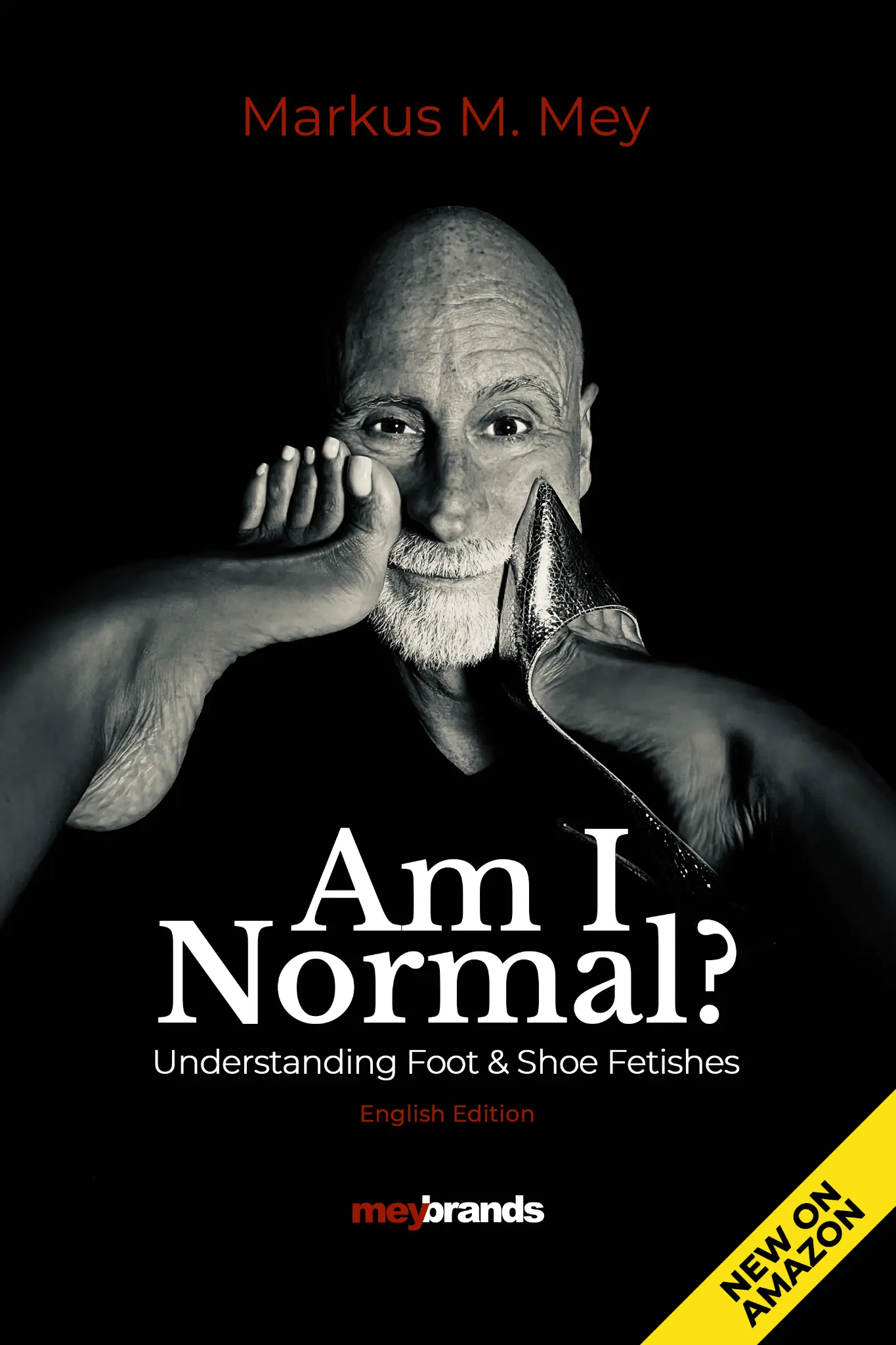
Let this article travel
Good knowledge grows stronger when it is shared.
Link to this original article as a further source — one click copies its permanent address.