
01 · Relationships & Communication
Respecting boundaries
First and foremost: if either person feels uncomfortable, that is a boundary, and it is respected. Even so, there is usually more room for manoeuvre in this situation than couples initially believe. Between ‘everything’ and ‘nothing’ lie many possibilities. I know from personal experience how to get it wrong, and I have learned from that what works better.
02 · Relationships & Communication
My mistake
For many years, I repeatedly saw my wife as a ‘queen’, as a dominant, leading figure. In everyday life, she is indeed a strong, self-assured woman. Sexually, however, she did not want to take the lead permanently. Above all, she did not want to be drawn ever deeper into a BDSM world that I sometimes expected her to share. At the time, I paid too little attention to her own needs. We both became unhappy, although we loved each other.
I tell this because I know how easily one can overlook the other person’s boundaries when one is very preoccupied with one’s own wishes. Boundaries also do not always present themselves as a clear no. If someone feels they have to perform in order for the relationship to last, their inner resistance often expresses itself quite differently: as lack of desire, as withdrawal, as emotional distance.
03 · Relationships & Communication
Understanding is not the same as joining in
A female partner can understand her partner’s fetish without finding it arousing herself. Putting up with that is not easy for either person. He may feel seen only in part. She is somewhere between understanding and her own boundary.
In my book, I describe every relationship as an encounter between two Libidoses. Each person brings their own inner collection of what arouses them. The fact that these collections do not completely overlap is not a relationship failure. I consider the expectation that two people who love each other must also match exactly sexually to be a misconception. The female partner’s libido deserves just as much respect as that of the man with a fetish.
Research offers an interesting indication in this regard. In studies by Giselle Rees and Justin Garcia, the majority of respondents with an object fetish stated that they were sexually aroused and active even without their fetish object. The participants had put themselves forward, so this cannot be generalised. However, it suggests that, for many people with a fetish, good sex does not depend on the fetish being present every time.
04 · Relationships & Communication
What helps couples
From my own experiences and many conversations, I have drawn a few principles:
And sometimes something unexpected happens in the process. A young woman once told me that she found neither feet nor shoes arousing. What she found arousing was the power to consciously increase or diminish her partner’s arousal. Such moments cannot be forced. They arise only where both people feel safe.
- Talk without pressure. Not during an argument and not in bed, but in a calm moment when no one has to decide anything immediately.
- Be specific. What exactly is it about? A particular pair of shoes, a touch, a role? To her, a fetish can often seem much bigger and more threatening than it is. Being clear about it takes away some of its power.
- Put her at the centre. If it is clear that it is about her feet because they are hers, she feels less reduced to a body part.
- Start small. Not every fantasy has to be acted out. Often a symbolic gesture is enough, such as a particular pair of shoes for a special occasion.
- No means no. Even the third time. Anyone who keeps asking turns an invitation into a demand.
- Her wishes count too. Anyone who wants their female partner to engage with their fetish should take her fantasies and boundaries just as seriously.
05 · Relationships & Communication
Three paths, all of which are all right
In the end, every couple finds its own path. Some actively incorporate the fetish into their sex life. Others consciously leave it in the background. Still others decide not to act it out together at all. All of this is legitimate as long as it is based on mutual respect.
Sometimes it also becomes clear that there is no shared middle ground. That is painful. But then it is more honest to acknowledge that difference without blaming either person than to force either person to be someone they are not. My wife and I only found our way when I stopped expecting her to take on a role she did not want. Since then, our sex life has been more alive than in many years before.
Sources
Sources
- Markus M. Mey: BIN ICH NORMAL? Fuß- und Schuhfetisch verstehen. Erste Edition, meybrands, Berlin 2026. ISBN 9798247074557.
- Rees, G. & Garcia, J. R. (2017): All I Need is Shoe: An Investigation into the Obligatory Aspect of Sexual Object Fetishism. International Journal of Sexual Health 29(4). doi:10.1080/19317611.2017.1309483
- Rees, G. (2019): Investigations into sexual fetishism: examining conceptualisations, practice, personal experience, and pathology. Dissertation, Macquarie University. doi:10.25949/19433471.v1
Explore further in the book
From the question to your own story.
“Am I Normal?” combines clear context with personal experience and perspectives for relationships.
View the English book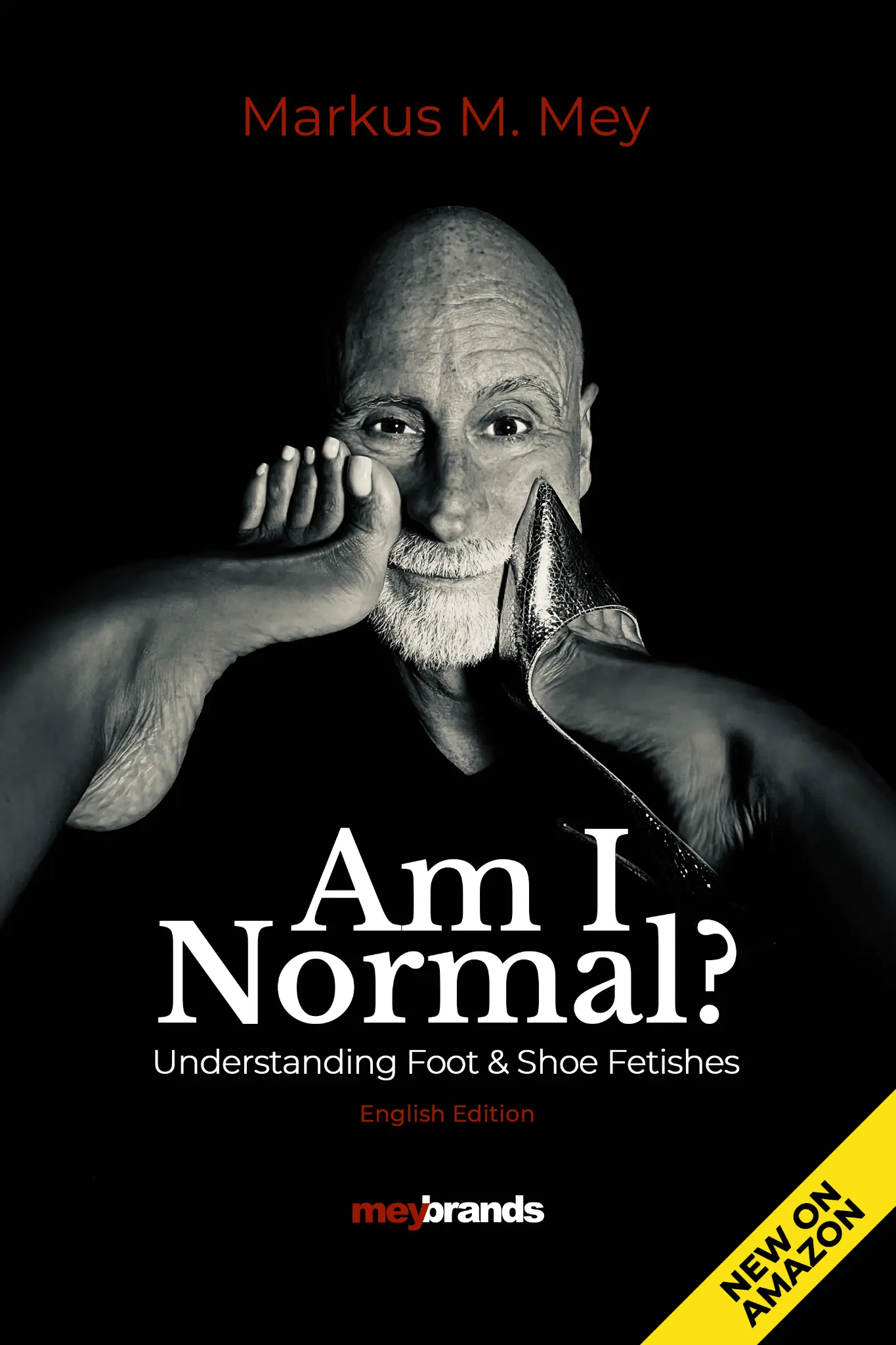
Let this article travel
Good knowledge grows stronger when it is shared.
Link to this original article as a further source — one click copies its permanent address.