
01 · Relationships & Trust
Introduction
Where exactly the boundary lies is for you to decide as a couple, and it is best to clarify it before a discovery occurs. There is no universally valid rule. What is self-evident for one couple is felt by another as a breach of trust. But there is a way to find your own boundary together, along with a few points that are often overlooked in the process.
02 · Relationships & Trust
Why Online Behaviour Is Especially Sensitive
Online content is available at all times, invisible to the other person, and nevertheless leaves traces. It is precisely this combination that makes it so sensitive. If a female partner accidentally discovers a search history, a subscription, or a chat, the matter quickly ceases to be about feet or shoes. It becomes about why he did not say anything and what else he is keeping from her.
Anyone who stays silent for years risks letting this very question of trust loom over everything. That can burden a relationship more than any fetish.
03 · Relationships & Trust
Five Steps Towards a Shared Agreement
A good agreement does not arise in a single conversation. These steps can help you:
- Step one: Each person reflects for themselves. What do I need? What would hurt me? What is purely a private matter for me?
- Step two: Clarify terms. What exactly do you mean by ‘online behaviour’? General images, following particular profiles, chats, paid content, or contact with real people are very different things.
- Step three: Define the degree of openness. Do you only want to know that such a thing exists? Do you want to know details? Or would you like to share it?
- Step four: Make concrete agreements. For example, about whether money may be spent, whether contact with other people is okay, and how much time seems appropriate for it.
- Step five: Check in regularly. Needs change. What worked a year ago may no longer work today.
04 · Relationships & Trust
Three Levels of Openness
It can help to distinguish between three levels. At the first level, the female partner knows that the fetish exists and that he sometimes engages in it by himself, without knowing the details. At the second level, she knows the details, for example, what content he looks at. At the third level, you share the subject with each other. None of these levels is better than the others. The only important thing is that both people know which one you are on.
05 · Relationships & Trust
Points That Are Often Overlooked
When people talk about online behaviour, the question is usually what is being viewed. Some other points are at least as important:
- Money. Subscriptions or paid content often affect the shared budget and should not be kept secret.
- Contact with real people. As soon as chats or individual requests enter the picture, an image becomes a relationship with another person. That has a different quality from an anonymous image.
- Safety. Anyone who exchanges private photos or intimate chats with strangers makes themselves vulnerable, up to and including blackmail. In the end, this often affects the female partner too.
- The people behind the content. Content distributed without the consent of the people depicted has no place in any agreement.
06 · Relationships & Trust
When an Agreement Has Been Broken
If one of you has not kept an agreement, it is a serious matter, but not a reason for shaming. Talk about what happened, what it triggered in the other person, and what you want to do differently in the future. Trust grows through the experience of new agreements being kept, not through punishment.
07 · Relationships & Trust
What the Research Says
There are hardly any direct studies on this question. However, researcher Giselle Rees examined how people experience their fetish alone and together with a female or male partner. The respondents reported both, and shared moments received better ratings on average. The participants had volunteered themselves, so this cannot be generalized. But it suggests that openness may be worthwhile.
08 · Relationships & Trust
My View
Since I was 23, I have told every female partner about my fetish right at the beginning. Where nothing has to be hidden, the question of secrecy does not arise in the first place with this degree of intensity. That does not mean every fantasy has to be shared. But anyone who does not have to conceal their fetish also need not fear their browser history.
Sources
Sources
- Markus M. Mey: BIN ICH NORMAL? Fuß- und Schuhfetisch verstehen. Erste Edition, meybrands, Berlin 2026. ISBN 9798247074557.
- Rees, G. & Garcia, J. R. (2017): An investigation into the solitary and interpersonal aspects of sexual object fetishism: a mixed-methods approach. Psychology & Sexuality 8(4). doi:10.1080/19419899.2017.1383301
Explore further in the book
From the question to your own story.
“Am I Normal?” combines clear context with personal experience and perspectives for relationships.
View the English book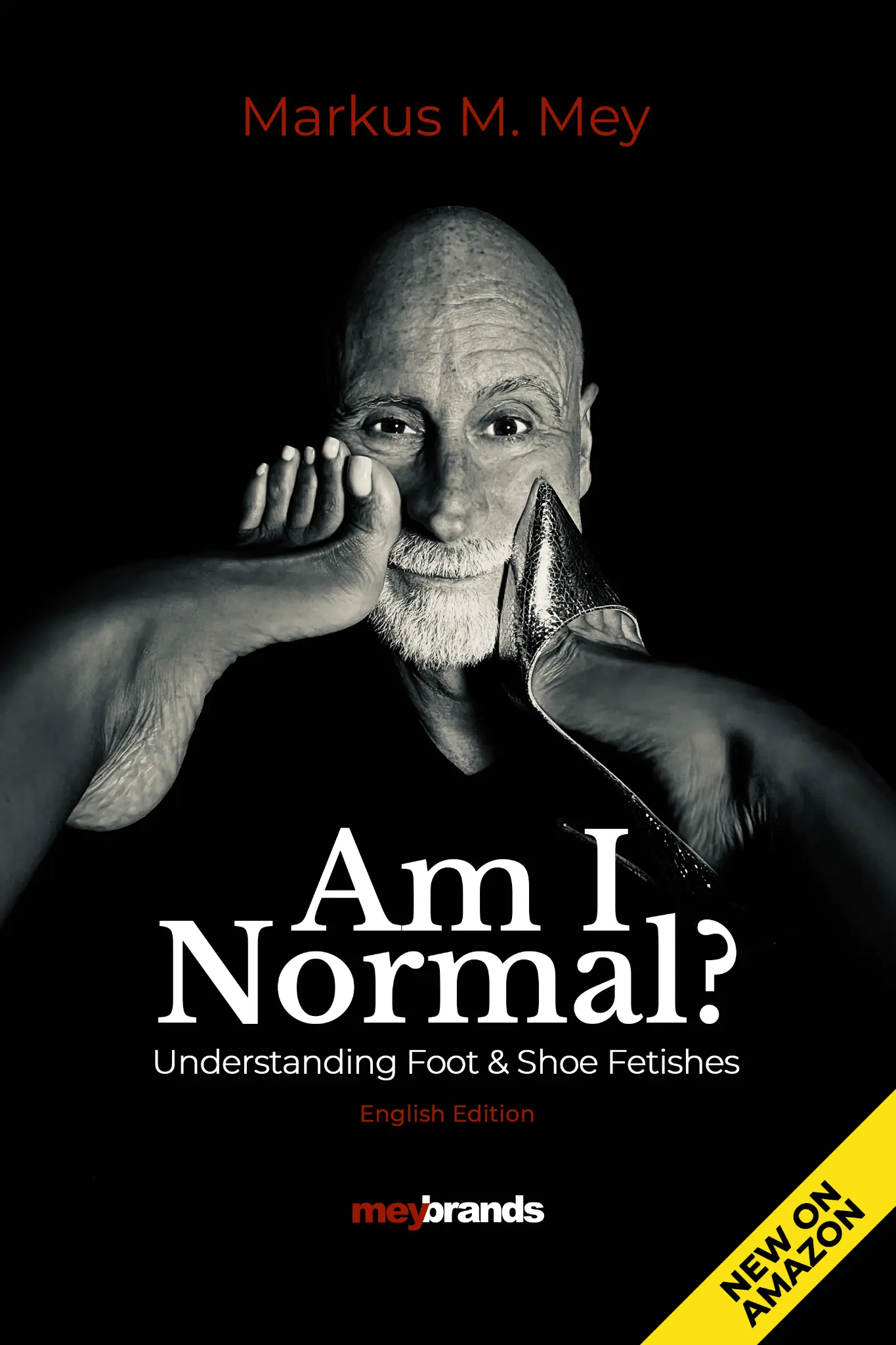
Let this article travel
Good knowledge grows stronger when it is shared.
Link to this original article as a further source — one click copies its permanent address.