
01 · Therapy & Sexuality
Introduction
It is best to do it directly, matter-of-factly, and without apologizing for it. Therapy is exactly the place where something like that is allowed to have room. And if something in the session itself triggers you, such as your therapist’s shoes, it is even important to address it. What remains unspoken in the room usually interferes with the work more than an open word.
02 · Therapy & Sexuality
Why it feels so difficult
Most people find it difficult to talk about sexuality, and even more difficult to talk about a fetish. There is the fear of being judged. The worry that your therapist will see you only through that lens from then on. And for some people, there is shame because the fetish is triggered precisely in therapy, in a room where you actually want to feel safe.
All of that is understandable. But it is no reason to leave the subject out. Therapy in which an important part of you is not allowed to be present remains incomplete.
03 · Therapy & Sexuality
What you should know
Therapists are trained to deal professionally with very personal topics, including sexuality. As a rule, they are bound by confidentiality. And since ICD-11 of the World Health Organization, a foot fetish is no longer, in itself, a mental disorder. So you are not confessing an offence. You are telling something about yourself.
Even so, not every professional is equally familiar with fetishes. In a survey of people with kink and fetish interests from the San Francisco region, participants wanted above all practitioners with whom they could speak openly without being shamed. It is entirely legitimate to ask about that.
04 · Therapy & Sexuality
Phrases that make it easier to get started
Sometimes it helps to prepare your first words in advance. For example:
If saying it out loud is too difficult for you, you can also write down your thoughts and bring the note with you. That is not a detour, but a legitimate start.
- “There is a subject that makes me uncomfortable, but that I would like to address. I have a foot fetish.”
- “I do not know how many details are useful here. Please tell me what you need to know.”
- “Do you have experience with fetishes? That would help me speak more openly.”
- “I have noticed that feet or shoes here in the session distract me. I am embarrassed about that, but I want to deal with it openly.”
05 · Therapy & Sexuality
You set the pace
No one expects you to tell everything in the first session. It is perfectly fine to say only at first that this subject exists and to let the details follow later. You can also say explicitly that something is still too close to you. Good therapy adapts to your pace, not the other way around.
06 · Therapy & Sexuality
If something triggers you during the session
This is perhaps the most delicate case. You are sitting opposite your therapist, and her shoes or feet draw your attention. What matters here is a clear position: your reaction belongs to you. Your therapist has done nothing wrong, and you do not have to demand anything from her. Raise it in a way that is about your experience, not about her clothing.
For therapy, such a moment is even valuable. It shows very concretely how your fetish affects everyday life, and you can work on it together. How you deal with it is something you clarify together. The responsibility for the professional boundaries lies with her.
However, one boundary applies without exception: therapy is not a place to act out the fetish. Requests, insinuations, or attempts to erotically charge the situation damage the therapeutic relationship. Talking about it, yes; acting on it, no.
07 · Therapy & Sexuality
If the reaction is not right
Good professionals respond professionally. But if you notice that your therapist responds dismissively, amusedly, or visibly overwhelmed, you may raise the issue and change therapists if necessary. That is not a failure. You need someone with whom you feel safe.
08 · Therapy & Sexuality
My experience
When my wife and I were going through a difficult period some years ago, I described my situation very openly to a psychologist who knew a great deal about fetishes and BDSM. It took courage. But precisely because I was so open, she was able to open up a perspective on my sexuality that still helps me today. The courage was worthwhile.
Sources
Sources
- Markus M. Mey: BIN ICH NORMAL? Fuß- und Schuhfetisch verstehen. Erste Edition, meybrands, Berlin 2026. ISBN 9798247074557.
- Waldura, J. F. et al. (2016): Fifty Shades of Stigma: Exploring the Health Care Experiences of Kink-Oriented Patients. Journal of Sexual Medicine 13(12). doi:10.1016/j.jsxm.2016.09.019
- World Health Organization: ICD-11 for Mortality and Morbidity Statistics, Paraphilic disorders (6D30–6D36), Release 2025-01. icd.who.int
Explore further in the book
From the question to your own story.
“Am I Normal?” combines clear context with personal experience and perspectives for relationships.
View the English book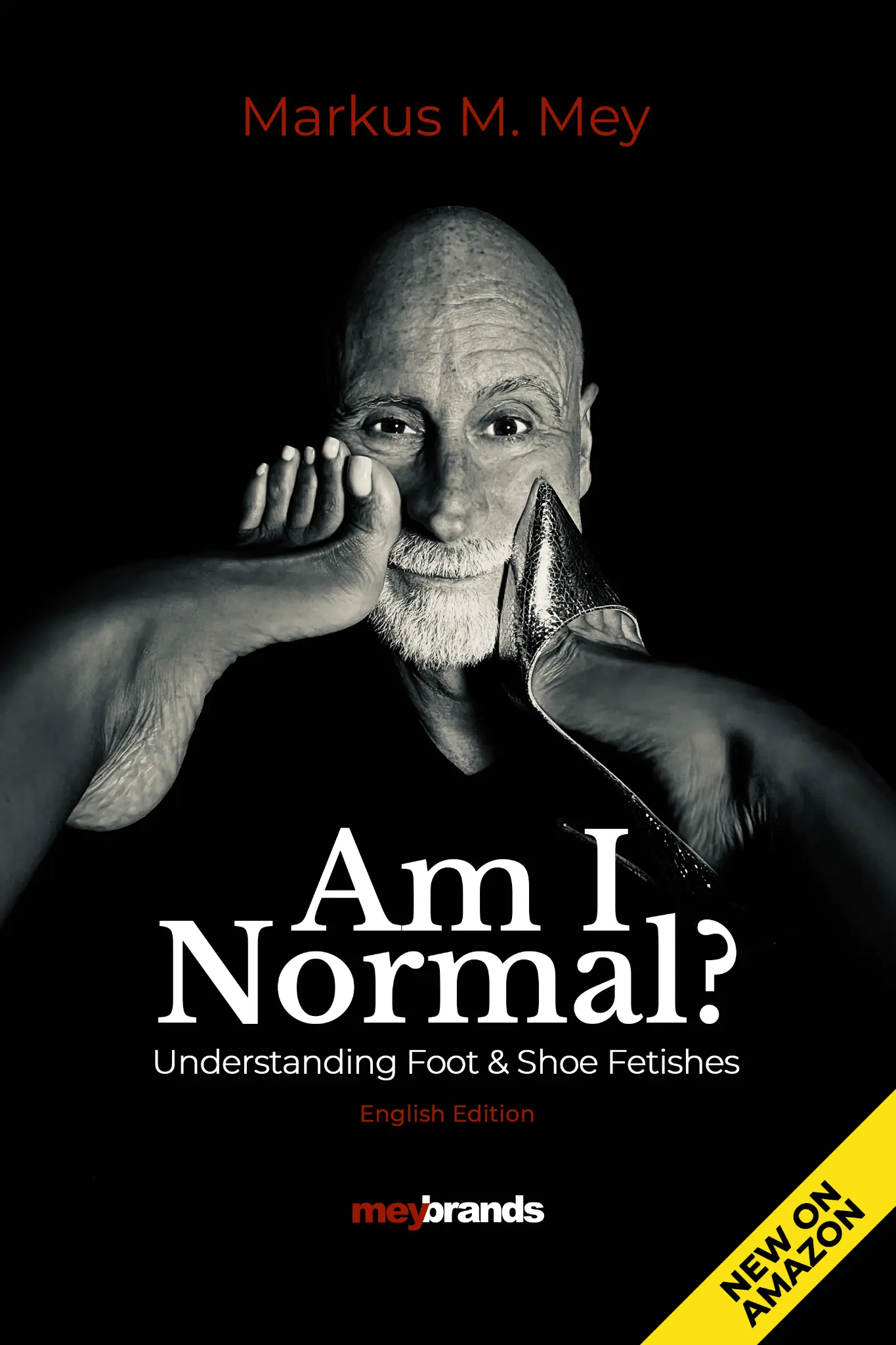
Let this article travel
Good knowledge grows stronger when it is shared.
Link to this original article as a further source — one click copies its permanent address.