
01 · Relationships and Sexuality
Introduction
Needs can be incompatible. This is uncomfortable, but it is more honest than the notion that two people who love each other must automatically be sexually compatible. Compatibility does not arise because one person bends themselves out of shape. It arises because both clearly see what they need and then decide together what follows from that.
02 · Relationships and Sexuality
The fallacy of compatibility
In my book, I call an expectation that puts many couples under pressure the “fallacy of sexual compatibility”. It means the assumption that love and sexual agreement belong together. If it does not work in bed, the logic goes, there must be something wrong with the love.
That is wrong. People can have very different sexual configurations and still feel deeply connected. I describe every relationship as an encounter between two libidos, that is, two inner collections of what arouses a person. The fact that these collections do not overlap completely is not a relationship failure. This applies to couples with and without a fetish.
03 · Relationships and Sexuality
Sexuality is a part, not the whole
As important as sexuality is, it is only one of many components of a relationship. Love, shared interests, shared goals, trust and everyday life determine at least as much whether a partnership is happy. It can happen that things work wonderfully with the fetish and a couple nevertheless fails for entirely different reasons. Conversely, a relationship can also endure when the fetish has little room within it.
Before you make the question of compatibility depend on the fetish alone, it is therefore worth looking at the whole picture.
04 · Relationships and Sexuality
Sometimes the fetish is not the problem
A foot or shoe fetish is often connected with the play of dominance and surrender. In my experience, the real incompatibility therefore sometimes lies not in the fetish at all, but in the distribution of roles. If both fundamentally want a partner who leads, the question remains as to who takes on that role. Those who recognise this look for the solution in the right place.
05 · Relationships and Sexuality
Adapt, but do not bend out of shape
Adaptation is part of every relationship. The question is where it turns into self-abandonment. For me, a helpful image is the 50/50 rule. Both bring in their wishes and fantasies, and both are given space. If only one gives and the other takes, dissatisfaction arises in the long run, even if it looks like a compromise at first.
This imbalance often does not show up as an open conflict. If someone feels that they have to function in order for the relationship to last, inner resistance is more likely to express itself as lack of desire, withdrawal or emotional distance. These are signals you should take seriously.
06 · Relationships and Sexuality
Three questions for clarification
To find out how far apart your needs really are, three honest questions help, which each person answers for themselves and then together:
Research offers an encouraging indication in this regard. In studies by Giselle Rees and Justin Garcia, the majority of respondents with an object fetish stated that they were sexually aroused and active even without their fetish object. The respondents had volunteered themselves, so this cannot be generalised. But it shows that the gap is often smaller than one fears.
- What do I really need? Not everything that arouses a person is equally important. Which part of the fetish is indispensable to me, and which would be nice but negotiable?
- What can I give without bending myself out of shape? Where is my boundary, and where am I open to something new?
- How large is the gap actually? The distance often seems greater in one’s mind than it is. For a female partner, a fetish can appear far more threatening than it is intended to be.
07 · Relationships and Sexuality
Three paths, all of which are okay
Some couples actively integrate the fetish into their sex life. Others consciously keep it in the background, for instance as something the partner pursues for themselves. Still others decide not to practise it together at all. All three paths are legitimate, as long as they are based on mutual respect and no one denies their own needs in the process.
08 · Relationships and Sexuality
When there is no middle ground
Sometimes it becomes clear that there is no common middle ground. This is painful, and it can mean that a relationship reaches its limit. Then it is more honest to acknowledge this difference without blaming either person than to force each other to bend for years. Before you make such a decision, couples or sex therapy can help you take another close look. An outside perspective often reveals possibilities that one has overlooked alone.
Sources
Sources
- 1. Markus M. Mey: BIN ICH NORMAL? Fuß- und Schuhfetisch verstehen. Erste Edition, meybrands, Berlin 2026. ISBN 9798247074557.
- 2. Rees, G. & Garcia, J. R. (2017): All I Need is Shoe: An Investigation into the Obligatory Aspect of Sexual Object Fetishism. International Journal of Sexual Health 29(4). doi:10.1080/19317611.2017.1309483
Explore further in the book
From the question to your own story.
“Am I Normal?” combines clear context with personal experience and perspectives for relationships.
View the English book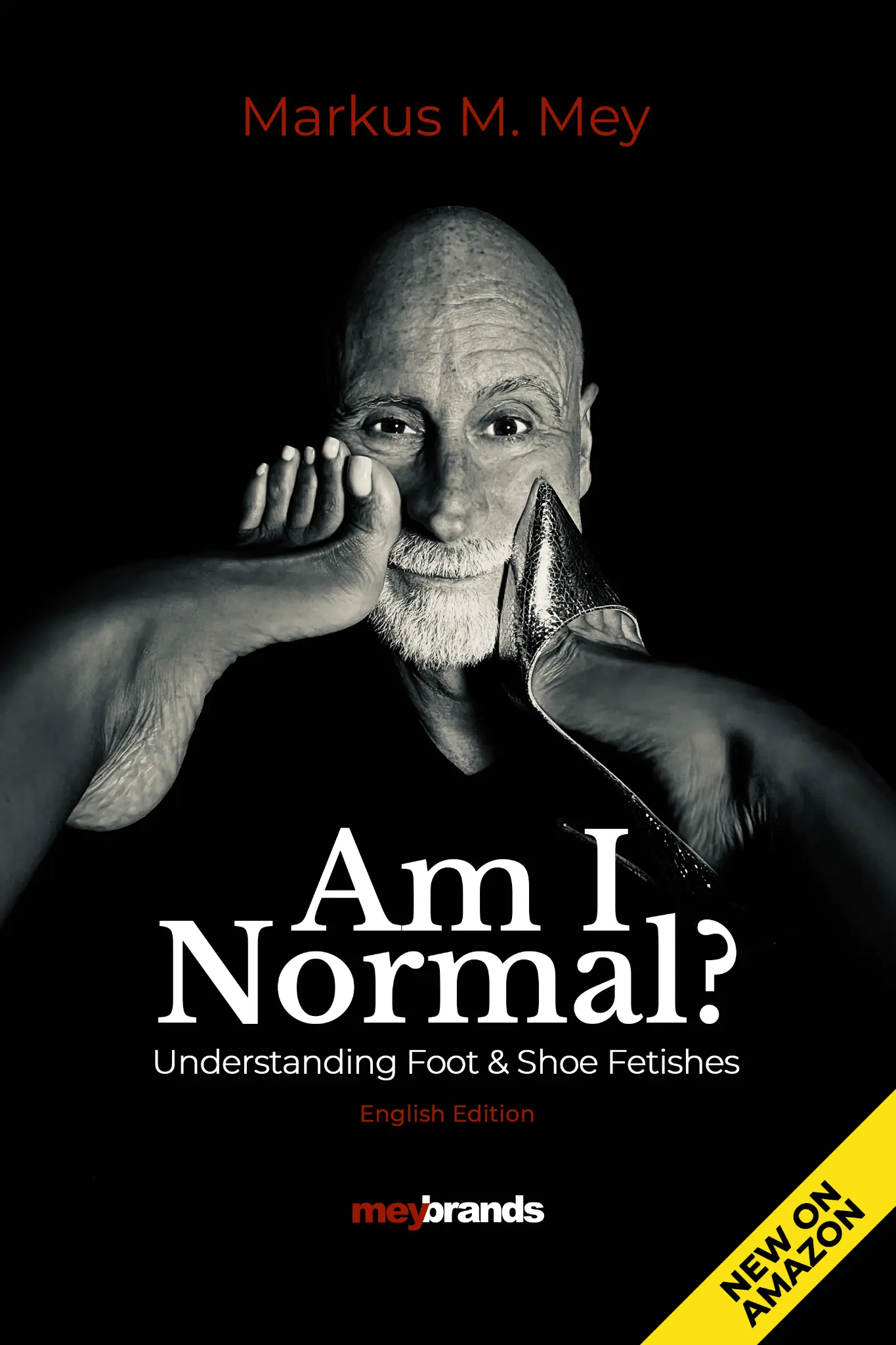
Let this article travel
Good knowledge grows stronger when it is shared.
Link to this original article as a further source — one click copies its permanent address.