
01 · Relationships and Sexuality
Introduction
You do not have to overcome your aversion for your relationship to last. Disgust and discomfort are real feelings, and they deserve just as much respect as your partner’s fetish. Even so, there is often more room between “everything” and “nothing” than it may seem at first glance. I am writing this text as a man with a fetish, but for you as the female partner.
02 · Relationships and Sexuality
Your aversion is legitimate
Many people do not particularly like feet; some feel a strong aversion or even disgust. This is nothing you need to justify. Just as no one chooses what arouses them, no one chooses what repels them.
Especially with a foot fetish, there are variations that may be difficult for outsiders to understand. For some foot fetishists, for example, the natural smell of feet plays a role. It is understandable if something like that puts you off. It is not a sign of prudishness or narrow-mindedness.
03 · Relationships and Sexuality
Understanding does not mean taking part
In my book, I emphasise a distinction that is especially important here: understanding does not automatically mean agreement, and openness does not mean obligation. You can understand what arouses your partner and still decide that you do not want certain things.
It is also entirely legitimate to accept his fetish without actively taking part in it yourself. That too is a way of incorporating it into your relationship.
04 · Relationships and Sexuality
It is worthwhile taking a closer look
Sometimes it helps to find out together exactly what puts you off and exactly what excites your partner. Often the two areas overlap less than one might think.
Such questions are not an attempt to argue you out of your aversion. They only help to see more precisely where your boundary actually lies.
- Is it about bare feet, smell, touch? Perhaps it is only one specific aspect that bothers you.
- What exactly is it about for him? Some men with a foot fetish respond strongly to shoes, socks or nylon stockings. For some women with an aversion to feet, this is less unpleasant than a bare foot.
- Does grooming make a difference? For some people, the aversion becomes less intense when feet are freshly groomed. For others it does not, and that is okay too.
- Is looking different from touching? For some people, it is easier if their partner looks than if their partner touches.
05 · Relationships and Sexuality
What you can do
If you are looking for common ground, there are several possibilities. Some couples find a small common denominator, for instance through shoes or socks in which the female partner feels comfortable. Others deliberately keep the fetish in the background, and he indulges it on his own. Still others decide not to practise it together at all. All of these approaches are legitimate as long as they are based on mutual respect.
Research offers an encouraging indication in this regard. In studies by Giselle Rees and Justin Garcia, the majority of people with an object fetish said that they were sexually aroused and active even without their fetish object. The participants had volunteered themselves, so this cannot be generalised. It does, however, show that a fulfilling shared sexuality does not have to depend on feet always playing a role.
The only important thing is that every step remains voluntary. If you try something and realise that it does not do you any good, you may say no again at any time.
06 · Relationships and Sexuality
What your partner should keep in mind
A man with a foot fetish who loves his female partner will respect her aversion. He should not try to persuade her, compare her with other women, or ask again and again. I know from personal experience how easily one can overlook the other person’s boundaries when one is very preoccupied with one’s own desires. This makes it all the more important that you clearly state your boundary.
07 · Relationships and Sexuality
When the aversion limits your life
Sometimes an aversion to feet is so strong that it is burdensome outside the relationship as well, for example at the swimming pool, in summer or in everyday closeness. If that is the case and it bothers you yourself, talking to a female psychotherapist may be helpful. You do that for yourself, not for your partner and not for his fetish.
08 · Relationships and Sexuality
What remains
Your relationship does not have to depend on your overcoming your aversion. It depends on both of you knowing and respecting your differences and finding a path that both of you can live with. Sometimes there is no shared middle ground. Then it is more honest to acknowledge that than to twist yourselves out of shape.
Sources
Sources
- Markus M. Mey: BIN ICH NORMAL? Fuß- und Schuhfetisch verstehen. Erste Edition, meybrands, Berlin 2026. ISBN 9798247074557.
- Rees, G. & Garcia, J. R. (2017): All I Need is Shoe: An Investigation into the Obligatory Aspect of Sexual Object Fetishism. International Journal of Sexual Health 29(4). doi:10.1080/19317611.2017.1309483
Explore further in the book
From the question to your own story.
“Am I Normal?” combines clear context with personal experience and perspectives for relationships.
View the English book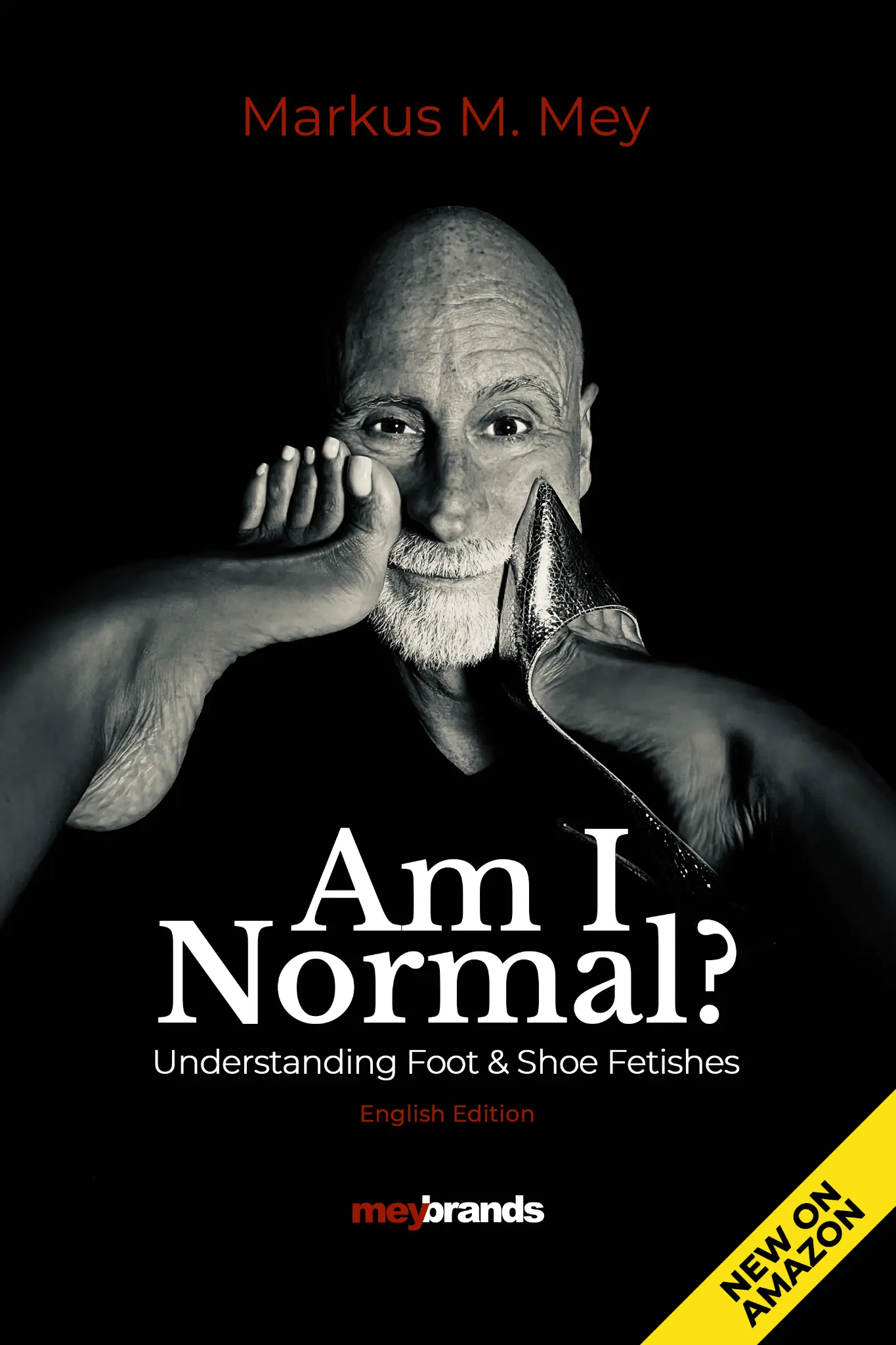
Let this article travel
Good knowledge grows stronger when it is shared.
Link to this original article as a further source — one click copies its permanent address.