
01 · Relationships & Sexuality
Introduction
By making sure that you retain the leading role in your sexuality together and, if anything, making the shoes your tool. If your partner’s attraction is strongly focused on shoes, it is understandable to feel that you are taking a back seat to an object. You can address that feeling, make clear agreements, and decide what role shoes may play between you. I am writing this text as a man with a shoe fetish, but for you as the female partner.
02 · Relationships & Sexuality
Why it feels that way
When your partner’s gaze goes first to your shoes every time you meet, when he seems more pleased about a new pair than about a conversation with you, it is easy to feel replaceable. As though any woman wearing those shoes would have the same effect. This concern deserves to be taken seriously and voiced.
In my experience, in most cases it is different from how it feels. For many men with a shoe fetish, a shoe only really works when a particular woman wears it and gives it posture and expression. But only you can find out together with him what it is like for your partner.
03 · Relationships & Sexuality
What the shoe means to him
It can help to understand why shoes have such a strong effect. A shoe changes how a person stands, walks, and presents themselves. A high heel elevates; a boot conveys strength. For a man with a shoe fetish, the shoe is therefore often a kind of amplifier for the presence of the woman who wears it. He does not simply see a shoe, but you in a particular posture.
04 · Relationships & Sexuality
Starting the conversation
Bring up the subject before it takes root inside you. Choose a quiet moment without time pressure, not directly after sex and not during an argument. A few sentences can help:
Pay less attention to the individual words in his answers than to whether you feel he means you. A partner who loves you will want to help you let go of this uncertainty.
- “Sometimes I feel that my shoes interest you more than I do.”
- “I want to know what you actually like about it when I wear them.”
- “I need to feel that you mean me, not just what I have on my feet.”
05 · Relationships & Sexuality
Agreements that put you at the centre
It can help to agree together on a few rules that strengthen your feeling of being valued. For example:
- Time without shoes. Intimacy and sexuality in which shoes consciously play no role.
- You choose. You decide which shoes you wear and when.
- You set the framework. Shoes come into play when you feel like it, not on demand.
- No comparisons. No comments about other women’s shoes, no celebrities as role models.
- Your wishes count too. I call it the 50/50 rule: your fantasies need just as much room in your sexuality together as his do.
06 · Relationships & Sexuality
Making the shoes your tool
Some women discover a completely different perspective on the subject as soon as they take control. A young woman once told me that she found neither feet nor shoes arousing. What she found arousing was the power to consciously increase or reduce her partner’s arousal. Whoever decides when which shoes come into play is no longer the wearer of a stimulus, but the person who directs the game.
This is an offer, not an obligation. If it does not suit you, that is completely fine. But for some couples, precisely this change of perspective changes a great deal.
07 · Relationships & Sexuality
What the research says
Perhaps you fear that your partner might no longer be able to get aroused at all without shoes. In studies by Giselle Rees and Justin Garcia, the majority of respondents with an object fetish stated that they were sexually aroused and active even without their fetish object. The participants had volunteered themselves, so this cannot be generalised. However, it suggests that periods without shoes can work quite well for many people.
08 · Relationships & Sexuality
When it still does not get better
If, despite conversations and agreements, you continue to feel reduced, if he makes comparisons or crosses your boundaries, that is a serious signal. Couples or sexual counselling can help to understand the dynamic. You are more than the shoes you wear, and you are entitled to insist on that.
Sources
Sources
- Markus M. Mey: BIN ICH NORMAL? Fuß- und Schuhfetisch verstehen. Erste Edition, meybrands, Berlin 2026. ISBN 9798247074557.
- Rees, G. & Garcia, J. R. (2017): All I Need is Shoe: An Investigation into the Obligatory Aspect of Sexual Object Fetishism. International Journal of Sexual Health 29(4). doi:10.1080/19317611.2017.1309483
Explore further in the book
From the question to your own story.
“Am I Normal?” combines clear context with personal experience and perspectives for relationships.
View the English book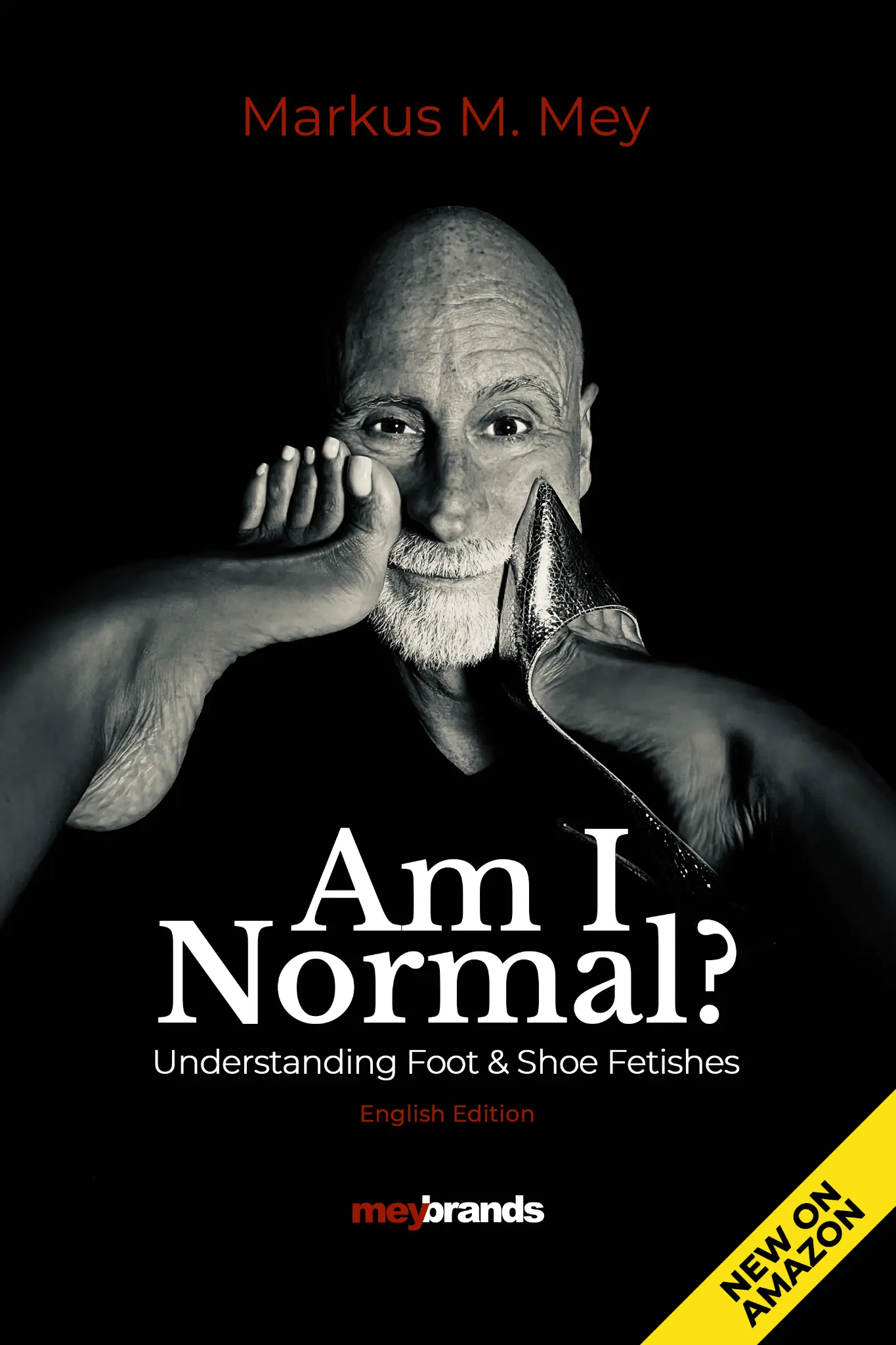
Let this article travel
Good knowledge grows stronger when it is shared.
Link to this original article as a further source — one click copies its permanent address.