
01 · Fetishes
Introduction
With a foot fetish, the body is at the centre; with a shoe fetish, it is an object. On paper, the difference can be described that simply. In practice, the two often overlap, and many people respond to both. If you want to find out where your own focus lies, a direct comparison and a few small thought experiments can help.
02 · Fetishes
The two compared
The following overview shows typical differences. Not every characteristic applies to every person, and the transitions are fluid:
In specialist literature, a foot fetish is also called podophilia. In the past, diagnostic manuals also distinguished whether a fetish related to a body part or to an object. Today, this distinction no longer plays a major role in classification, but it can still be helpful for your own understanding.
- What is it about? Foot fetish: The foot as part of the body; shoe fetish: The shoe as an independent source of arousal.
- What is often arousing? Foot fetish: Shape, proportions, skin, movement, touch, sometimes scent; shoe fetish: Shape, material, heel height, design, brand, condition.
- What role does the person play? Foot fetish: The foot is inseparably part of them; shoe fetish: For some, it is arousing only on a person, for others already as an object.
- How is it experienced? Foot fetish: Often through touch, massage, kissing; shoe fetish: Often through sight, and the effect on posture and gait.
- What connection is there to power? Foot fetish: Possible, for example in foot worship; shoe fetish: Frequent, because shoes make presence and dominance visible.
03 · Fetishes
Why the two are so often linked
That foot and shoe fetishes so often occur together is no coincidence. Shoes and stockings enhance the effect of feet, alter them, or place them in a particular context. A high heel tenses the foot and changes posture; a boot encloses it. In an analysis of 381 online discussion groups from 2007, feet and associated items such as shoes and socks together formed the most visible category.
04 · Fetishes
Small thought experiments
If you are unsure where you see yourself, try imagining the following. As you do, honestly observe what appeals to you:
People who respond chiefly to the bare foot and touch are more likely to have a foot fetish. People who respond chiefly to shoes, their material and their effect are more likely to have a shoe fetish. And if your answer to almost all questions is “both,” you are in good company.
- Barefoot or in a shoe? Imagine the same foot bare once and in an elegant shoe once. Which image has the stronger effect?
- On the shelf or on a person? Imagine a shoe in a shop window, and that same shoe on a woman walking through the room. Does the object itself arouse you, or only the person wearing it?
- New or worn? For some people with a shoe fetish, shoes must be new and expensive; for others, it is precisely shoes that are worn and scuffed.
- Looking or touching? Is the appeal more in looking or in touching?
- And in between? How do stockings, nylons or socks affect you? They sit exactly between body and object and are particularly arousing for some.
05 · Fetishes
My own focus
I speak of my own foot and shoe fetish, but for me shoes are clearly the main focus. More specifically: shoes on a woman. A product photo of my favourite shoes leaves me completely cold. The same shoes on a self-assured woman immediately trigger a fantasy. My shoe fetish therefore needs a person.
My taste has also changed over the years. In my early twenties, simple high heels aroused me; later, through my work in fashion photography, it was above all designer shoes. At some point, cowboy boots on my own feet were added too. Where your focus lies today does not have to remain that way forever.
06 · Fetishes
Why the distinction can be useful
Knowing whether it is more feet, more shoes or both is especially helpful in conversation with a female partner. Being able to say “Your feet arouse me when you are barefoot” or “Your boots arouse me when you wear them” makes it easier for her to understand what it is about. Vague hints, by contrast, often seem bigger and more threatening than they are intended to be.
You do not need a fixed classification, however. Foot and shoe fetishes belong to one shared, broad spectrum. Whether you find yourself more at one end or somewhere in the middle is not a question of right or wrong.
Sources
Sources
- Markus M. Mey: BIN ICH NORMAL? Fuß- und Schuhfetisch verstehen. Erste Edition, meybrands, Berlin 2026. ISBN 9798247074557.
- Kafka, M. P. (2010): The DSM Diagnostic Criteria for Fetishism. Archives of Sexual Behavior 39(2). doi:10.1007/s10508-009-9558-7
- Scorolli, C. et al. (2007): Relative prevalence of different fetishes. International Journal of Impotence Research 19(4), 432–437. doi:10.1038/sj.ijir.3901547
Explore further in the book
From the question to your own story.
“Am I Normal?” combines clear context with personal experience and perspectives for relationships.
View the English book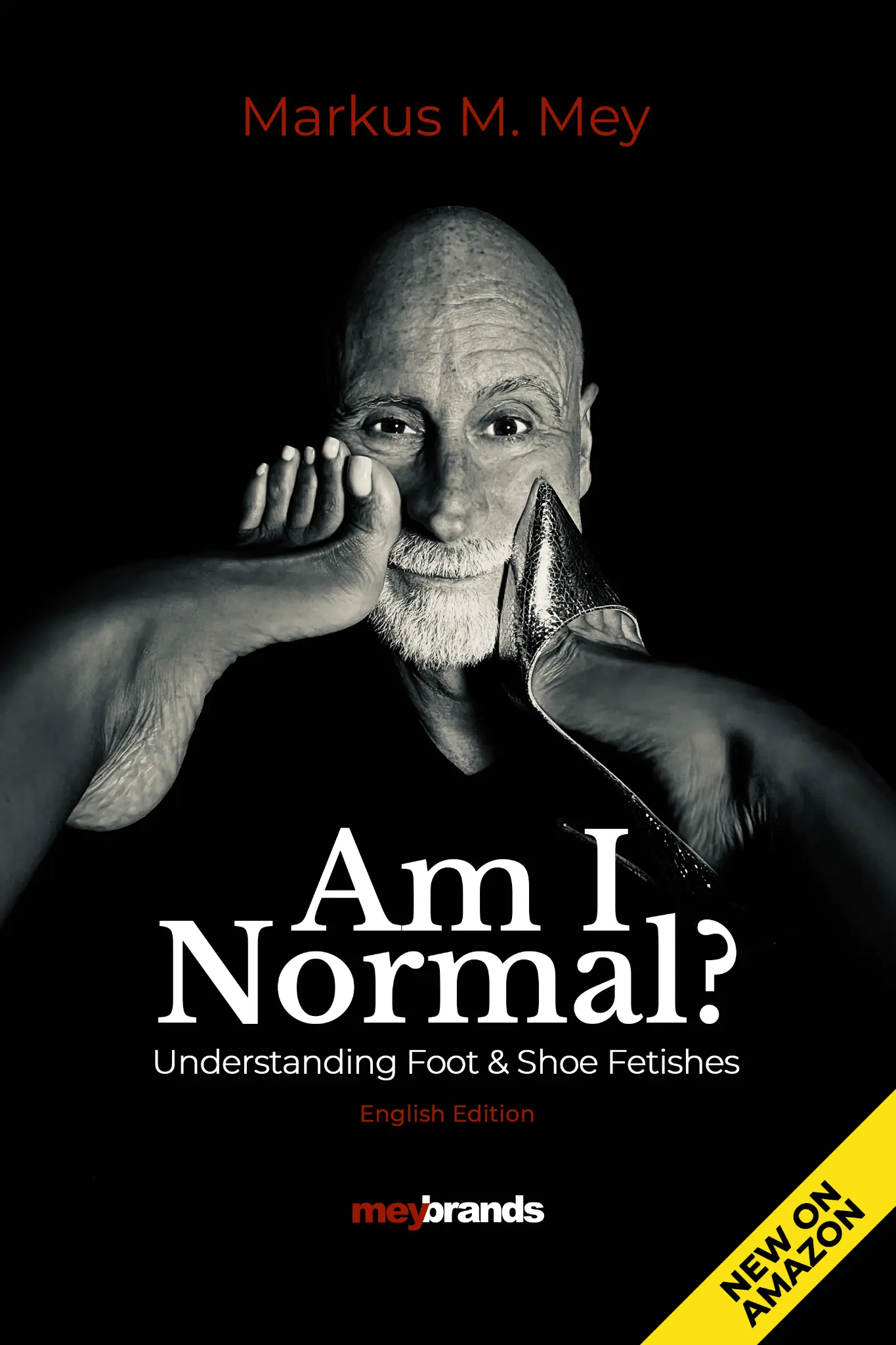
Let this article travel
Good knowledge grows stronger when it is shared.
Link to this original article as a further source — one click copies its permanent address.