
01 · Origins & Psychology
Putting it into perspective
You do not have to do anything at all. A foot fetish is not an illness that needs to be treated. From everything I have experienced, it cannot simply be got rid of either. Something can still change, sometimes more than one might think possible.
02 · Origins & Psychology
The desire to stop it
Can I change it if it is causing me distress? This question is asked very often online, in many languages and almost always with the same undertone. I can understand the wish very well. Anyone who lives with a secret for a long time eventually longs for peace.
Before considering how to get rid of something, it is worth taking a close look at where the pressure really comes from. In my experience, it is often not the fetish itself that causes distress at all. It is the fear of what others might think. Or the feeling of being completely alone with this side of oneself.
03 · Origins & Psychology
Why a fetish cannot be erased
You do not choose a fetish. It develops from associations that grow over many years, often long before you understand them. In my book, I describe this using the image of the Libidose, a kind of piggy bank for everything that sexually appeals to us. Once something is in it, it stays there for the time being. You cannot consciously take it out, any more than you can consciously put something into it.
Research is similarly cautious on this point. Based on current knowledge, learning processes probably play a role in the development of sexual preferences. However, it is not possible to reliably trace how a particular fetish developed in a particular person.
In the past, people nevertheless tried to treat fetishes out of existence. Older specialist literature contains reports of so-called aversive treatments, in which arousal was supposed to be unlearned with the help of unpleasant stimuli. These are historical individual cases from a time when fetishism was still regarded as an illness. They are not suitable as a basis for treatment today.
04 · Origins & Psychology
What can still change
Getting rid of it is one thing. Changing is another, and that is where I experienced a surprise myself.
For decades, I had lived out my shoe fetish from a rather submissive role. In 2017 and 2018, my wife and I were stuck, and I sought advice from a psychologist who was well versed in fetishes and BDSM. Her view went in a completely different direction from mine. She saw a dominant side in me that I had suppressed for a long time, and advised me to simply try out that side.
I was sceptical and did it anyway. It aroused me, and my wife liked it too. Afterwards I discovered cowboy boots for myself, this time on my own feet. The fetish remained; its direction changed. For me, that was not a loss but rather an expansion, and it noticeably enlivened our shared sex life.
Research also suggests that a fetish rarely determines a person's whole sexuality. In two studies of people who attribute an object fetish to themselves, the majority stated that they could also be sexually aroused and active without their fetish object. The participants had volunteered for the study themselves, and shoes were not evaluated separately. But it suggests that for many people, a fetish is an important part of their sexuality without being the only part.
05 · Origins & Psychology
When the distress remains
There are situations in which a fetish genuinely becomes a problem. For instance, when it feels compulsive, when it dictates everyday life, or when other people's boundaries are at risk. In that case, support from a specialist in sex therapy or sexual medicine is appropriate. In my image of the Libidose, in such cases I speak of a false bottom that one cannot reach alone.
What matters to me here is a distinction that the World Health Organization also makes. Distress that arises solely because others reject a preference does not yet make it a disorder. Anyone who suffers chiefly from shame therefore generally does not need to change their fetish. In my experience, a different way of dealing with oneself is more helpful then, and sometimes a conversation with someone who listens without judging.
06 · Origins & Psychology
The counter-question
To anyone who asks me whether they should get rid of their foot fetish, I would ask a question in return: What exactly do you want to change? Should the shame disappear, the conflict in the relationship, the feeling of being alone? All of that can change. The fetish itself will probably remain. But it does not have to dictate your life.
Sources
Sources
- Markus M. Mey: BIN ICH NORMAL? Fuß- und Schuhfetisch verstehen. Erste Edition, meybrands, Berlin 2026. ISBN 9798247074557.
- Rees, G. & Garcia, J. R. (2017): All I Need is Shoe: An Investigation into the Obligatory Aspect of Sexual Object Fetishism. International Journal of Sexual Health 29(4). doi:10.1080/19317611.2017.1309483
- Schippers, E. E., Hoogsteder, L. M. & de Vogel, V. (2025): Theories on the Etiology of Deviant Sexual Interests: A Systematic Review. Sexual Abuse 37(1). doi:10.1177/10790632241271308
- Kunjukrishnan, R., Pawlak, A. & Varan, L. R. (1988): The Clinical and Forensic Psychiatric Issues of Retifism. Canadian Journal of Psychiatry 33(9). doi:10.1177/070674378803300907
- World Health Organization: ICD-11 for Mortality and Morbidity Statistics, Paraphilic disorders (6D30–6D36), Release 2025-01. icd.who.int
Explore further in the book
From the question to your own story.
“Am I Normal?” combines clear context with personal experience and perspectives for relationships.
View the English book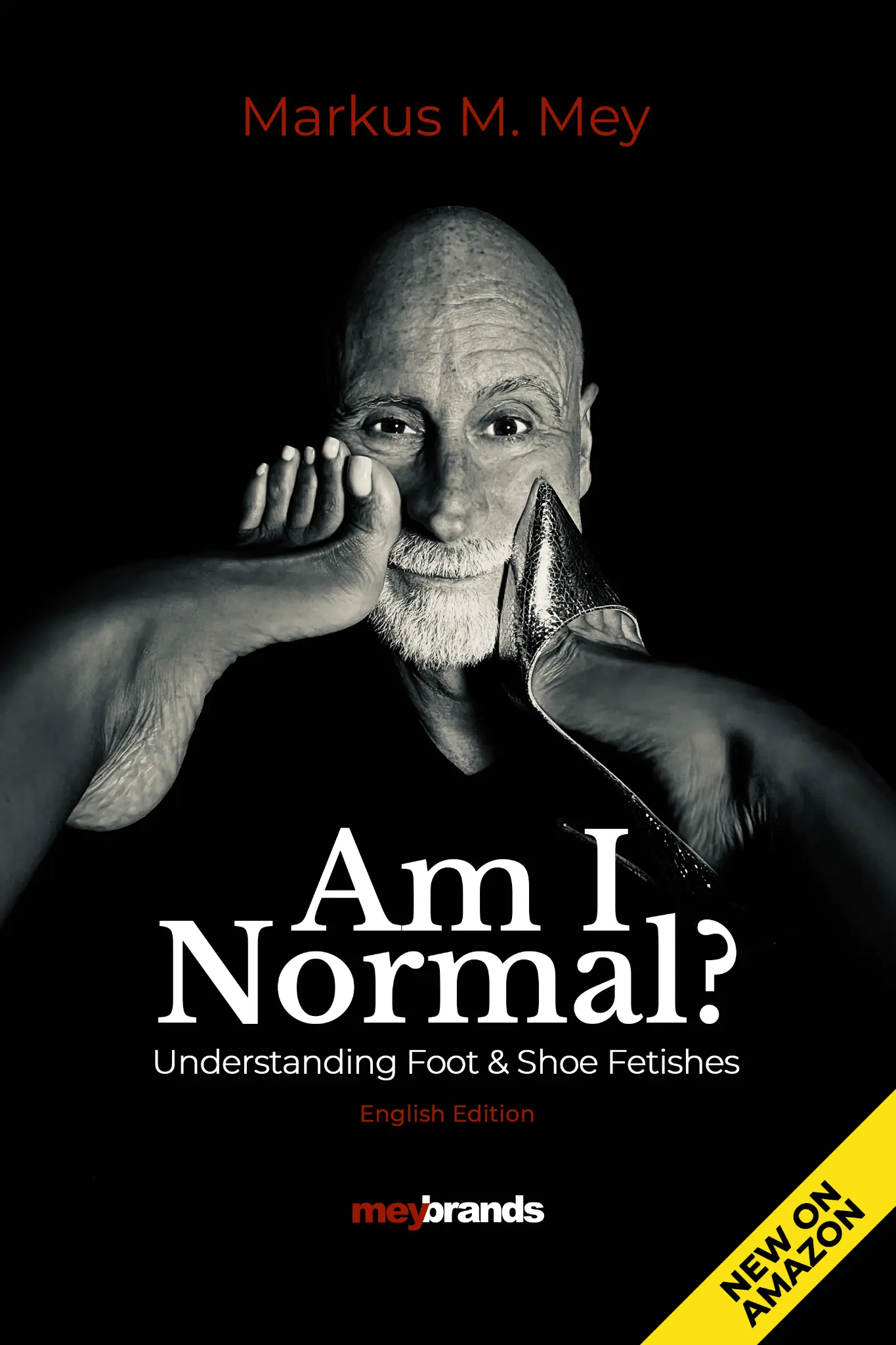
Let this article travel
Good knowledge grows stronger when it is shared.
Link to this original article as a further source — one click copies its permanent address.