
01 · Origins & Psychology
Context
A little bit of everything probably plays a part, and nobody knows for sure. There are dozens of theories about how unusual sexual preferences develop, but none can explain the development of a foot fetish. I have my own hunch about it. Above all, though, I have learned that the answer matters less than it feels like it does.
02 · Origins & Psychology
The story of the kitten heels
My mother once told me that, when I was one or two years old, I shuffled along the long hallway of our flat in her much too large stiletto-heeled shoes, pushing the pram ahead of me. She took the shoes away from me then, worried that I might break the heel. I do not remember it myself.
Naturally, it is tempting to see the beginning of it all in this scene. Sigmund Freud would surely have pricked up his ears at this point. But many children play with their parents’ shoes. Whether this one scene had any significance for me, nobody can say, including me.
03 · Origins & Psychology
Innate?
Research has so far provided no proof that a foot fetish is innate. I nevertheless consider it quite possible that some people have a basic predisposition that makes it more likely for their arousal to become closely bound to specific stimuli. This is my hypothesis, not an established finding.
What a fetish is directed towards then depends, in my view, on the environment. I like to use a thought experiment for this. If, as an infant, I had grown up in an isolated community in the jungle, with no contact whatsoever with Western culture, I would never have heard of high heels. I could therefore not have developed a high-heel fetish at all. Perhaps it would have been jewellery or particular body paint. The object is interchangeable; the mechanism behind it probably is not.
04 · Origins & Psychology
Learned?
There are at least indications that learning plays a role. As early as 1966, in a small experiment, the psychologist Stanley Rachman showed that a sexual response to the image of a women’s boot could be built up in young men. To do this, he repeatedly showed them the image together with erotic photos. However, only nine students took part, and the response lasted only briefly. That has only a remote connection to a fetish that lasts a lifetime.
A systematic review from 2025 examined 47 theories about the origin of unusual sexual interests. The researchers rated only seven of them as genuinely well grounded. These seven explain the origin more as an interplay of several processes, such as conditioning, social learning and the transfer of arousal to other stimuli. None of them settles on a single cause, and most were not developed specifically for feet or shoes either.
A group led by the neuroscientist James Pfaus even considers learning processes to be the most likely route through which sexual preferences emerge. However, the researchers themselves concede that this can scarcely be observed directly in humans, let alone replicated in an experiment.
05 · Origins & Psychology
Early experiences?
As early as 1887, the French psychologist Alfred Binet suggested that a detail that is essentially secondary can become especially deeply imprinted in an emotionally charged situation. Later, that detail is sought out again and again because it reawakens the tension of that time. I still find this idea astonishingly modern today, especially since Binet did not see the fetish primarily as an illness.
Nevertheless, caution is called for. Memories of early experiences form in retrospect. We tell ourselves our own story from today’s point of view, and in doing so some scenes acquire a significance that they may not have had at the time at all. Research, too, considers learning processes plausible, but cannot reliably say for any individual person which experience triggered their fetish.
06 · Origins & Psychology
Why the answer matters less than it feels like it does
I suspect that behind the question of origin there is often another one: Am I myself to blame? Could I have done something differently? There is a clear answer to that. Nobody gets to choose what arouses them. In early adolescence, we have no influence over what enters our Libidose, the term I use for the inner collection of our sexual stimuli. And even as adults, we cannot switch our preferences on and off at will.
We may never fully understand the why. I consider the what and the how more important. What belongs to my sexuality, and how do I deal with it well? Everyone can answer these questions for themselves, entirely without searching for causes. By contrast, those who keep searching for the one cause soon end up with questions of guilt that help nobody.
Sources
Sources
- Markus M. Mey: BIN ICH NORMAL? Fuß- und Schuhfetisch verstehen. Erste Edition, meybrands, Berlin 2026. ISBN 9798247074557.
- Rachman, S. (1966): Sexual Fetishism: An Experimental Analogue. The Psychological Record 16(3). doi:10.1007/BF03393671
- Schippers, E. E., Hoogsteder, L. M. & de Vogel, V. (2025): Theories on the Etiology of Deviant Sexual Interests: A Systematic Review. Sexual Abuse 37(1). doi:10.1177/10790632241271308
- Pfaus, J. G. et al. (2020): Conditioning of Sexual Interests and Paraphilias in Humans Is Difficult to See, Virtually Impossible to Test, and Probably Exactly How It Happens. Archives of Sexual Behavior 49(5). doi:10.1007/s10508-020-01739-2
- Alfred Binet (1887): Le fétichisme dans l’amour. Revue philosophique de la France et de l’étranger 24.
Explore further in the book
From the question to your own story.
“Am I Normal?” combines clear context with personal experience and perspectives for relationships.
View the English book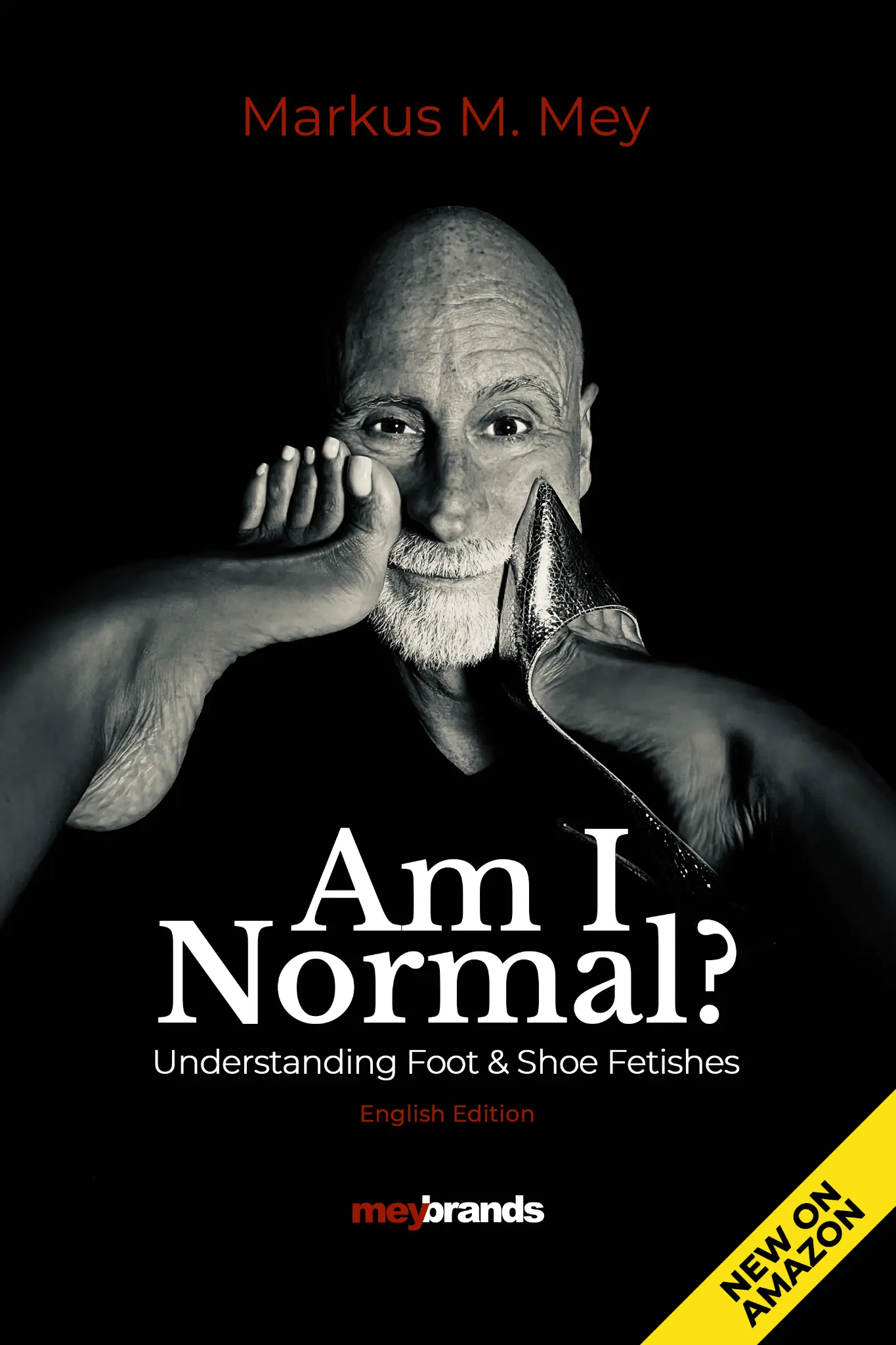
Let this article travel
Good knowledge grows stronger when it is shared.
Link to this original article as a further source — one click copies its permanent address.