
01 · History & Diagnosis
Introduction
No, a foot fetish is not a mental disorder. I say this not only on the basis of more than forty years of experience with my own foot and shoe fetish. Since 2022, the World Health Organization has seen it that way too. Whether you should be worried depends on something quite different from what arouses you.
02 · History & Diagnosis
A bedsheet and a question that remains
I was 19 when I first tried to speak to a girlfriend about my fetish. More precisely, I only asked whether she could keep her shoes on. She was puzzled and said the bedsheet would get dirty then. Nothing more came of it, and I never raised the subject with her again.
That sounds harmless. Yet moments like these give rise to a question that stayed with me for a long time and that I later encountered again in countless conversations with men who have a fetish and with their partners: Am I actually normal?
You see feet and shoes everywhere. They are part of everyday life, and there is a tacit convention that they are not supposed to be erotic. Anyone who feels differently quickly feels that something is wrong with them, even though they are doing no one any harm. The shame rarely comes from one’s own experience. It comes from imagining how others might look at it.
03 · History & Diagnosis
How a diagnosis became a preference
On my bookshelf is an original edition of Richard von Krafft-Ebing’s „Psychopathia Sexualis“, ninth edition, 1894. At the time, the book was a reference work for doctors and lawyers. Fetishism was regarded as a mental disorder, and feet and shoes as a substitute behaviour pointing to an abnormal development.
This way of thinking had a long afterlife. Even in ICD-10, the World Health Organization’s international diagnostic catalogue, fetishism appeared under the code F65.0 among disorders of sexual preference. Anyone who searches online for their fetish today often lands on precisely these old terms. They sound official and definitive.
With ICD-11, which has been in force since 1 January 2022, fetishism ceased to be a diagnosis in its own right. The experts who prepared this revision explained it soberly: what is practised consensually or alone is not inherently harmful or distressing. The American Psychiatric Association (APA), which publishes the DSM diagnostic manual, takes a similar line. It clearly distinguishes an unusual sexual interest from a disorder and stresses that most people with such interests do not have a mental disorder.
Personally, this reassessment did not change much for me, because I had long since made my peace with it. For everyone who still measures their sexuality against the old categories, it is a great relief. Unfortunately, hardly anyone has heard about it to this day.
04 · History & Diagnosis
Where the boundary actually lies
Does that mean a foot fetish can never become a problem? No. ICD-11 still allows a diagnosis, though only under strict conditions. For instance, if someone themselves suffers markedly because of their pattern of arousal, or if the behaviour carries a serious risk of severe injury. And as soon as people are involved without their consent, we are no longer talking about a preference anyway.
There is a detail in the WHO’s wording that I find particularly important. Distress that arises only because other people reject the preference does not count. Someone who feels ashamed primarily because they fear the judgement of others therefore does not have a disorder on that basis.
I also know what the other side feels like. In 2017 and 2018, my fetish had taken up too much space in my life, in my relationship and in my work. My head was so full of images that I often could no longer switch off when having sex with my wife. We were both dissatisfied. At that time, I sought advice from a psychologist who knew a great deal about fetishes. The conversations with her opened up a view of my sexuality that I still find liberating today.
So if your fetish causes you distress, speaking to a professional in sex therapy or sexual medicine is not an admission of illness. You cannot simply switch off a fetish. But you can learn to deal with it well.
05 · History & Diagnosis
And how many of us are there?
No one knows exactly, and neither do I. To this day, there is no representative population study that records interests in feet and shoes separately. In my book, I present a study by Claudia Scorolli and colleagues from 2007. The team analysed 381 online discussion groups on fetishes, and feet together with everything that goes with them, including shoes and socks, were the most visible individual category there.
That shows how present the subject is. But it does not allow a figure for the population to be inferred, because groups are not people, and many people are active in several groups. In another survey of 316 people from fetish communities, life satisfaction fell within the usual range. This too is not a representative sample, but it fits with what I have observed myself. For the vast majority, their fetish is neither a problem nor a burden.
06 · History & Diagnosis
The better question
In my book, I describe sexuality with a simple image: the Libidose. It is a kind of container in which, over the course of a lifetime, everything that arouses us collects: experiences, memories, fantasies, images. For most fetishists, the fetish lies in it alongside many other things. You cannot choose the contents.
That is why I now consider the question „Am I normal?“ to be the wrong one. Normality is a statistical term, and it says nothing about responsibility, maturity or the capacity for a good relationship. I have lived with my fetish since my youth, have been with my wife for many years and have a family. One does not preclude the other.
I find other questions more helpful. Can you accept your fetish as part of yourself? Does it cause distress to you or someone close to you? And do you live it in a way that everyone involved consents to? If you have good answers to those questions, you can safely set aside the question of normality.
Sources
Sources
- Markus M. Mey: BIN ICH NORMAL? Fuß- und Schuhfetisch verstehen. Erste Edition, meybrands, Berlin 2026. ISBN 9798247074557.
- Richard von Krafft-Ebing: Psychopathia Sexualis. 9. Auflage, Verlag von Ferdinand Enke, 1894.
- Giami, A. (2015): Between DSM and ICD: Paraphilias and the Transformation of Sexual Norms. Archives of Sexual Behavior 44(5). doi:10.1007/s10508-015-0549-6
- World Health Organization: ICD-11 for Mortality and Morbidity Statistics, Paraphilic disorders (6D30–6D36), Release 2025-01. icd.who.int
- Krueger, R. B. et al. (2017): Proposals for Paraphilic Disorders in the International Classification of Diseases and Related Health Problems, Eleventh Revision (ICD-11). Archives of Sexual Behavior. doi:10.1007/s10508-017-0944-2
- American Psychiatric Association (2013): Paraphilic Disorders. DSM-5 Fact Sheet. psychiatry.org
- Scorolli, C. et al. (2007): Relative prevalence of different fetishes. International Journal of Impotence Research 19(4), 432–437. doi:10.1038/sj.ijir.3901547
- Harrison, M. A. & Murphy, B. E. (2021): Sexual fetishes: sensations, perceptions, and correlates. Psychology & Sexuality 13(3). doi:10.1080/19419899.2021.1915368
Explore further in the book
From the question to your own story.
“Am I Normal?” combines clear context with personal experience and perspectives for relationships.
View the English book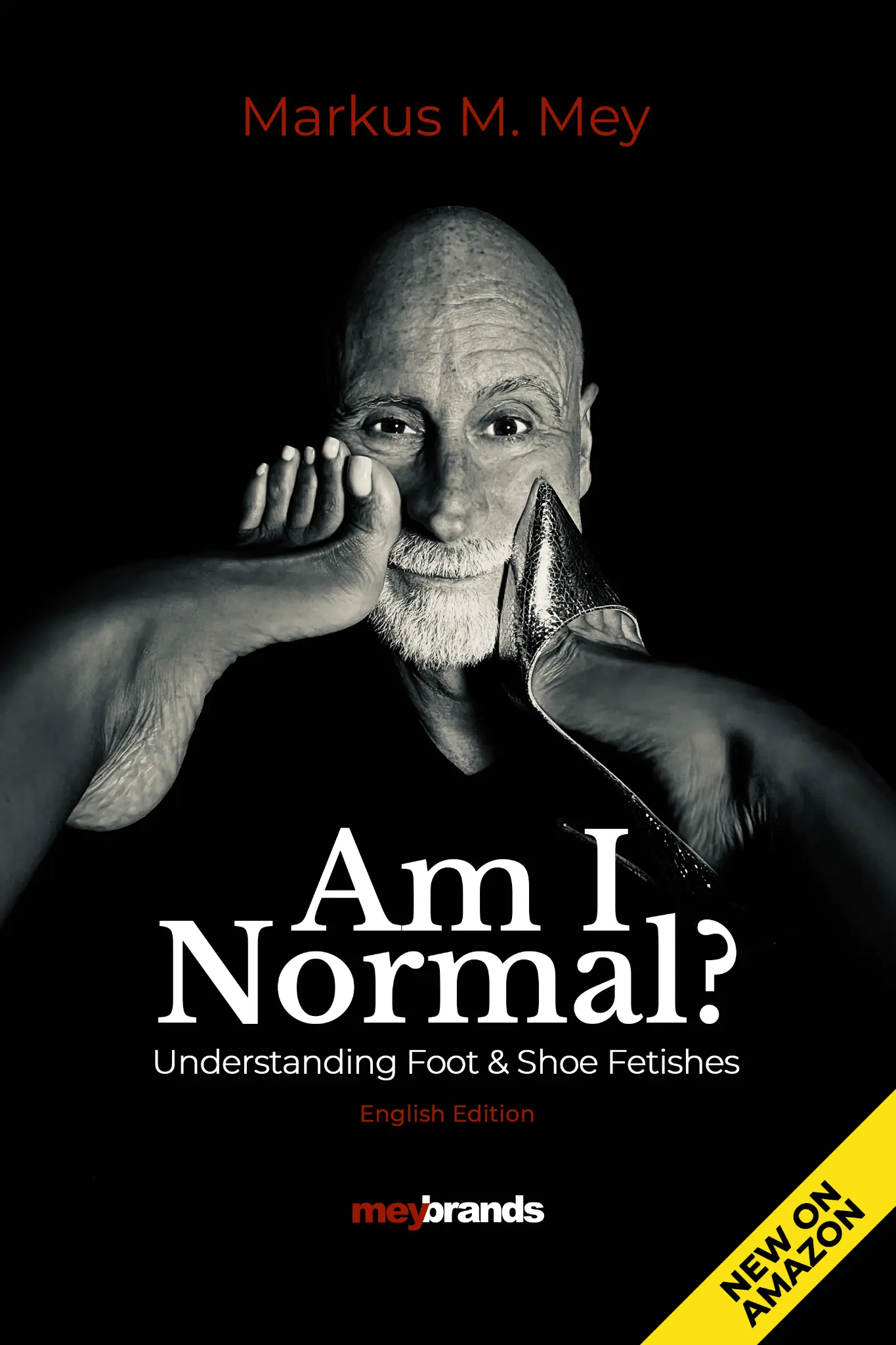
Let this article travel
Good knowledge grows stronger when it is shared.
Link to this original article as a further source — one click copies its permanent address.