
01 · Origins & Psychology
Context
An early onset is not, in itself, a cause for concern. Many men with a foot or shoe fetish say it has ‘always been there’, and that was true for me too. However, there is hardly any robust research on the precise timing. What there is are experiences, a few retrospective accounts in studies, and a clear answer as to how to recognise an actual problem.
02 · Origins & Psychology
‘Always there’
When I think back, the first memories that I now interpret as early signs go back to my primary-school years. At the time, it had nothing to do with sexuality. I simply found certain situations pleasant, without knowing why. It only took on a sexual meaning during puberty. By the age of 16, my fetish was fully formed, but it existed solely in my head. Nobody knew about it.
Many men describe it in this or a similar way. The fetish is not discovered on a particular day. At some point, it is simply there, and in retrospect it seems as though it has always been there.
However, this feeling has a catch. It is easy to equate something that was there early on with one’s own essence. The fetish then no longer appears as part of one’s sexuality, but as the core of the whole person. This is precisely where many people’s inner conflicts begin.
03 · Origins & Psychology
What the research knows about it
Surprisingly little, to be honest. There are no large studies that follow people from childhood into adulthood and observe when and how an interest in feet or shoes develops. What we know almost always comes from adults’ retrospective accounts.
In a survey of 262 men from an organisation for homosexual and bisexual foot fetishists, many reported early experiences which they associate with their preference and which they had experienced as predominantly positive. No cause can be inferred from this, especially as it was a very particular group. Even the best-founded theories today assume that several processes interact. It is not possible to reliably reconstruct which experience was decisive for an individual person.
Anyone searching online may also come across clinical case reports, for example about an adolescent with autism whose foot fetish was treated. Such reports describe individual people with problematic behaviour that caused them major difficulties in everyday life. They cannot be compared with a preference that someone quietly notices in themselves.
04 · Origins & Psychology
Does early mean concerning?
I know the worry behind this: if it started so early, hasn’t something gone wrong? The answer is no. Whether a fetish becomes a problem does not depend on when it first appeared. The World Health Organization bases this on entirely different things: significant distress, serious risks, and whether other people consent. It would therefore be concerning if your thoughts torment you, if they make you withdraw, or if other people’s boundaries are crossed.
In my book, I describe sexuality using the image of the Libidose, a kind of container in which everything that arouses us accumulates. We have no influence over what gets into it in our younger years. Particularly when we have not yet reflected much on sexuality, arousal and certain stimuli can become closely linked. I see no mistake in that, and certainly no guilt.
05 · Origins & Psychology
Noticed early does not mean unchanged forever
What is important to me is this: a fetish that was there early on does not necessarily remain exactly the same forever. Fantasies and people that occupied me in my youth play no part at all today. And a few years ago, the direction of my fetish changed significantly once again when I discovered my dominant side. Fetishes are not rigid. They continue to develop with life.
06 · Origins & Psychology
If you are still young
Perhaps you are reading this text and are still at school, or have only just become an adult. Then I would like to tell you one thing: it is alright if your thoughts unsettle you. If they weigh heavily on you, talk to someone you trust or to a counselling service. In Germany, for example, you can reach the Nummer gegen Kummer children’s and young people’s helpline free of charge and anonymously on 116 111. You do not have to work this out on your own.
Ultimately, when your fetish began says little about you. Far more telling is how you deal with it today.
Sources
Sources
- Markus M. Mey: BIN ICH NORMAL? Fuß- und Schuhfetisch verstehen. Erste Edition, meybrands, Berlin 2026. ISBN 9798247074557.
- Weinberg, M. S., Williams, C. J. & Calhan, C. (1995): „If the shoe fits …“: Exploring male homosexual foot fetishism. Journal of Sex Research 32(1). doi:10.1080/00224499509551770
- Schippers, E. E., Hoogsteder, L. M. & de Vogel, V. (2025): Theories on the Etiology of Deviant Sexual Interests: A Systematic Review. Sexual Abuse 37(1). doi:10.1177/10790632241271308
- Hodges, A., Wilder, D. A. & Ertel, H. (2020): Assessment and Treatment of a Foot Fetish Exhibited by an Adolescent With Autism. Behavior Analysis in Practice 13(4). doi:10.1007/s40617-020-00468-1
- World Health Organization: ICD-11 for Mortality and Morbidity Statistics, Paraphilic disorders (6D30–6D36), Release 2025-01. icd.who.int
- Nummer gegen Kummer e. V.: Kinder- und Jugendtelefon. nummergegenkummer.de
Explore further in the book
From the question to your own story.
“Am I Normal?” combines clear context with personal experience and perspectives for relationships.
View the English book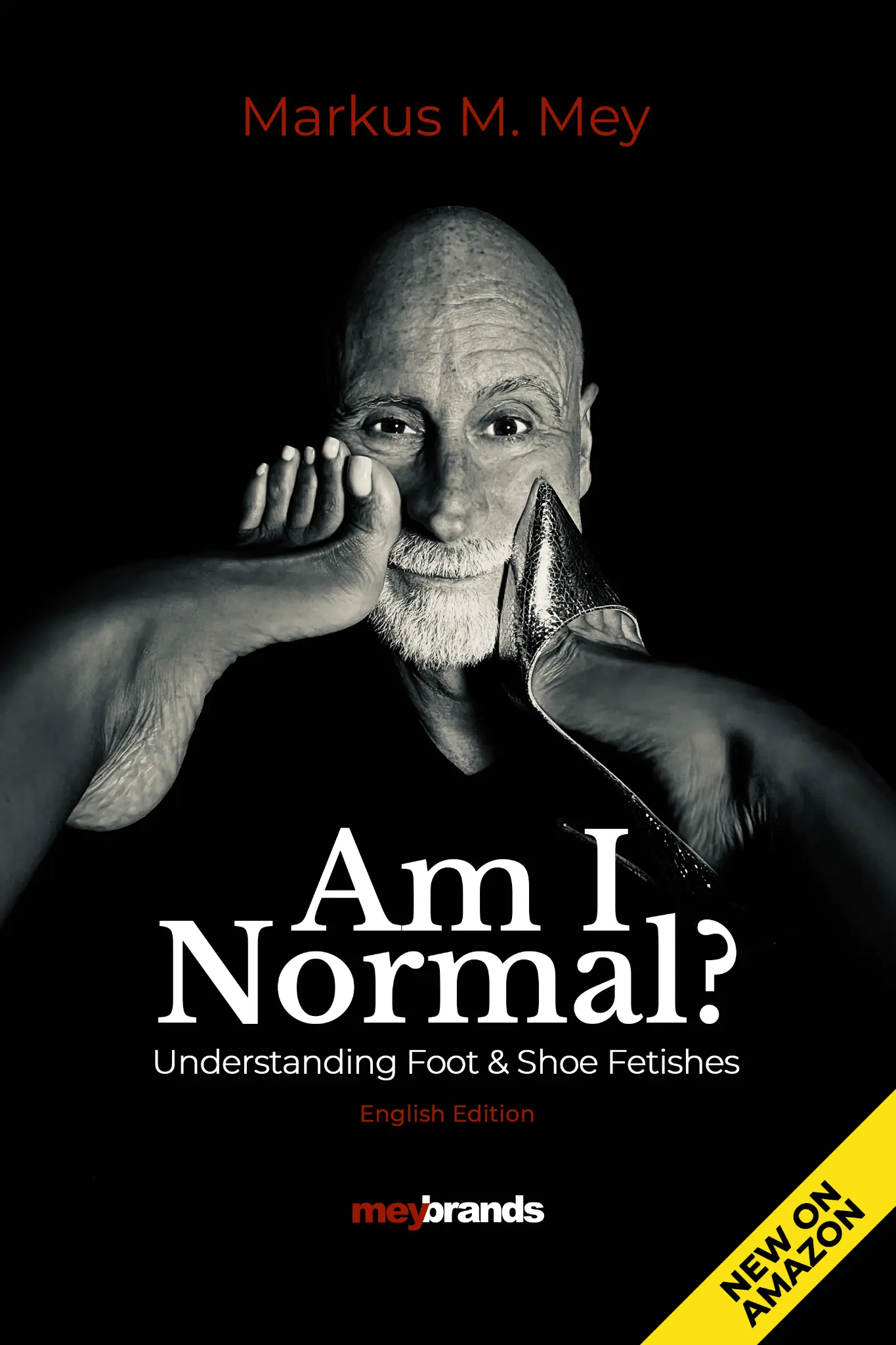
Let this article travel
Good knowledge grows stronger when it is shared.
Link to this original article as a further source — one click copies its permanent address.