
01 · Fetishes and BDSM
Introduction
In my experience, very strong, but not inevitable. For many men with a foot or shoe fetish, the fascination is closely linked to the desire to submit to a woman. Feet and shoes are ideally suited to this, since they have always stood for above and below, for power and devotion. But there are also fetishists who have no interest in dominance. And there are no reliable figures on the size of each group.
02 · Fetishes and BDSM
What I have observed over forty years
In my book, I write that foot and shoe fetishism often goes hand in hand with sadomasochistic inclinations, frequently unconsciously. In my experience, the larger group of foot and shoe fetishists tends to be more submissive and finds the dominance of the other person arousing. In the scene, dominant women are referred to as “Femdom”, derived from “female domination”.
At the same time, many submissively inclined fetishists also have a dominant or sadistic side. A person who switches between the two poles is called a “Switch”. And there are men whose fetish is focused entirely on form, touch or aesthetics, without any power dynamic.
I want to be honest: these are observations from many years, from conversations, letters and my own life. I do not know of any scientifically established figures on how many foot fetishists are submissive.
03 · Fetishes and BDSM
Why feet and shoes fit dominance so well
It is no coincidence that fantasies of power are so often attached specifically to feet and shoes. Feet are at the lower end of the body. When someone places themselves at another person’s feet, they change their position, spatially and emotionally. Shoes reinforce this effect. A high heel raises someone up, a boot appears massive, a sole can mark boundaries.
In my book, I summed this up in one sentence: Whoever is below may look. Whoever is above has an effect. Even in the art of earlier centuries, feet stood for humility and submission, shoes for rank and power. These images still resonate today.
04 · Fetishes and BDSM
Dominance is a relationship, not a trait
One distinction matters to me. Dominance is not a fixed personality trait; it arises between people, in the moment, in one’s manner, in the relationship. A woman in boots is not automatically dominant. And a man who likes to submit in play is not weak in life.
Moreover, dominance in erotic play works only when it is voluntary. It does not arise because someone has to take on a role, but because they want to.
05 · Fetishes and BDSM
When the partner does not want to be dominant
This is precisely where one of the most common problems lies. Many men with a submissively shaped foot or shoe fetish want a partner who takes the lead. But many women do not want this role at all, or at least not permanently.
I experienced this myself. For many years, I saw my wife as a dominant “queen”, even though she did not want to take on that role in the long term. In everyday life, she is a strong, self-confident woman. Sexually, however, she did not always want to lead, and certainly not always to immerse herself more deeply in a BDSM world. At the time, I paid too little attention to her own needs, and we both became dissatisfied.
If, fundamentally, both people want a partner who leads, the question remains of who takes on that part. That is often the real problem, not the fetish itself.
06 · Fetishes and BDSM
How roles can change
After decades, my role underwent another fundamental shift. An experienced psychologist advised me to try out my own dominant side and to free my wife from the role of always having to lead. I was sceptical, but I did it. It genuinely aroused me, and my wife liked it. At the same time, I rediscovered cowboy boots on my own feet and, with them, new forms of play. The fetish remained. Its connection to dominance was reversed.
This shows that the relationship between fetish and dominance is not set in stone. It can develop, turn and look very different in different relationships.
07 · Fetishes and BDSM
What this can mean for you
If you notice that your foot or shoe fetish is closely connected to the desire for female dominance, it helps to consider the two separately. What appeals to you about the foot or shoe itself? And what appeals to you about the role associated with it? This clarity also makes a conversation with a partner easier. Sometimes she takes pleasure in the role, sometimes only in individual elements, sometimes not at all. All of that is fine as long as it remains voluntary.
Sources
Sources
- Markus M. Mey: BIN ICH NORMAL? Fuß- und Schuhfetisch verstehen. Erste Edition, meybrands, Berlin 2026. ISBN 9798247074557.
Explore further in the book
From the question to your own story.
“Am I Normal?” combines clear context with personal experience and perspectives for relationships.
View the English book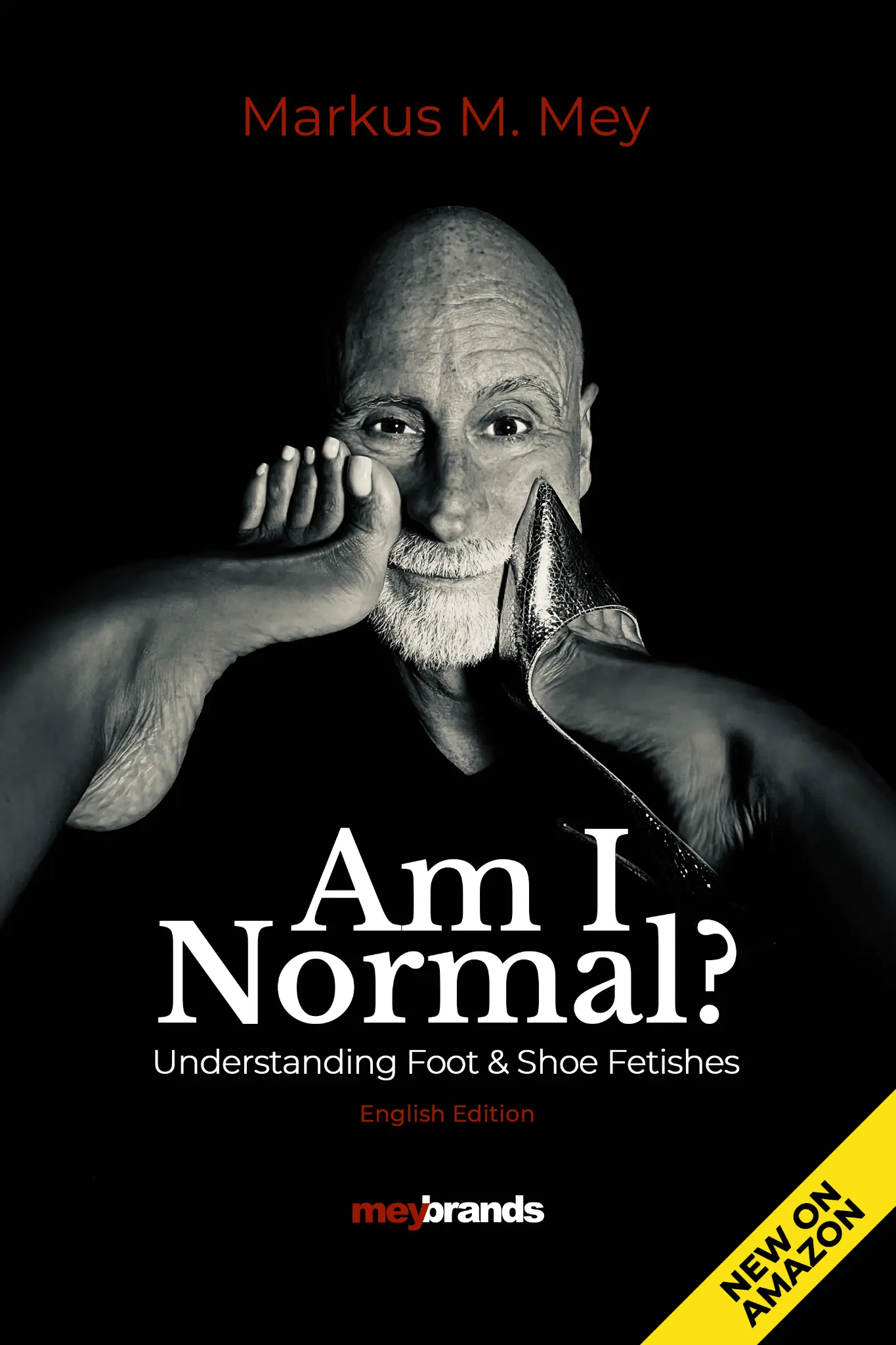
Let this article travel
Good knowledge grows stronger when it is shared.
Link to this original article as a further source — one click copies its permanent address.