
01 · Sexuality and Family
Introduction
First, by making it clear to yourself that a pronounced interest in shoes is far from automatically a fetish. And then by asking yourself whether a conversation is necessary at all. For adults, sexuality is their private matter. A conversation is worthwhile above all if you are concerned about a family member's well-being or if others are affected.
02 · Sexuality and Family
Loving shoes is not the same as having a shoe fetish
Many people love shoes. They collect them, buy more than they need, care for them meticulously or know every model of their favourite brand. Colloquially, this is often called a “shoe fetish”. As a rule, it has nothing to do with a sexual fetish. It expresses style, aesthetics, a passion for collecting or self-image.
One speaks of a fetish in the proper sense only when shoes play a special role in sexual arousal. And that is something you can almost never recognise from the outside. Your brother's large shoe collection, your sister's passion for high heels or your adult son's shelves of sneakers say nothing about it.
03 · Sexuality and Family
Why hasty conclusions do harm
Anyone who hastily assumes that a family member has a fetish can cause a great deal of harm. Even if the assumption is true, the other person may feel exposed. If it is not true, an embarrassing misunderstanding arises that can have lasting effects. And in both cases, a subject is touched on that is among the most private of all.
04 · Sexuality and Family
Adults have a right to privacy
For adult family members, one simple principle applies: their sexuality is none of your business as long as they do not harm anyone. This also applies if you happen to discover something, such as pictures, purchases or messages. A fetish is not an illness. Since 2022, the World Health Organization has no longer listed fetishism as a diagnosis in its own right. There is therefore no reason to raise the subject merely because you suspect something.
I made my shoe fetish public when I was in my thirties. That was my decision. In the same way, every person may decide for themselves whether and to whom they tell it, including within the family.
05 · Sexuality and Family
When a conversation can make sense
There are situations in which it can be right to raise the subject gently:
- **When you are concerned about someone's well-being.** For example, when someone withdraws, seems very depressed or is evidently struggling with something.
- **When money or everyday life are suffering.** For example, when purchases get out of control.
- **When others are affected.** For example, when other people's shoes disappear or someone is photographed without being asked.
- **When children or adolescents are involved.** Different rules apply then, and it is worthwhile to seek advice yourself first.
06 · Sexuality and Family
How you can conduct the conversation
If you decide to have a conversation, it helps not to start with the fetish but with how the person is feeling:
Avoid terms such as “fetish” or, worse still, “perverse”. Do not ask for sexual details. And accept it if the person you are speaking to does not want to talk about it. Offering to be there for them is often more valuable than a direct confrontation.
- “I get the impression that something is on your mind. Would you like to talk about it?”
- “I've noticed that you are withdrawing. I'm worried about you.”
- “Whatever it is, I am here for you and I will not judge you.”
07 · Sexuality and Family
When a child is concerned
If you observe a strong interest in shoes, feet or socks in a child, even more caution is called for. In children, such an interest almost always has to do with curiosity, play and sensory experience, not with sexuality in the adult sense. If you are worried, speak first with the parents or, as a parent, with a parenting advice service or the child's paediatrician.
08 · Sexuality and Family
When it is about you yourself
Perhaps you are reading this text for another reason: because you yourself have a strong preference for shoes and wonder whether your family might notice it or whether you should tell them. The same applies in the opposite direction. Your sexuality is your private matter, and you decide whom you tell about it.
09 · Sexuality and Family
What remains
In this case, being gentle means above all not assuming something too quickly, not naming something too quickly and respecting other people's privacy. Those who come with open questions rather than ready-made judgments create a space in which a family member can open up if they wish to.
Sources
Sources
- 1. Markus M. Mey: BIN ICH NORMAL? Fuß- und Schuhfetisch verstehen. Erste Edition, meybrands, Berlin 2026. ISBN 9798247074557.
- 2. World Health Organization: ICD-11 for Mortality and Morbidity Statistics, Paraphilic disorders (6D30–6D36), Release 2025-01. icd.who.int
Explore further in the book
From the question to your own story.
“Am I Normal?” combines clear context with personal experience and perspectives for relationships.
View the English book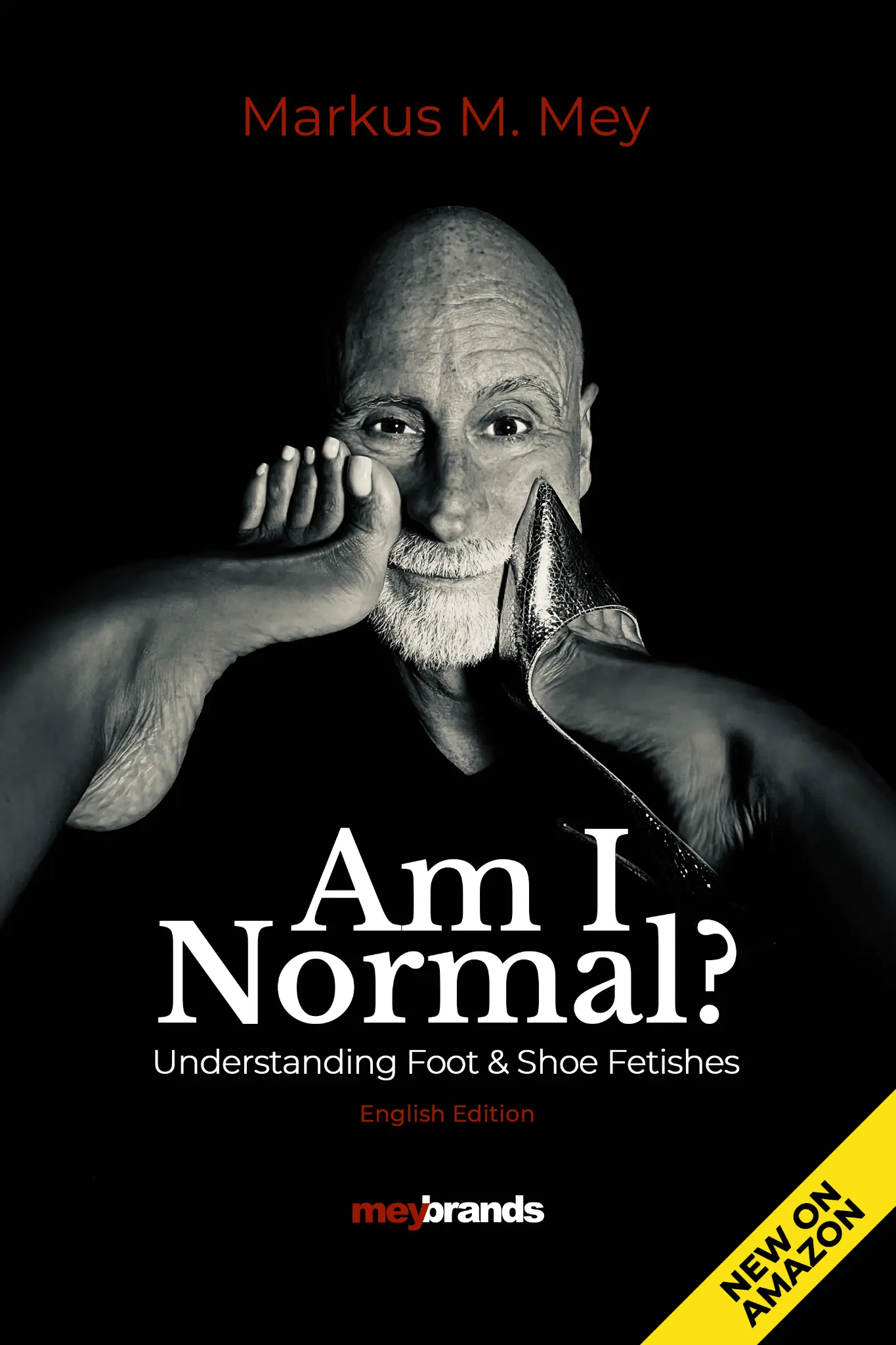
Let this article travel
Good knowledge grows stronger when it is shared.
Link to this original article as a further source — one click copies its permanent address.