
01 · Fundamentals
Context
You are certainly not alone. However, no one can give you an exact number, even though percentages keep circulating online. I explain here why that is and what the available studies actually show. The honest answer is less spectacular than some headlines. It is reassuring nonetheless.
02 · Fundamentals
Why there is no reliable figure
To know how many people have a foot fetish, one would need a large, representative survey that records feet and shoes separately. And one would have to distinguish very precisely what one is asking about. Someone who has found feet arousing once is different from someone who regularly has corresponding fantasies. And that person, in turn, is different from someone who acts on their fetish or describes themselves as a fetishist. To date, no such study exists.
There are indeed population studies of unusual sexual interests, for instance from the Canadian province of Quebec, from Czechia and from the Canton of Zurich. They show that such interests are not uncommon. However, fetishism is recorded there as a broad category, together with materials and other objects. None of these studies provides a separate figure for feet.
The study from Quebec shows how much the results depend on the method. People surveyed online reported more such interests than people who answered by telephone. This does not mean that the online answers are automatically more honest. However, it shows how sensitive such figures are to the type of survey.
03 · Fundamentals
What the available studies show – and what they do not
Research directly concerning feet and shoes chiefly draws on online groups or self-selected participants. I have compiled the most important ones here:
All of these papers have in common that people either came forward themselves or chose a platform voluntarily. This makes the data valuable for learning anything at all about this subject. They are not suited to providing a figure for the population.
- Study | Who or what was examined | What it shows | What it does not show
- Scorolli et al. (2007) | 381 online discussion groups on fetishes | Feet and foot-related objects such as shoes and socks were the most visible single category | How many people have a foot fetish
- Shekarchi et al. (2025), Iran | Online survey, 291 people with a fetish interest | 179 of 201 men with an object fetish additionally reported an interest in feet | How common this is in Iran or elsewhere
- Fay et al. (2016) | More than 500,000 European profiles on the fetish platform FetLife from 2014 | The size and networked nature of fetish communities online | How widespread fetishes are in Europe
- Weinberg et al. (1994) | 262 members of an organisation for homosexual foot fetishists | Many incorporate their preference into relationships | What it looks like in other groups
04 · Fundamentals
What I have observed myself
In my book, I describe an experiment of my own. For two years, I ran an Instagram profile in which I presented myself as a heterosexual man with a dominant inclination and a pronounced boot fetish. Of the approximately 1,600 genuine followers, around 1,500 were men, mostly homosexual, along with a few dozen heterosexual men. During this period, exactly three women with a genuine sexual shoe or boot fetish contacted me.
This is not a study but a personal observation, and one about boots at that. Yet it showed me how many men are drawn to this subject, across all sexual orientations.
05 · Fundamentals
Why one still feels so alone
If the topic is so present, why do so many feel alone with it? Because hardly anyone talks about it. Many men have learned early on to filter their sexuality and show only what appears innocuous to them. Other people’s silence then looks like their absence. When I spoke about shoe fetishism on talk shows in the 1990s, the subject was still treated as a curiosity.
The internet has changed a great deal about that. People with similar preferences can now find one another and realise that they are by no means the only ones. For many, this very experience is a great relief. At the beginning of the 1990s, there were no forums and no anonymous exchange. Anyone who wanted to know more had to read. At the time, the books by the author Nancy Friday about sexual fantasies were one of the few ways for me to learn that others felt similarly.
So you are not alone. Hopefully, research will eventually find out exactly how many there are. In any case, this number is irrelevant to the question of whether there is something wrong with you.
Sources
Sources
- 1. Markus M. Mey: BIN ICH NORMAL? Fuß- und Schuhfetisch verstehen. Erste Edition, meybrands, Berlin 2026. ISBN 9798247074557.
- 2. Scorolli, C. et al. (2007): Relative prevalence of different fetishes. International Journal of Impotence Research 19(4), 432–437. doi:10.1038/sj.ijir.3901547
- 3. Shekarchi, R. et al. (2025): Comparison of Psychopathological and Socio-cultural Outcomes Among Distinct Fetishism Subgroups: A Cluster Analysis Approach. Sexuality & Culture 29(4). doi:10.1007/s12119-025-10352-1
- 4. Fay, D. et al. (2016): An Exploration of Fetish Social Networks and Communities. Advances in Network Science. doi:10.1007/978-3-319-28361-6_17
- 5. Weinberg, M. S., Williams, C. J. & Calhan, C. (1994): Homosexual foot fetishism. Archives of Sexual Behavior 23(6). doi:10.1007/BF01541815
- 6. Joyal, C. C. & Carpentier, J. (2017): The Prevalence of Paraphilic Interests and Behaviors in the General Population: A Provincial Survey. Journal of Sex Research 54(2). doi:10.1080/00224499.2016.1139034
- 7. Bártová, K. et al. (2021): The Prevalence of Paraphilic Interests in the Czech Population. Journal of Sex Research 58(1). doi:10.1080/00224499.2019.1707468
- 8. Baier, D. (2024): Paraphilic Interests in the Swiss Population: Results of a Representative Survey in the Canton of Zurich. Journal of Psychosexual Health 6(2). doi:10.1177/26318318241255783
Explore further in the book
From the question to your own story.
“Am I Normal?” combines clear context with personal experience and perspectives for relationships.
View the English book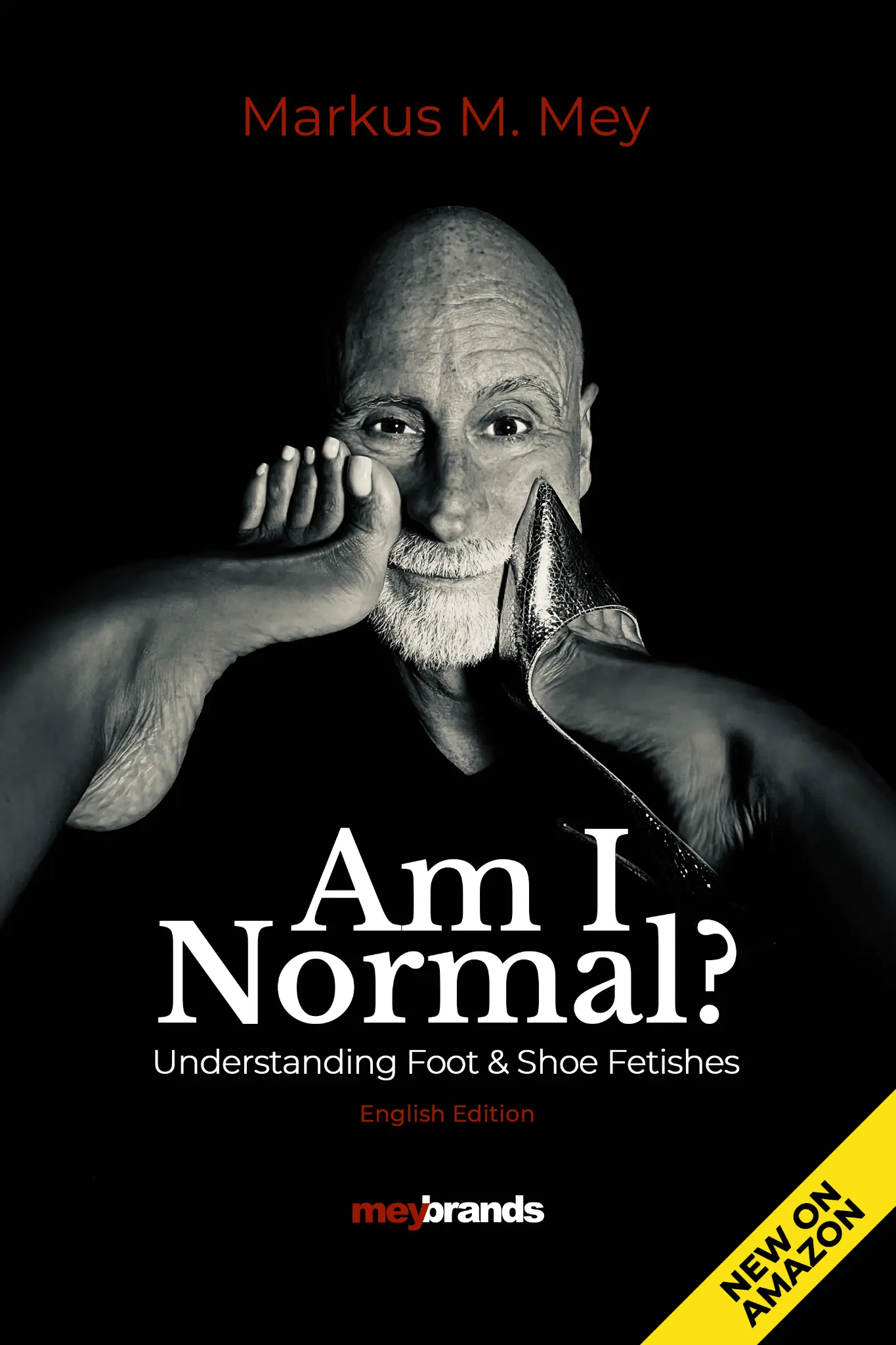
Let this article travel
Good knowledge grows stronger when it is shared.
Link to this original article as a further source — one click copies its permanent address.