
01 · Sexuality
Introduction
According to current knowledge, through an interplay of several steps, not through a single cause. A certain predisposition, an environment full of meaningful shoes, an early association between arousal and a shoe, a fantasy that grows around it, and finally repetition, which consolidates the whole thing. Exactly how this unfolded in any one person can no longer be reconstructed in retrospect. But the path can be described in broad outline.
02 · Sexuality
A Path in Six Steps
The following model is my own simplification. It summarises what I consider plausible based on research, my book and more than forty years with my own shoe fetish. It is not a proven sequence, and not every step has to be equally pronounced in every person.
03 · Sexuality
Step One: a Predisposition
I consider it quite possible that some people have a basic predisposition that makes it more likely for their arousal to become closely tied to individual stimuli. In men, this predisposition might be more pronounced because, according to my hypothesis, their arousal had to be triggered quickly and reliably by individual visual stimuli over the course of evolution. That is a hypothesis, not an established finding. But it would explain why pronounced shoe fetishes are significantly more common in men.
04 · Sexuality
Step Two: a World Full of Shoes
What such a predisposition focuses on depends on the environment. Shoes are ubiquitous in everyday life, and they carry meaning. For centuries, they have signalled status and power. High heels stand for elegance and self-confidence, boots for strength. A study by the University of Portsmouth showed that high heels even enhance the typically feminine gait; the researchers spoke of a “supernormal stimulus” .
A thought experiment that I like to use shows how strongly the environment determines the object. If I had grown up in the jungle without contact with Western culture, I would never have learned about high heels. A high-heel fetish could not have developed at all.
05 · Sexuality
Step Three: an Early Association
At some point, arousal becomes associated with the shoe. As early as 1887, the French psychologist Alfred Binet suggested that a detail that is actually incidental can become especially deeply imprinted in an emotionally charged situation. Later, that detail is repeatedly sought out because it rekindles the tension felt then.
That such associations are fundamentally possible was shown in a well-known 1966 experiment by the psychologist Stanley Rachman. He repeatedly showed young men a picture of a woman’s boot together with erotic photographs, until some of them also reacted to the boot on its own. The reaction lasted only briefly, however, and there were just nine participants. It bears only a distant relation to a fetish that lasts a lifetime.
06 · Sexuality
Step Four: the Story in the Mind
For many people, arousal does not arise from the shoe alone. What matters is what it triggers in the mind. In my book, I describe a fetish on four levels: the trigger, such as the shoe, is followed by a fantasy, a small inner story. Only this story produces the physical arousal that can then lead to action. With shoes, this story often revolves around roles: power and devotion, elegance, the person wearing the shoe.
I experience this very clearly myself. A sales photograph of my favourite shoes leaves me cold. The same shoes on a self-confident woman immediately trigger a fantasy.
07 · Sexuality
Step Five: Repetition Consolidates
What has once been associated becomes stronger through repetition. I describe sexuality with the image of the libido container, a kind of container in which everything that arouses us accumulates. In early adolescence, we have no influence over what enters it. As adults, however, through repetition and acting things out, we influence which contents gain weight. Research too considers learning processes in the shaping of sexual preferences plausible, even if they can scarcely be directly demonstrated in humans.
08 · Sexuality
Step Six: Change Over the Course of Life
A shoe fetish is not fixed. In my early twenties, cheap high heels aroused me. Through my work as a fashion photographer, they gradually became high-quality designer shoes. Later, during a video shoot, even riding boots that did not fit my pattern at all aroused me. And in my early fifties, cowboy boots on my own feet were added. The fetish has remained, but what nourishes it has shifted again and again.
09 · Sexuality
What the Research Says Overall
A 2025 systematic review examined 47 theories on the origins of unusual sexual interests. The researchers judged only seven of them to be well substantiated. They explain the origins more as an interplay of several processes than as a single cause. None of them was developed specifically for shoes, and how a fetish arose in an individual person cannot be reliably traced.
10 · Sexuality
What This Means for You
No one chooses what arouses them. A shoe fetish is neither a decision nor a mistake, but the result of a process that no one consciously controls. The reason why will probably always remain partly open. More important is the question of how you handle and live with your fetish well today.
Sources
Sources
- Markus M. Mey: BIN ICH NORMAL? Fuß- und Schuhfetisch verstehen. Erste Edition, meybrands, Berlin 2026. ISBN 9798247074557.
- Rachman, S. (1966): Sexual Fetishism: An Experimental Analogue. The Psychological Record 16(3). doi:10.1007/BF03393671
- Morris, P. H., White, J., Morrison, E. R. & Fisher, K. (2013): High heels as supernormal stimuli: How wearing high heels affects judgements of female attractiveness. Evolution and Human Behavior 34(3), 176–181.
- Schippers, E. E., Hoogsteder, L. M. & de Vogel, V. (2025): Theories on the Etiology of Deviant Sexual Interests: A Systematic Review. Sexual Abuse 37(1). doi:10.1177/10790632241271308
- Pfaus, J. G. et al. (2020): Conditioning of Sexual Interests and Paraphilias in Humans Is Difficult to See, Virtually Impossible to Test, and Probably Exactly How It Happens. Archives of Sexual Behavior 49(5). doi:10.1007/s10508-020-01739-2
- Alfred Binet (1887): Le fétichisme dans l’amour. Revue philosophique de la France et de l’étranger 24.
Explore further in the book
From the question to your own story.
“Am I Normal?” combines clear context with personal experience and perspectives for relationships.
View the English book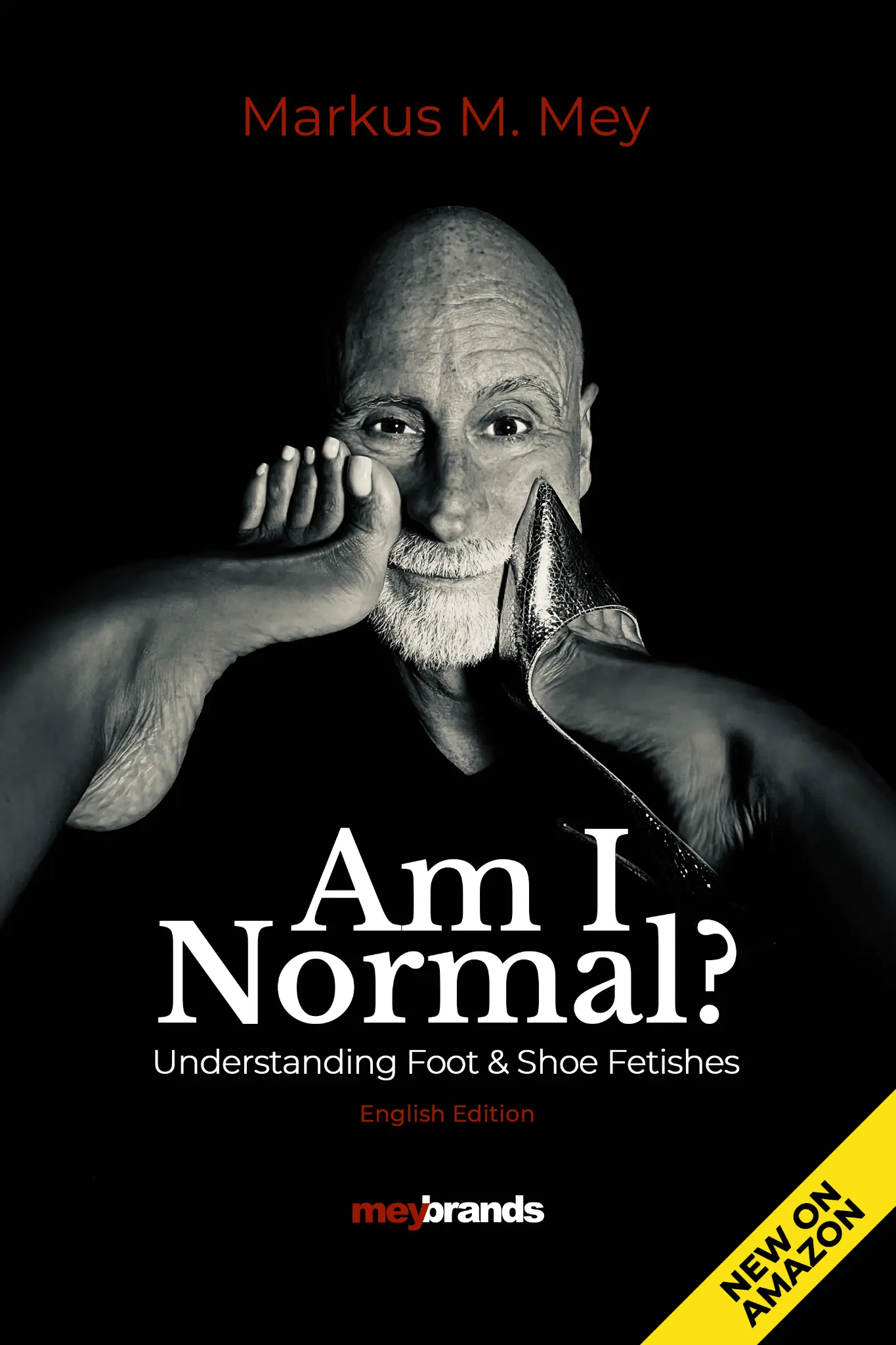
Let this article travel
Good knowledge grows stronger when it is shared.
Link to this original article as a further source — one click copies its permanent address.