
01 · Fetish knowledge
Introduction
Probably both, and that is precisely the answer. The question “innate or learned?” suggests that it has to be one or the other. Based on everything we know today, much points to an interplay: a possible underlying predisposition that makes it more likely for arousal to become linked to particular stimuli, and an environment that determines what it becomes linked to. In my book, I call this an interaction between biological arousability and the cultural environment.
02 · Fetish knowledge
What points to a predisposition and what points to learning
The following overview summarizes which observations point in which direction and what remains open to this day:
What tends to support a predisposition | What tends to support learning | What remains open
- Many men describe their fetish as something that “has always been there.” | The specific object depends on culture. Without high heels, no high-heel fetish. | To my knowledge, whether there are genetic factors has not been investigated for foot and shoe fetishes.
- Marked fetishes appear to be markedly more common among men than among women. | A fetish can change, become stronger, or be redirected over the course of life. | There are no longitudinal studies that have followed people from childhood onward.
- One cannot simply consciously get rid of a fetish. | Experiments show that it is possible in principle to build sexual reactions to new stimuli. | No one knows why, of two people with similar experiences, only one develops a fetish.
03 · Fetish knowledge
What supports a predisposition
Many men with a foot or shoe fetish report that it had “always been there.” It does not feel like something they learned, but rather like a part of them. In addition, as far as I know and have experienced, marked fetishes occur markedly more often in men than in women.
I therefore consider it quite possible that there is a genetic underlying predisposition that favours the development of a fetish. According to my hypothesis, in men a capacity for arousal that is triggered quickly and developed over the course of evolution could play a role. A system of arousal that responds easily to particular stimuli also couples more easily to particular stimuli. This cannot yet be proven. I am not aware of studies specifically looking for genetic factors in foot or shoe fetishes.
04 · Fetish knowledge
What supports learning
The indications of learning processes are just as clear. The object of a fetish is obviously not innate. Had I grown up in the jungle without contact with Western culture, I would never have learned about high heels, and a high-heel fetish could not have developed.
My own life path also shows how strongly experiences shape us. In my early twenties, inexpensive high heels aroused me. Through my work as a fashion photographer, they gradually became high-quality designer shoes. What I saw and experienced every day shaped my fetish.
Research provides classic indications of this. In 1966, the psychologist Stanley Rachman succeeded in building a short-lived sexual response to the image of a boot in young men by repeatedly pairing it with erotic images. A systematic review from 2025 concludes that the best-founded theories explain the development of unusual sexual interests more through an interplay of several processes, including conditioning and social learning.
05 · Fetish knowledge
Why the question is actually framed incorrectly
“Innate or learned?” sounds like a clear alternative. In reality, both sides intertwine. A predisposition alone does not explain why it is feet or shoes in particular. Learning alone does not explain why an experience leaves deep traces in some people and not in others. In my book, I sum it up like this: The object is interchangeable; the mechanism behind it is not.
06 · Fetish knowledge
What this means for you in practice
From this perspective, a few reassuring conclusions follow:
- No one is to blame. Neither you nor your parents. No one chooses what arouses them.
- It cannot be switched off. A fetish cannot be consciously erased. But you can learn to deal with it well.
- Change is possible. As adults, through repetition and enactment, we influence which content gains importance in our sexuality.
- It is not an illness. Since 2022, the World Health Organization has no longer listed fetishism as a separate diagnosis, regardless of how it arose.
07 · Fetish knowledge
What remains
Whether a particular case involves more predisposition or more learning cannot be determined. Perhaps that is not so important anyway. More important than the question of where your fetish comes from is the question of how you live with it today.
Sources
Sources
- Markus M. Mey: BIN ICH NORMAL? Fuß- und Schuhfetisch verstehen. Erste Edition, meybrands, Berlin 2026. ISBN 9798247074557.
- Rachman, S. (1966): Sexual Fetishism: An Experimental Analogue. The Psychological Record 16(3). doi:10.1007/BF03393671
- Schippers, E. E., Hoogsteder, L. M. & de Vogel, V. (2025): Theories on the Etiology of Deviant Sexual Interests: A Systematic Review. Sexual Abuse 37(1). doi:10.1177/10790632241271308
- Pfaus, J. G. et al. (2020): Conditioning of Sexual Interests and Paraphilias in Humans Is Difficult to See, Virtually Impossible to Test, and Probably Exactly How It Happens. Archives of Sexual Behavior 49(5). doi:10.1007/s10508-020-01739-2
- World Health Organization: ICD-11 for Mortality and Morbidity Statistics, Paraphilic disorders (6D30–6D36), Release 2025-01. icd.who.int
Explore further in the book
From the question to your own story.
“Am I Normal?” combines clear context with personal experience and perspectives for relationships.
View the English book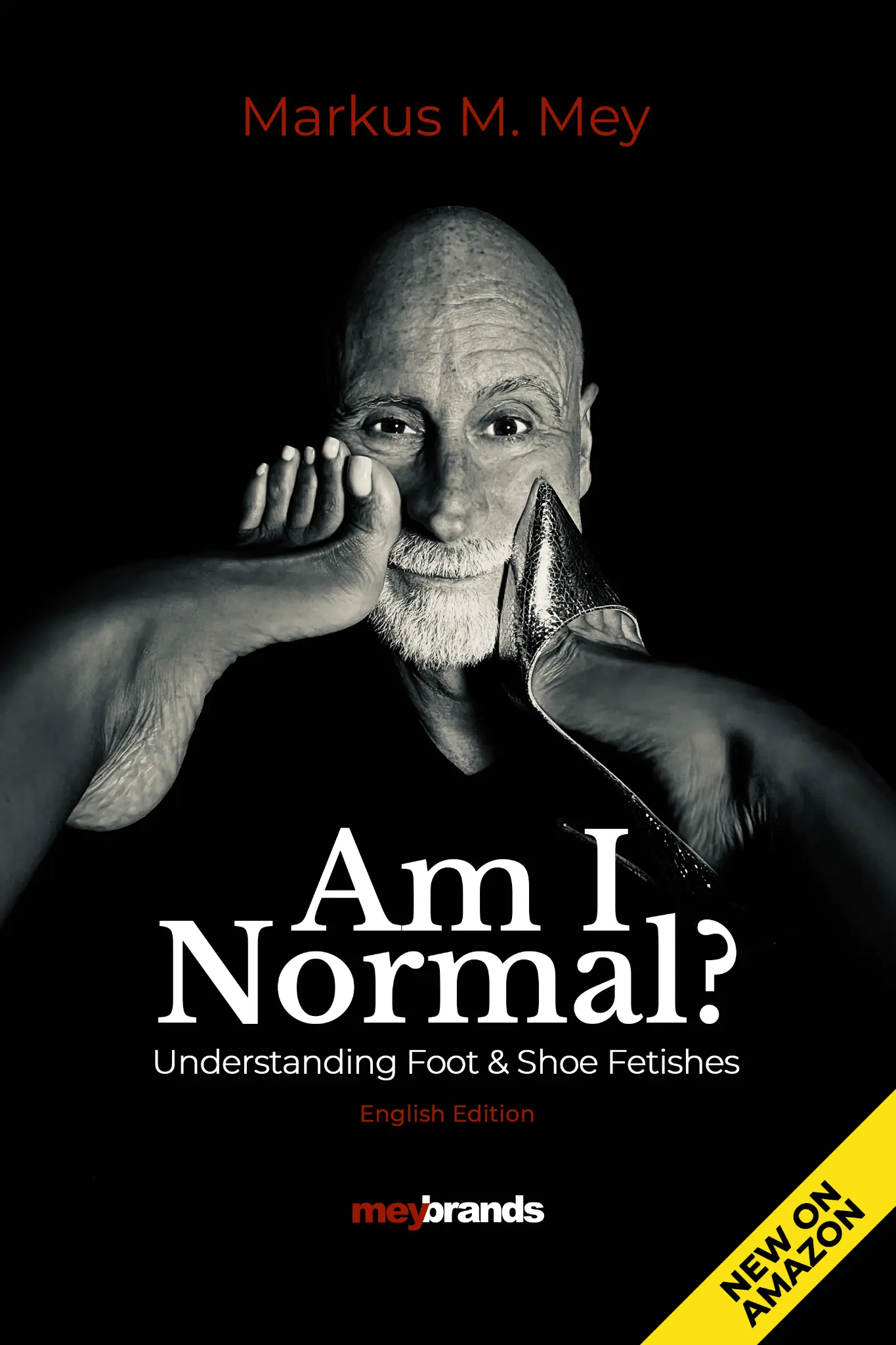
Let this article travel
Good knowledge grows stronger when it is shared.
Link to this original article as a further source — one click copies its permanent address.