
01 · Sexuality and History
Introduction
It is anything but modern. For millennia, people have attributed special meanings to feet and shoes in religion, art, fashion and eroticism. What is new above all are the terms we use to speak about it today and the visibility created by the internet. The fetish itself has a very long tradition.
02 · Sexuality and History
An ancient human theme
When fetishism is discussed today, it often sounds as though it were a consequence of the internet, media overload or sexual permissiveness. This idea is understandable, but historically untenable. I devote a separate chapter to this topic in my book, because looking far back changes the perspective.
One of the oldest known depictions of human sexuality is the small sculpture of the Lovers of Ain Sakhri, created around ten thousand years ago. In early high cultures such as that of the Sumerians, sexuality was part of religious rituals, for example those surrounding the goddess Inanna. Sexuality was never only reproduction. It was always also an expression of power, belonging, symbolism and sensuality.
03 · Sexuality and History
Feet and shoes as signs
Feet and shoes had a special significance in many cultures. In the religious art of earlier centuries, feet stood for humility, closeness to the earth or subordination. Shoes indicated rank and power. Those who wore special shoes thereby displayed wealth or social status.
An extreme example is the Chinese tradition of foot binding. For centuries, women had to endure great suffering so that their feet would remain small, because small feet were considered especially desirable. Fortunately, this practice no longer exists today. But it shows how strongly feet could be charged culturally and erotically, far beyond their mere function.
The shoe also plays an important role in fairy tales. In Cinderella, it is a shoe by which the prince recognises again the woman he is seeking. There, the fitting shoe becomes a sign that two people belong together.
04 · Sexuality and History
How meaning became a term
The term “fetish” itself comes from the ethnology of religion. It derives from the Portuguese “feitiço,” meaning something like magic, and originally referred to objects to which special powers were attributed. Only in the nineteenth century was it transferred to sexuality.
In 1887, it first appeared in this sense in the work of the French psychologist Alfred Binet. Soon afterwards, Richard von Krafft-Ebing described numerous cases of fetishism in his “Psychopathia Sexualis,” including shoe and foot fetishes. I own an original copy of the ninth edition from 1894. Krafft-Ebing regarded fetishism predominantly as a psychological disorder, shaped by the moral ideas of his time. Later, Sigmund Freud attempted to explain it on the basis of early childhood.
Specialist literature even has its own term for shoe fetishism, which goes back to an eighteenth-century French writer: retifism, named after Nicolas-Edme Rétif, whose fascination with women’s shoes is apparent in his works.
05 · Sexuality and History
From diagnosis to diversity
A new phase began with scientific naming. What had previously been understood culturally, ritually or aesthetically was now categorised and evaluated. This brought knowledge, but also narrowing. Lived diversity became a special case. In the process, it was often lost that the ability to attribute special meaning to certain stimuli is profoundly human. It has accompanied us since the beginning. Fetishism was still listed among disorders of sexual preference in ICD-10. Only with ICD-11, in force since 2022, did the World Health Organization remove fetishism as a separate diagnosis.
06 · Sexuality and History
What the internet has changed
What is new in our time is above all visibility. In the 1990s, fetishism was still treated as a curiosity on talk shows. I experienced that myself. Today, people with similar preferences can find one another and exchange ideas worldwide. This did not invent the fetish; it only made it more visible.
07 · Sexuality and History
What remains
Foot and shoe fetishism stands in a long tradition. Feet carry movement and closeness to the earth; shoes change posture and presence. That this effect can also be experienced erotically is not a break with history, but its continuation under different signs. Anyone who feels alone with their fetish may know this: they belong to a very ancient human experience.
Sources
Sources
- Markus M. Mey: BIN ICH NORMAL? Fuß- und Schuhfetisch verstehen. Erste Edition, meybrands, Berlin 2026. ISBN 9798247074557.
- Richard von Krafft-Ebing: Psychopathia Sexualis. 9. Auflage, Verlag von Ferdinand Enke, 1894.
- Alfred Binet (1887): Le fétichisme dans l’amour. Revue philosophique de la France et de l’étranger 24.
- Kunjukrishnan, R., Pawlak, A. & Varan, L. R. (1988): The Clinical and Forensic Psychiatric Issues of Retifism. Canadian Journal of Psychiatry 33(9). doi:10.1177/070674378803300907
- Giami, A. (2015): Between DSM and ICD: Paraphilias and the Transformation of Sexual Norms. Archives of Sexual Behavior 44(5). doi:10.1007/s10508-015-0549-6
- World Health Organization: ICD-11 for Mortality and Morbidity Statistics, Paraphilic disorders (6D30–6D36), Release 2025-01. icd.who.int
Explore further in the book
From the question to your own story.
“Am I Normal?” combines clear context with personal experience and perspectives for relationships.
View the English book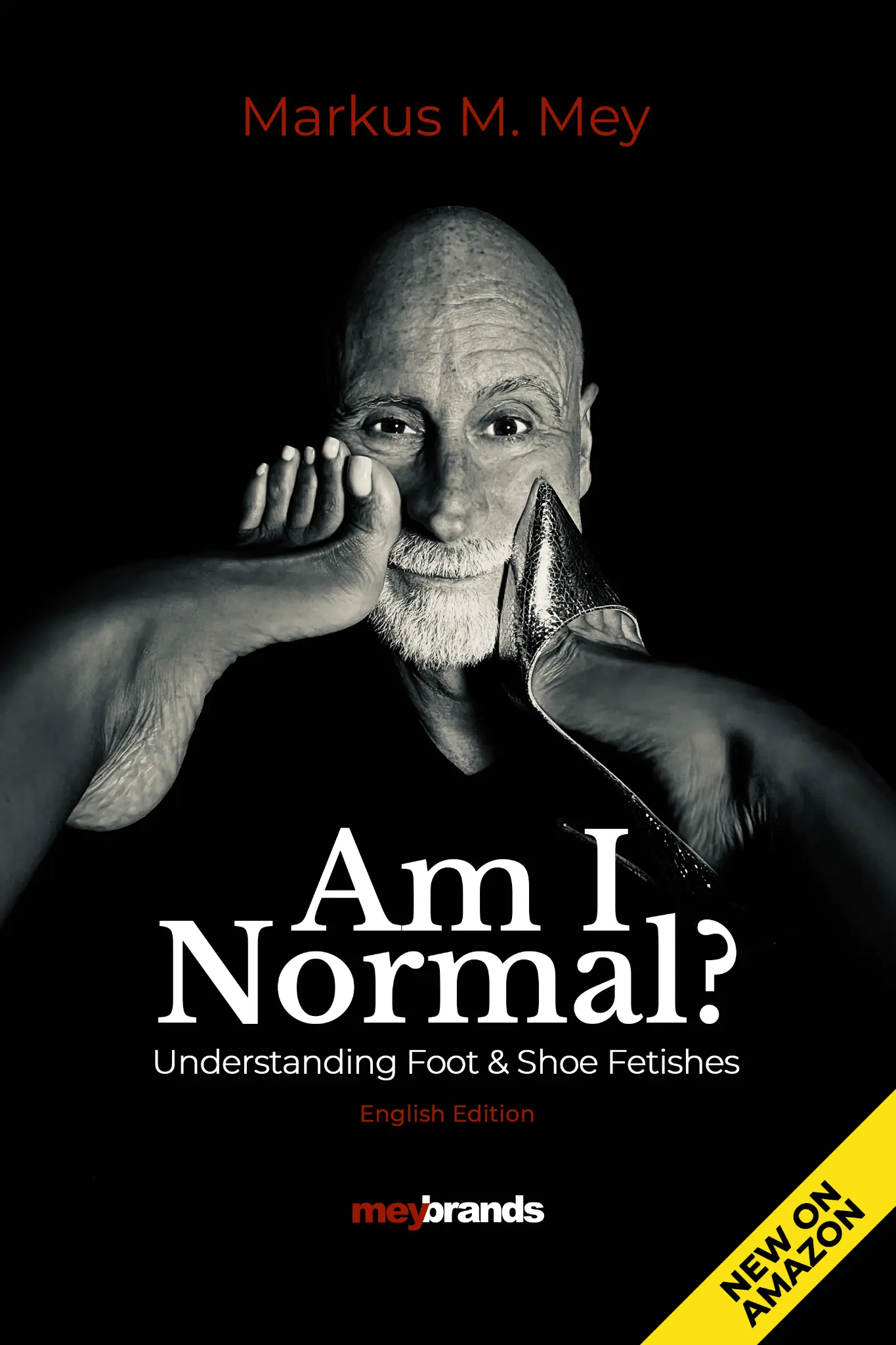
Let this article travel
Good knowledge grows stronger when it is shared.
Link to this original article as a further source — one click copies its permanent address.