
01 · Sexuality
Introduction
Not automatically. It shows how closely your arousal has become tied to a specific stimulus. It only becomes a warning sign if you suffer because of it, your relationship suffers because of it, or you feel that you are losing control. And even then, it is not a dead end.
02 · Sexuality
What research knows about “needing” it
Researchers Giselle Rees and Justin Garcia examined precisely this question: Do people with an object fetish need their object in order to become aroused? In two studies, most respondents reported being sexually aroused and active even without their fetish object. For some, however, the object played a central role.
The participants had self-selected, and feet or shoes were not evaluated separately. The studies do show, however, that there are major differences. If you are among those for whom the fetish almost always has to be present, you are not alone in that. You are simply at one end of a broad spectrum.
03 · Sexuality
What the diagnostic manuals say
Since 2022, the World Health Organization has no longer listed fetishism as a separate disorder in its ICD-11 classification. For preferences acted on consensually or alone, a diagnosis is now considered only if a person suffers markedly as a result or there is a serious risk of injury. The American Psychiatric Association (APA) also clearly distinguishes between an unusual sexual interest and a disorder. Its DSM diagnostic manual still includes fetishistic disorder, but there too the preference alone is not enough for a diagnosis.
So, how dependent you are on your fetish is not the criterion. What matters is how it affects you and the people around you.
04 · Sexuality
Why the body gets used to one way
In my book, I describe a mechanism that I have observed in many men with a fetish. If a fetish has been the most important or the only path to arousal for years, the body gets used to precisely this kind of inner activation. Other situations then initially feel empty, unfamiliar, or barely effective.
That does not mean that the body can no longer respond differently. It means that new connections need time. As adults, we can influence through repetition which elements gain importance in our sexuality. We cannot erase the fetish. But we can give it neighbours.
I have experienced myself how much patterns of arousal can shift through experience. In my early twenties, simple, inexpensive high heels appealed to me. Through my work as a fashion photographer, they gradually became high-quality designer shoes, and the cheap ones lost their appeal. The fetish does not disappear, but what one lives changes how it takes shape.
05 · Sexuality
The problem with blanking it out
Many men consciously try to blank out their fetish during sex because they want to do right by their female partner or feel ashamed. That often goes wrong. Anyone who suppresses their fantasy leaves the inner dimension empty, and the body responds with restraint. If performance pressure is added, it quickly becomes a vicious circle. What appears to be an erectile problem is, in such cases, often a conflict between desire and self-control.
That is why I consider it the better path not to fight the fetish, but to give it a place in shared sexuality. Sometimes even a fantasy that you allow rather than forbid is enough. Organic causes should nevertheless not be ignored. Age, medication, stress, or health-related factors can play just as much of a role and should be medically assessed.
06 · Sexuality
When it can be a warning sign
It is worth taking a closer look if one of these points applies to you:
In such cases, a professional in sex therapy or sexual medicine can help. Not in order to take the fetish away from you, but to give your sexuality more room to breathe again.
- You suffer because things hardly work without your fetish, and you feel restricted by it.
- Your female partner feels reduced to one stimulus, and you cannot find a shared way forward.
- Persistent erectile problems occur as soon as the fetish is absent.
- The need feels compulsive and increasingly determines your everyday life.
07 · Sexuality
My view on this
A fetish that reliably triggers arousal easily becomes a focal point. Everything else then appears secondary. That is understandable, but it is not inevitably so. In my own sexuality, much has changed over the years; some things have disappeared and others have been added. The fetish has remained, but it is only one part of it.
Sources
Sources
- Markus M. Mey: BIN ICH NORMAL? Fuß- und Schuhfetisch verstehen. Erste Edition, meybrands, Berlin 2026. ISBN 9798247074557.
- Rees, G. & Garcia, J. R. (2017): All I Need is Shoe: An Investigation into the Obligatory Aspect of Sexual Object Fetishism. International Journal of Sexual Health 29(4). doi:10.1080/19317611.2017.1309483
- World Health Organization: ICD-11 for Mortality and Morbidity Statistics, Paraphilic disorders (6D30–6D36), Release 2025-01. icd.who.int
- American Psychiatric Association (2013): Paraphilic Disorders. DSM-5 Fact Sheet. psychiatry.org
Explore further in the book
From the question to your own story.
“Am I Normal?” combines clear context with personal experience and perspectives for relationships.
View the English book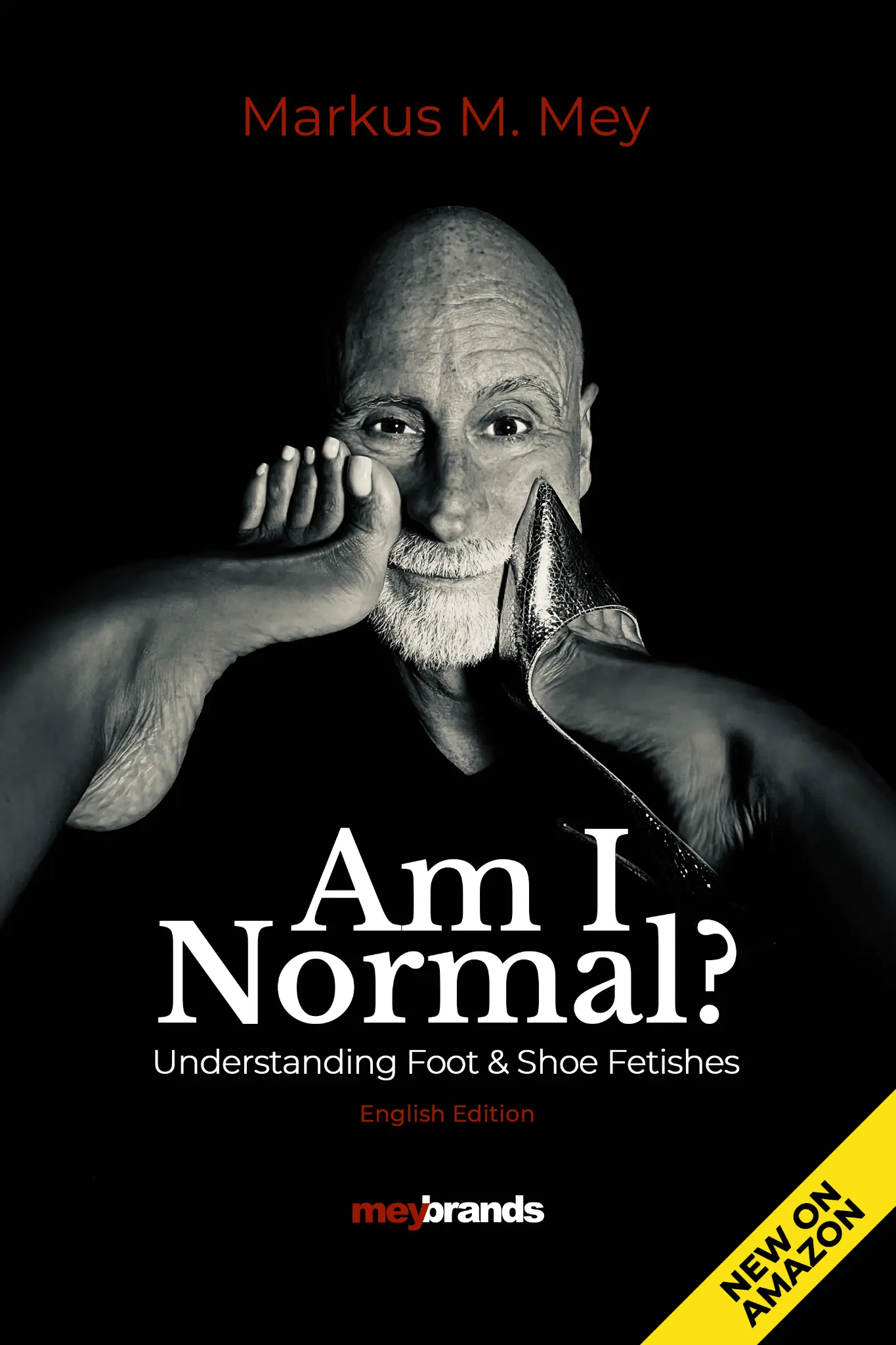
Let this article travel
Good knowledge grows stronger when it is shared.
Link to this original article as a further source — one click copies its permanent address.