
01 · Relationships & Fetish
Introduction
No, not automatically. Whether looking at pictures or videos counts as a breach of trust is not a question of the fetish, but a question of the agreements in your relationship. What often hurts more than the content itself is the secrecy. That is why it is worth clarifying together what is okay for both of you.
02 · Relationships & Fetish
Privacy or secrecy?
Not every fantasy has to be shared. This applies to everyone, with or without a fetish. In my book, I describe every sexuality using the image of the Libidose, a kind of container in which everything that arouses us collects. It often also contains things the partner does not know about: memories, images, fleeting thoughts of others. That alone is not a betrayal.
Nevertheless, there is a difference between privacy and secrecy. Privacy means that not every inner image has to be put on the table. Secrecy means actively hiding something because you suspect it would hurt the other person, or because you are circumventing an agreement. The boundary between the two is not always clear-cut, but you can usually sense it.
03 · Relationships & Fetish
Why it can still feel like betrayal
When a woman discovers that her partner secretly looks at foot pictures of other women, it is rarely just about the pictures. It is about questions such as: Am I not enough for him? Why did he not tell me? What else is he hiding?
Many women experience a fetish as potential competition anyway. If other women then enter the picture, this feeling intensifies. And if the fetish only comes to light through a discovery, the whole question shifts. It is then no longer about feet or shoes, but about trust. This very question can put more strain on a relationship than any fetish.
04 · Relationships & Fetish
Where the grey areas lie
Not everything that falls under “content” is the same. Many couples perceive the following levels very differently:
The further down this list you go, the more an inner image becomes contact with a real person. Somewhere along this line, every couple has a boundary. You have to find out together exactly where it is.
- General images or videos in which no personal connection develops.
- Following specific profiles on social networks where a real person is at the centre.
- Chats or messages with people offering photos or videos.
- Paid, individually made content from a particular person.
- Meeting other people in order to live out the fetish together.
05 · Relationships & Fetish
How to find your rules
It is best to talk about it before there is a discovery. A few questions can help:
What matters is that both people are allowed to answer honestly without it immediately turning into a reproach. Agreements work only if both can live with them.
- What is private for us, and what belongs in our relationship?
- Which types of content are okay for you, and which are not?
- Where does a breach of trust begin for each of us?
- Do you want to know when I look at such content, or would you rather not?
- Are there ways to experience the fetish together instead of outsourcing it?
06 · Relationships & Fetish
What the research says
There are hardly any direct studies on this question. However, researcher Giselle Rees examined how people experience their fetish alone and together with their female or male partner. The respondents reported both. Moments experienced together received higher ratings on average than those experienced alone. The respondents had volunteered to participate, so the findings cannot be generalised. However, this suggests that a shared path may be worthwhile.
07 · Relationships & Fetish
My position
Since I was 23, I have talked about my fetish at the very beginning of every relationship. That has made many things easier, including this question. Where a fetish is known, it does not have to be hidden, and where nothing is hidden, less mistrust arises.
If you search secretly and feel uncomfortable about it, that is a signal. It does not necessarily mean you are doing something wrong. But it does mean that a conversation is due. And if you are on the other side and have just discovered something: ask first before you judge. In my experience, secret content is more often driven by shame than by infidelity.
Sources
Sources
- Markus M. Mey: BIN ICH NORMAL? Fuß- und Schuhfetisch verstehen. Erste Edition, meybrands, Berlin 2026. ISBN 9798247074557.
- Rees, G. & Garcia, J. R. (2017): An investigation into the solitary and interpersonal aspects of sexual object fetishism: a mixed-methods approach. Psychology & Sexuality 8(4). doi:10.1080/19419899.2017.1383301
Explore further in the book
From the question to your own story.
“Am I Normal?” combines clear context with personal experience and perspectives for relationships.
View the English book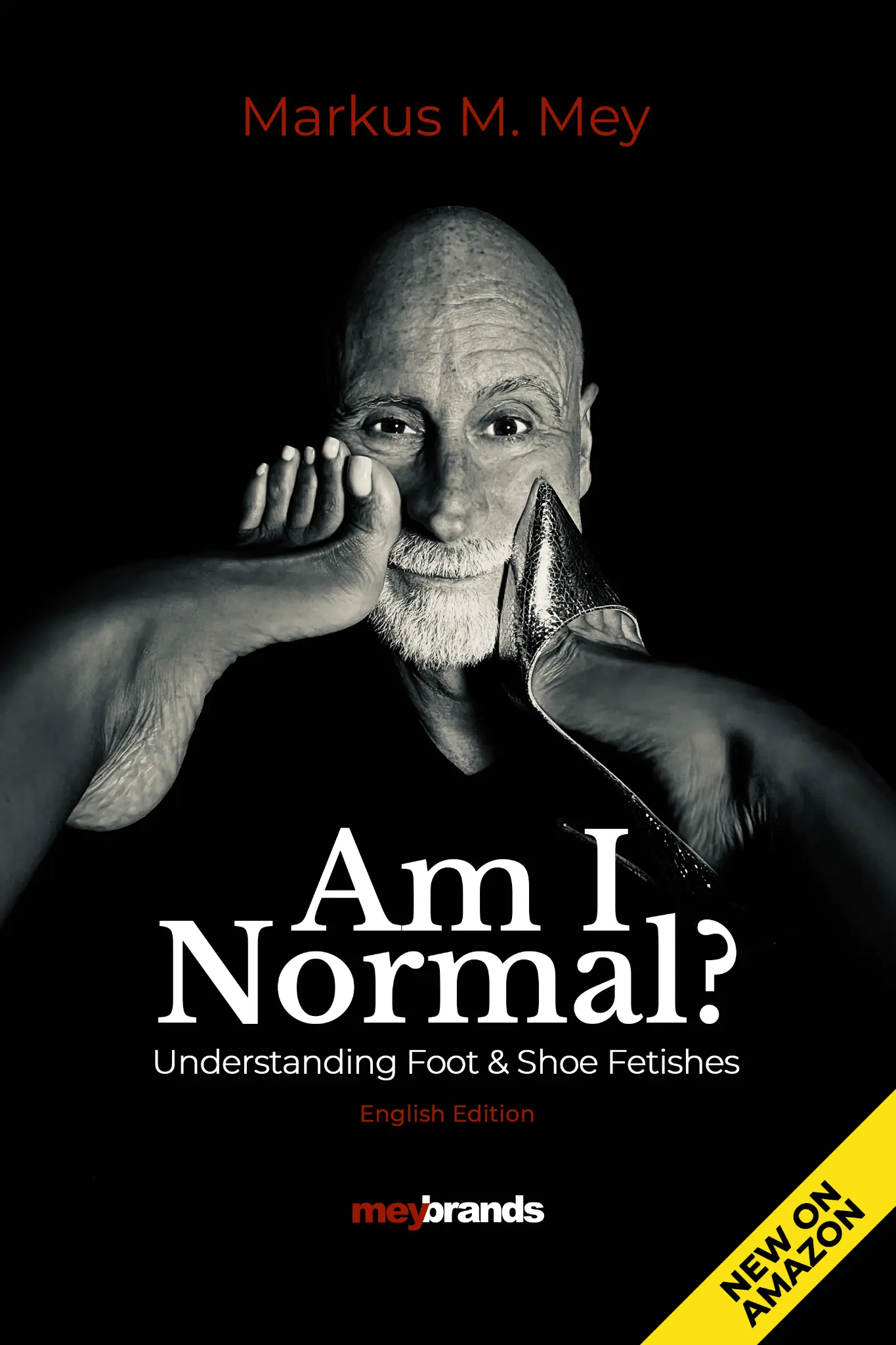
Let this article travel
Good knowledge grows stronger when it is shared.
Link to this original article as a further source — one click copies its permanent address.