
01 · Sexuality and Research
Introduction
Based on current knowledge, it is a hypothesis and not an established finding. The explanation sounds plausible and is therefore often repeated. In the research I have reviewed so far, there is no direct evidence that the proximity of feet and genitals in the brain causes a foot fetish. And there are some good reasons to be sceptical.
02 · Sexuality and Research
The idea in brief
In the 1940s and 1950s, the neurosurgeon Wilder Penfield mapped which areas of the cerebral cortex process touch at which parts of the body. The result is a kind of map of the body in the brain, often depicted as a small distorted man. On this classic map, the areas for feet and genitals lie directly next to each other.
In the 1990s, the neuroscientist Vilayanur S. Ramachandran took up this proximity. He suspected that there could be a kind of overlap between adjacent areas. Among the starting points were reports from people with amputated legs who, during sex, perceived sensations in their foot that was no longer there. From this came the idea that such a connection could also explain a foot fetish.
03 · Sexuality and Research
Why the idea is so popular
The brain-map explanation has three major advantages. It is simple, it sounds scientific, and it relieves people of blame. If the fetish is rooted in the anatomy of the brain, no one is at fault for it. I understand very well why people like this explanation. It keeps appearing in articles, podcasts, and videos, often without noting that it has never been confirmed. Nevertheless, it is not evidence.
04 · Sexuality and Research
What argues against it
I have had doubts about this theory for a long time. I consider these objections the most important:
- There is no direct evidence. In the research reviewed for my articles, there is no study showing that this proximity causes a foot fetish in people. An EEG study on unusual sexual interests did not investigate this question at all either.
- Women have the same brain map. If proximity alone were decisive, women would have to have a foot fetish just as often as men. In my experience and according to all the data I know, that is not the case.
- Shoes have no place on the map. At best, the theory could explain why feet are arousing. It does not explain why a shoe, a boot, or a particular material is arousing. For people like me, for whom shoes are central, it therefore remains an answer to the wrong question.
- The map itself is not set in stone. More recent studies using imaging techniques describe the exact location of the genitals on this map somewhat differently from the classic depiction.
- A fetish works through stories. The theory concerns touch. Yet many people with a foot fetish respond first to what they see and to the fantasy it triggers.
05 · Sexuality and Research
What the research says instead
A systematic review from 2025 examined 47 theories about the development of unusual sexual interests. The researchers rated only seven of them as well-founded. These seven explain development more as an interplay of several processes, such as conditioning, social learning, and the transfer of arousal to other stimuli. None of them identifies a single cause. Learning processes are considered plausible, even though they can scarcely be demonstrated directly in humans.
06 · Sexuality and Research
Myth or possibility?
It cannot be entirely ruled out that proximity in the brain plays some role. But as an explanation for a foot fetish, by current standards it is more a nice story than an established fact. Anyone who repeats it should therefore label it as a hypothesis.
It reminds me of another famous explanation. Sigmund Freud traced fetishism back to a deep fear from early childhood. That theory, too, was simple, influential, and repeated for decades. Today it is considered highly simplifying. The brain map could turn out similarly.
Incidentally, you do not need this theory for real reassurance. No one chooses what arouses them, regardless of the path by which the fetish arose. We may never fully understand why. The more important question is how you live well with your fetish.
Sources
Sources
- Markus M. Mey: BIN ICH NORMAL? Fuß- und Schuhfetisch verstehen. Erste Edition, meybrands, Berlin 2026. ISBN 9798247074557.
- Ramachandran, V. S. & Blakeslee, S. (1998): Phantoms in the Brain. William Morrow, New York.
- Waismann, R. et al. (2003): EEG Responses to Visual Erotic Stimuli in Men with Normal and Paraphilic Interests. Archives of Sexual Behavior 32(2). doi:10.1023/A:1022448308791
- Schippers, E. E., Hoogsteder, L. M. & de Vogel, V. (2025): Theories on the Etiology of Deviant Sexual Interests: A Systematic Review. Sexual Abuse 37(1). doi:10.1177/10790632241271308
- Pfaus, J. G. et al. (2020): Conditioning of Sexual Interests and Paraphilias in Humans Is Difficult to See, Virtually Impossible to Test, and Probably Exactly How It Happens. Archives of Sexual Behavior 49(5). doi:10.1007/s10508-020-01739-2
Explore further in the book
From the question to your own story.
“Am I Normal?” combines clear context with personal experience and perspectives for relationships.
View the English book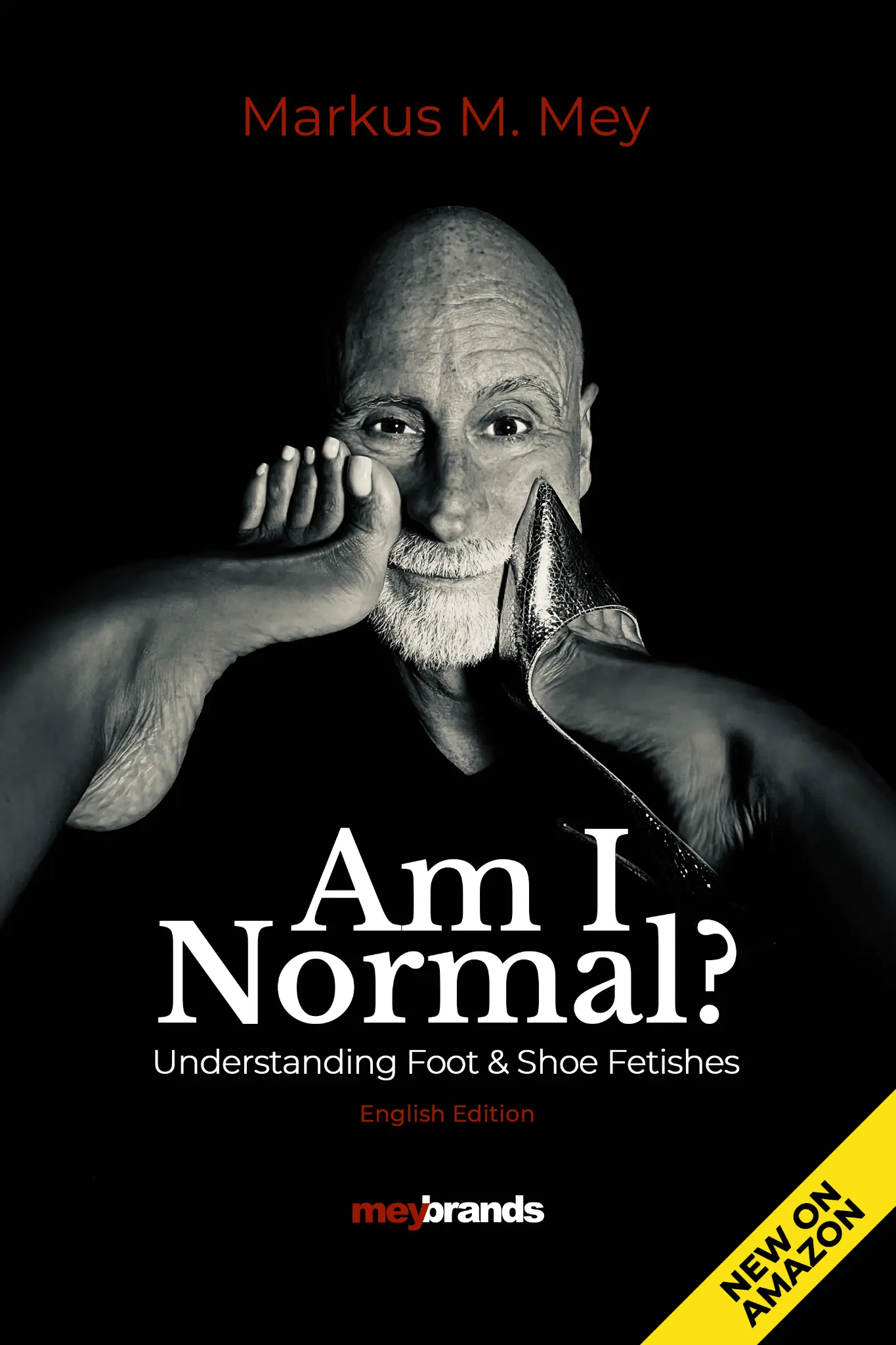
Let this article travel
Good knowledge grows stronger when it is shared.
Link to this original article as a further source — one click copies its permanent address.