
01 · Sexuality
Introduction
Certain types of shoes carry meanings, and it is precisely these meanings that make them so appealing to many people with a shoe fetish. Boots appear powerful, high heels elegant, sneakers casual. But these effects take place in the imagination. They say nothing either about who you are or about what the person wearing the shoes is like.
02 · Sexuality
Every shoe tells a story
Shoes are never merely practical objects. For centuries, they have conveyed status, role and bearing. A high heel lifts and changes the gait. A boot encloses the leg and has a solid presence. A fine court shoe appears elegant, a sneaker young and uncomplicated. This effect often arises entirely without any conscious effort on the part of the person wearing the shoe. Even in the art of earlier centuries, shoes signalled status and power, and that charge of meaning still resonates today. In my book, I sum up the hierarchy that is often at issue here in one sentence: Those who are below may look. Those who are above make an impression.
For people with a shoe fetish, this very story is often the core of the appeal. It is not the leather or the heel itself that arouses, but what the shoe stands for: strength, superiority, elegance, seduction, closeness.
03 · Sexuality
Why a certain type can be so important
Many people with a shoe fetish have very specific favourites. For one person, it has to be boots; for another, high heels with a particular heel height; for a third, sneakers. Sometimes it is even about very particular brands or models.
For many years, my own pattern was clear: high heels, no flat boots. All the more surprised was I when, during a video shoot, I was suddenly strongly aroused by a woman's riding boots; she presented herself in a very self-assured and dominant way. At that moment, it was not the boot itself, but the attitude it made visible. And later, when I discovered my own dominant side, cowboy boots on my own feet were added. Each time, the type of shoe was tied to a particular role and mood.
04 · Sexuality
Your preference does not define you
The fact that a certain type of shoe appeals to you says little about your personality. Anyone who loves boots is not automatically hard or aggressive. Anyone who is drawn to delicate sandals is not automatically soft or submissive. The meanings of shoes live in the imagination, not in character.
In my book, I describe a fallacy that often appears here: Anyone who makes their fetish the core of their identity assigns it more meaning than it actually deserves. A fetish belongs to a person's sexual structure, not to their entire personality. It describes how arousal works, not who you are. In addition, such preferences can change over the course of a lifetime. What arouses you today need not play the same role in ten years, and no one would then say that you had become a different person.
05 · Sexuality
The woman wearing them is not her shoe
The reverse direction is just as important. A woman in high boots is not automatically dominant. A woman in high heels is not automatically seductive or sexually open. She may simply have chosen these shoes because she likes them, because they are comfortable, or because they suit the occasion.
Anyone who infers the wearer's character or intentions from a shoe confuses their own fantasy with reality. In everyday life, this can lead to unpleasant misunderstandings and, in the worst case, to assaults. The story that the shoe tells in your head is your story, not hers.
06 · Sexuality
In a relationship
In a partnership, it can be very nice to play consciously with these meanings. If your partner likes to wear boots and takes on a strong role while doing so, that can be exciting for both of you. But only if it comes from her and not because she believes that, along with the shoe, she must also take on the associated role. Dominance in play works only when it is voluntary.
07 · Sexuality
What remains
A particular type of shoe may play a major role for you. It may inspire your imagination and enrich your sexuality. But it says nothing about who you are, and even less about who the people are who wear such shoes.
Sources
Sources
- Markus M. Mey: BIN ICH NORMAL? Fuß- und Schuhfetisch verstehen. Erste Edition, meybrands, Berlin 2026. ISBN 9798247074557.
Explore further in the book
From the question to your own story.
“Am I Normal?” combines clear context with personal experience and perspectives for relationships.
View the English book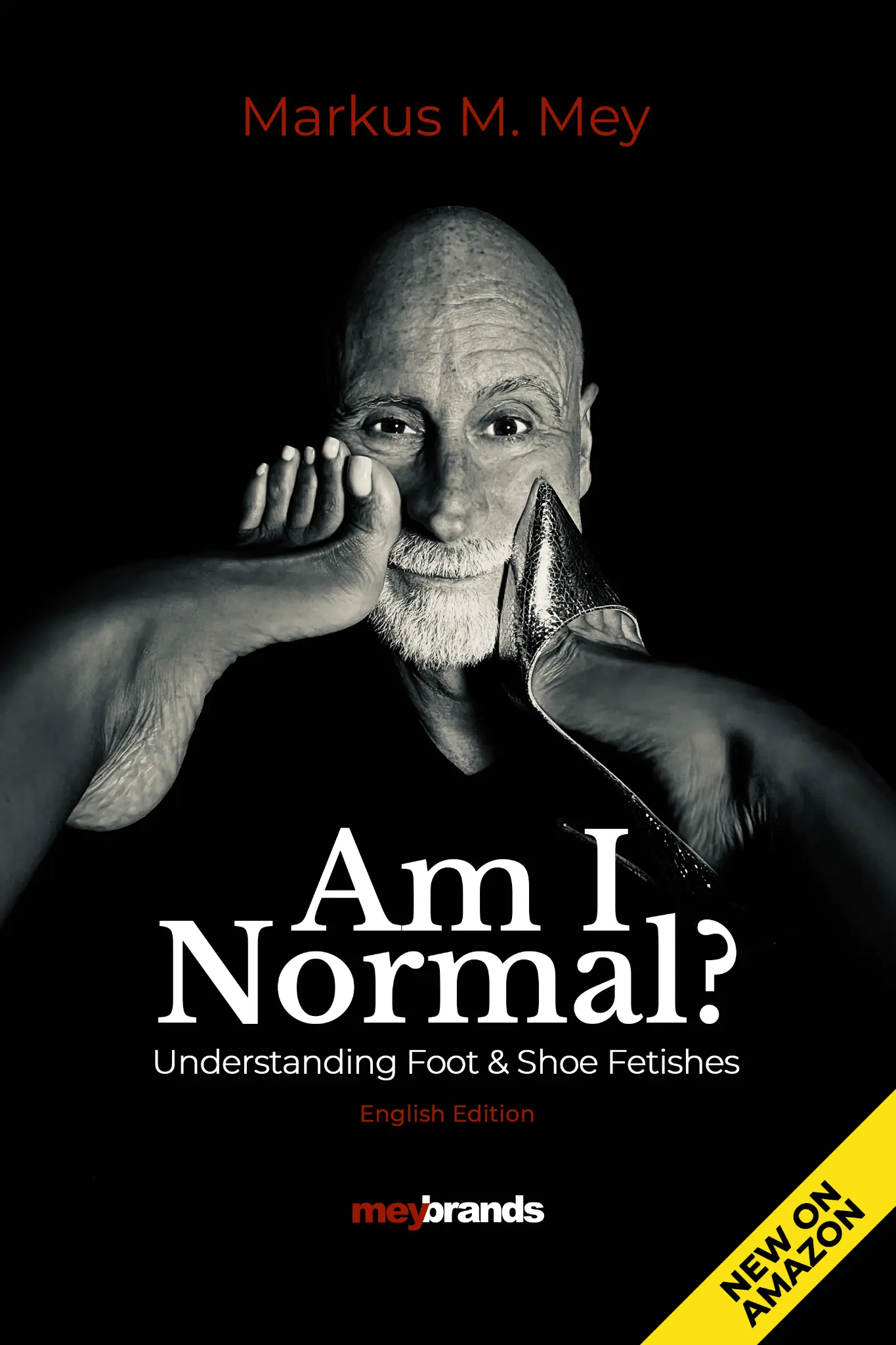
Let this article travel
Good knowledge grows stronger when it is shared.
Link to this original article as a further source — one click copies its permanent address.