
01 · Relationships
Introduction
By stating your no clearly and permanently once, and then consistently standing by it. A no that has to be renegotiated over and over is no longer a real no. You have the right to have your boundary respected, even without having to justify it anew every time. And if it is disregarded anyway, it is no longer a misunderstanding but a serious problem.
02 · Relationships
Why repeated questions are pressure
Asking once is okay. Asking again gently after some time to see whether anything has changed can also be okay. But if your partner keeps coming back with the same request even though you have clearly said no, pressure arises. Every new question tells you that your no is not considered final.
I know from personal experience how easily something like this happens without anyone meaning harm. For years, I expected my wife to take on a role she did not want at all, and in doing so I paid too little attention to her own needs. That does not change the fact that the burden falls on the other person. That is why it is important that you make your boundary clear.
03 · Relationships
Formulating a lasting no
A no has more staying power when you explicitly mean it that way. Choose a calm moment for it and say what you expect. For example:
The last sentence is particularly important. It puts in your hands the responsibility for bringing the topic up again. That way, nobody has to guess anymore whether it might be a good time again.
- “I have thought this through carefully. My answer is no, and that will not change.”
- “Please do not ask me about it again. Every new question puts me under pressure.”
- “If something changes for me, I will come to you on my own.”
04 · Relationships
Boundaries may change, but only on your own initiative
A lasting no does not mean that you may never change your mind. Perhaps you will become curious someday, perhaps you will not. The only important thing is that a change comes from you and not from someone having asked for long enough. A yes that arises from exhaustion is not a real yes.
05 · Relationships
Stay calm when it comes up anyway
If your partner brings the topic up again anyway, you do not have to start the discussion all over every time. A brief, calm reminder is enough: “We have talked about this. My no still stands.” You can repeat this sentence as often as necessary without justifying yourself. A lengthy explanation is not the price of admission for your right to say no.
06 · Relationships
Even subtle pressure counts
Pressure does not have to come in words. Pay attention to these patterns too:
Such signals are just as much a form of pressure as direct questions. You may name them.
- He withdraws after your no or sulks.
- He leaves certain shoes out “by chance” or keeps hinting at them.
- He suggests that other women would be more open.
- He makes affection or sex conditional on you giving in.
07 · Relationships
When words are not enough
If your no is repeatedly disregarded despite clear conversations, more than another conversation is needed. Couples counselling can help to understand why your partner cannot accept the no and to find a way forward together. Sometimes there is a distress behind it that he cannot cope with alone.
But you may also ask yourself whether a relationship in which your boundaries are permanently disregarded is good for you. Respect for a no is the foundation of every relationship.
08 · Relationships
When pressure becomes coercion
There is a boundary that is non-negotiable. If your partner harasses you despite your no, intimidates you or pressures you into sexual acts, this is no longer a relationship conflict but violence. In Germany, you can reach the “Violence Against Women” helpline around the clock, free of charge and anonymously at 116 016. For men, there is the “Violence Against Men” helpline at 0800 1239900.
09 · Relationships
What he can do with his request
A no does not mean that your partner has to give up his fetish. He can pursue it on his own, in his fantasy or while masturbating. Some couples deliberately leave a fetish in the background, and that is a legitimate path. His disappointment is legitimate. But it is his responsibility, not yours.
Sources
Sources
- Markus M. Mey: BIN ICH NORMAL? Fuß- und Schuhfetisch verstehen. Erste Edition, meybrands, Berlin 2026. ISBN 9798247074557.
- Hilfetelefon Gewalt gegen Frauen. hilfetelefon.de
- Hilfetelefon Gewalt an Männern. maennerhilfetelefon.de
Explore further in the book
From the question to your own story.
“Am I Normal?” combines clear context with personal experience and perspectives for relationships.
View the English book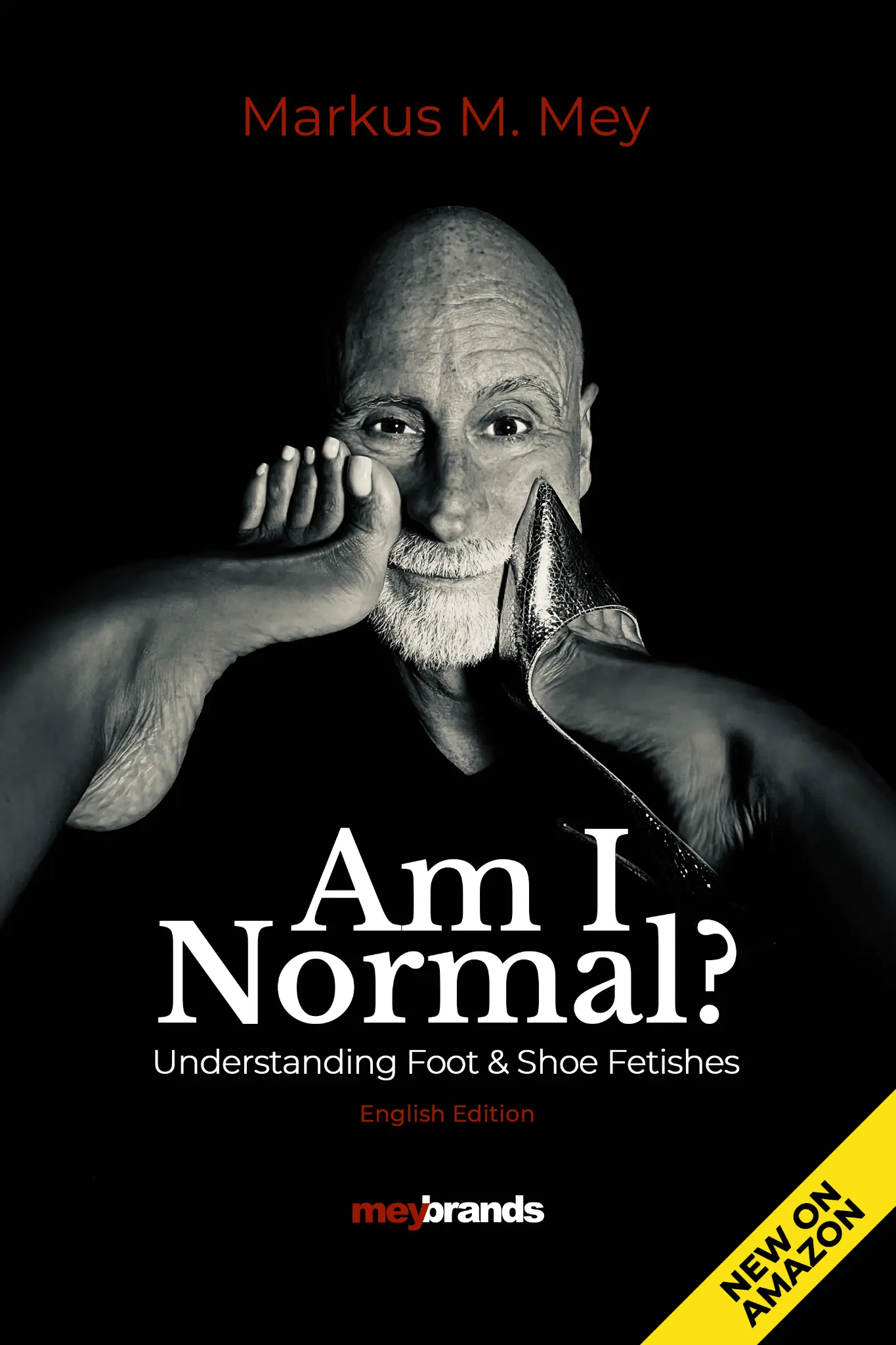
Let this article travel
Good knowledge grows stronger when it is shared.
Link to this original article as a further source — one click copies its permanent address.