
01 · Relationships and Fetish
Introduction
Make room for the pain, but do not let it become a judgment of yourself. Rejection hurts, especially when it concerns something so personal. But it says more about what did or did not fit between two particular people than about whether you are lovable. And it does not determine how your next relationship will unfold.
02 · Relationships and Fetish
My first no
I know what that feels like. At 19, I cautiously tried for the first time to hint to a female friend about my fetish. I only asked her whether she could leave her shoes on. She was puzzled and said that the bed sheet would get dirty. Nothing more came of it, and I never brought up the subject with her again.
Four years later, I met a woman whom I told about my fetish very early on. She reacted calmly, and shoes were a completely natural part of our relationship. Since then, I have talked about my fetish at the beginning of every relationship, and none of my partners has rejected me because of it. The first no was not a pattern, then. It was a single experience.
03 · Relationships and Fetish
What rejection means—and what it does not
After a rejection, one thought is tempting: If she did not accept it, no woman will. This conclusion is understandable, but it is not true. Women react very differently to foot and shoe fetishes. Some are curious, some distant, some reject them. A single reaction says nothing about all the others.
In my book, I describe a mistaken assumption that causes a great deal of suffering. We expect that two people who love each other must also be an exact sexual match. That is not the case. If two sexual worlds cannot be brought together, that is an incompatibility, not anyone's fault. Neither yours nor hers.
04 · Relationships and Fetish
Not every breakup is a fetish breakup
When a relationship ends after the fetish has been brought up, it can quickly seem like the only reason. Often, the picture is more complicated. Sexuality is only one part of a relationship. Love, shared goals, everyday life, and trust are at least as decisive in whether two people stay together.
Sometimes the problem is not the fetish itself, but the timing or the way it was brought up. Anyone who talks about it only after years quickly faces an entirely different question. Then it is no longer about feet or shoes, but about why he did not have trust for so long. That can burden a relationship more than any fetish.
05 · Relationships and Fetish
The shame afterward
After a rejection, shame often returns in full force. You feel exposed and regret having opened up. One detail that the World Health Organization also notes is helpful: distress that arises only from rejection by others does not make a preference a disorder. Rejection changes nothing about who you are.
Research, too, shows how differently such disclosures can turn out. Researcher Giselle Rees describes that people with a fetish disclose, hint at, or conceal their preference, with both positive and negative consequences for the relationship. There is no sure path. A painful experience is unfortunately among the possible outcomes, but it is not the only one.
06 · Relationships and Fetish
What you can take with you into the next relationship
From my own experiences, a few things emerge that I would give to every man after a rejection:
- Talk about it early. At the beginning of a relationship, the conversation is easier, and she can decide for herself whether she wants that.
- Ask about her first. Anyone who takes an interest in her wishes creates an atmosphere in which yours have a place too.
- Put her at the center. It is about her feet, her shoes, not feet in general.
- Do not say too much at once. At first, you are better off keeping to yourself details that she cannot fulfill.
- Do not expect miracles. Very few women experience a fetish in the way you do. Curiosity and enjoyment in the shared play are entirely enough.
07 · Relationships and Fetish
When the fear remains
Sometimes the fear of the next rejection is so deeply rooted that you no longer want to get involved with anyone at all. If that continues for a longer period, a conversation with a professional in psychotherapy or sex therapy can help. You do not have to process the disappointment alone, and you do not have to make yourself smaller in order to be loved again.
Sources
Sources
- Markus M. Mey: BIN ICH NORMAL? Fuß- und Schuhfetisch verstehen. Erste Edition, meybrands, Berlin 2026. ISBN 9798247074557.
- Rees, G. (2019): Investigations into sexual fetishism: examining conceptualisations, practice, personal experience, and pathology. Dissertation, Macquarie University. doi:10.25949/19433471.v1
- World Health Organization: ICD-11 for Mortality and Morbidity Statistics, Paraphilic disorders (6D30–6D36), Release 2025-01. icd.who.int
Explore further in the book
From the question to your own story.
“Am I Normal?” combines clear context with personal experience and perspectives for relationships.
View the English book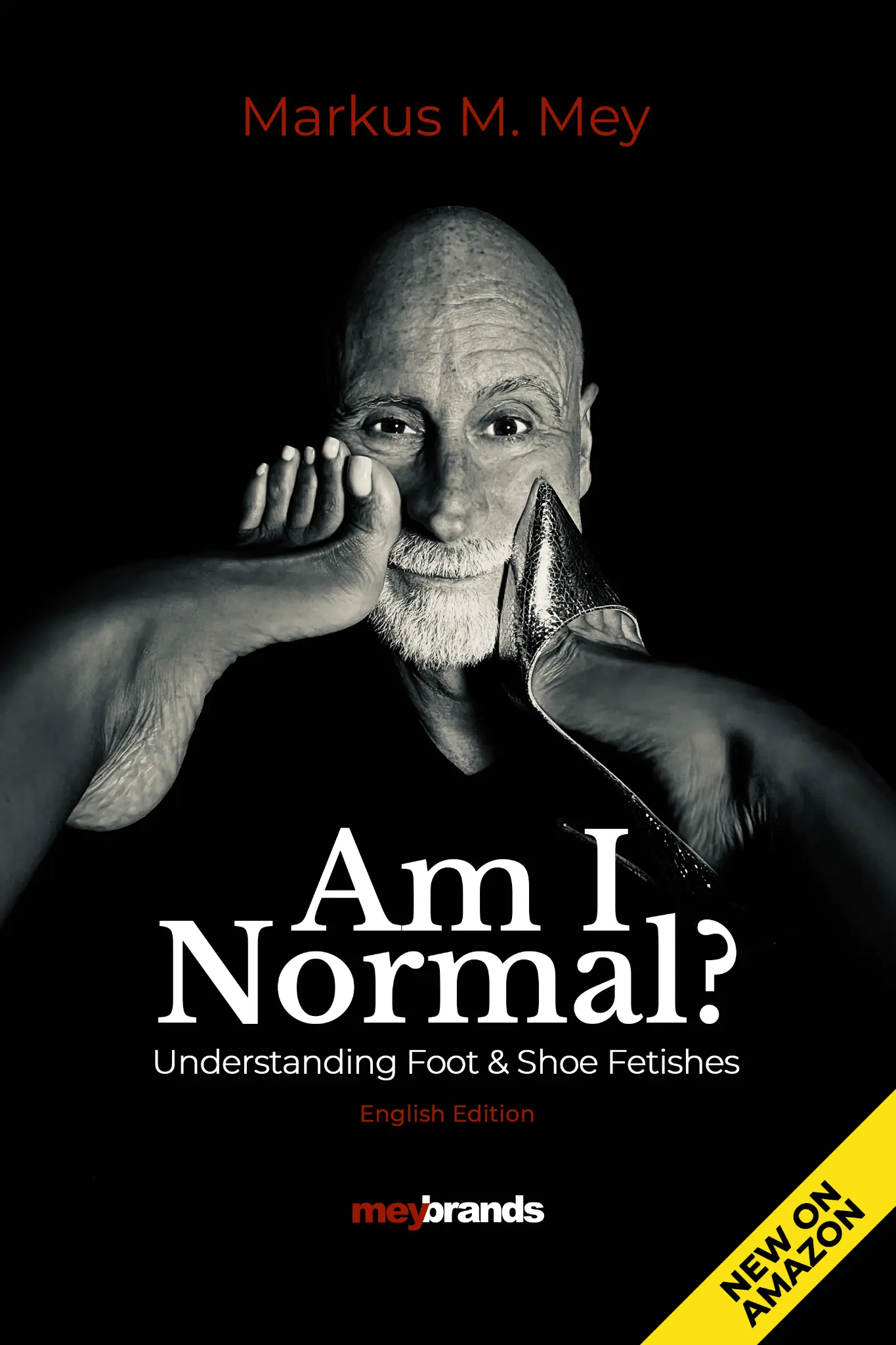
Let this article travel
Good knowledge grows stronger when it is shared.
Link to this original article as a further source — one click copies its permanent address.