
01 · Sexuality and Everyday Life
Introduction
Make access to the stimuli harder, give the urge time, and seek support early if your work or everyday life is suffering. Shoes are everywhere: in street scenes, shop windows, online shops and on social media. Anyone with a strong shoe fetish can feel completely overwhelmed by them. Feeling barely able to control yourself is a serious signal. But there are specific ways to regain more control.
02 · Sexuality and Everyday Life
Where shoe-related stimuli are especially strong
Alongside stimuli in the street, a shoe fetish brings some particular additional ones. Shoes can be bought, collected, looked at and tried on. In online shops and on Instagram, they are staged perfectly, and designer shoes are often presented like works of art. This very staging makes them so effective, and it is always just one click away.
Loss of control in connection with a shoe fetish therefore often shows itself not only in thoughts. It can also show itself in spending hours browsing shops, buying shoes that you do not need at all, or spending more money than you can afford.
03 · Sexuality and Everyday Life
What happens in the mind
After more than forty years with my own shoe fetish, I know that the shoe itself is usually only the trigger. The actual arousal develops in a small story that unfolds around it in the mind. Anyone who understands this does not have to fight every sight. They can learn to notice the story that has just started up and let it pass.
In my book, I also describe that, as adults, repetition influences which content gains weight in our sexuality. Anyone who spends hours every day looking at images of shoes gives the subject more and more space in their mind.
04 · Sexuality and Everyday Life
Reducing access paths
It often helps most to deliberately make the paths to the stimuli more difficult:
- Tidy up social media. Unfollow shoe profiles and shops that keep pulling you back in.
- Block shops or unsubscribe from them. Cancel newsletters, delete saved payment details, remove apps from your phone.
- Set a fixed budget. If you buy shoes, do so with a clear upper limit per month.
- Set time windows. If you look at content, do so consciously and for a limited time, not in passing and without end.
05 · Sexuality and Everyday Life
Giving the urge time
A strong urge often feels as if you have to give in to it immediately. But it often becomes weaker if you wait for a while. Try consciously putting a pause between impulse and action, for example ten minutes. Get up, take a few steps, drink a glass of water. Sometimes the urge is already noticeably quieter afterwards.
06 · Sexuality and Everyday Life
Why bans alone rarely help
Many try to get the fetish under control with strict bans and then feel twice as ashamed when it does not work. In my experience, trying to play down a fetish or suppress it completely tends to create inner resistance. It is more helpful to change the circumstances and to treat yourself with a little more kindness when a day does not go well.
07 · Sexuality and Everyday Life
Giving the fetish a place
You cannot switch a fetish off, but you can give it a fixed place. If it has room in your relationship or in a consciously lived fantasy, it has less need to assert itself incidentally in everyday life. I myself know a period in which my fetish shaped my love life and my working life at the same time. My mind was so full of images that I could hardly switch off anymore. What helped me then was a new perspective on my sexuality, opened up to me by an experienced psychologist.
08 · Sexuality and Everyday Life
When you need professional help
If you notice that you are losing control over your behaviour, that work, relationships or finances are suffering, or that you repeatedly relapse despite good intentions, you should seek support. In the ICD-11, the World Health Organization describes a distinct diagnosis for compulsive sexual behaviour, in which people cannot control intense sexual impulses over a prolonged period and neglect other areas of life as a result. Only a specialist can assess whether this applies to you.
Psychotherapists, ideally with a focus on sex therapy, and sexual-medicine outpatient clinics are appropriate contacts. If it is primarily purchasing behaviour that is getting out of control, debt counselling or addiction counselling can also help.
09 · Sexuality and Everyday Life
What remains
A strong shoe fetish is not an illness. But if it distracts you so much that your life suffers as a result, you deserve support. More control does not mean getting rid of the fetish. It means that you once again decide for yourself when it is given space.
Sources
Sources
- Markus M. Mey: BIN ICH NORMAL? Fuß- und Schuhfetisch verstehen. Erste Edition, meybrands, Berlin 2026. ISBN 9798247074557.
- World Health Organization: ICD-11 for Mortality and Morbidity Statistics, 6C72 Compulsive sexual behaviour disorder. icd.who.int
Explore further in the book
From the question to your own story.
“Am I Normal?” combines clear context with personal experience and perspectives for relationships.
View the English book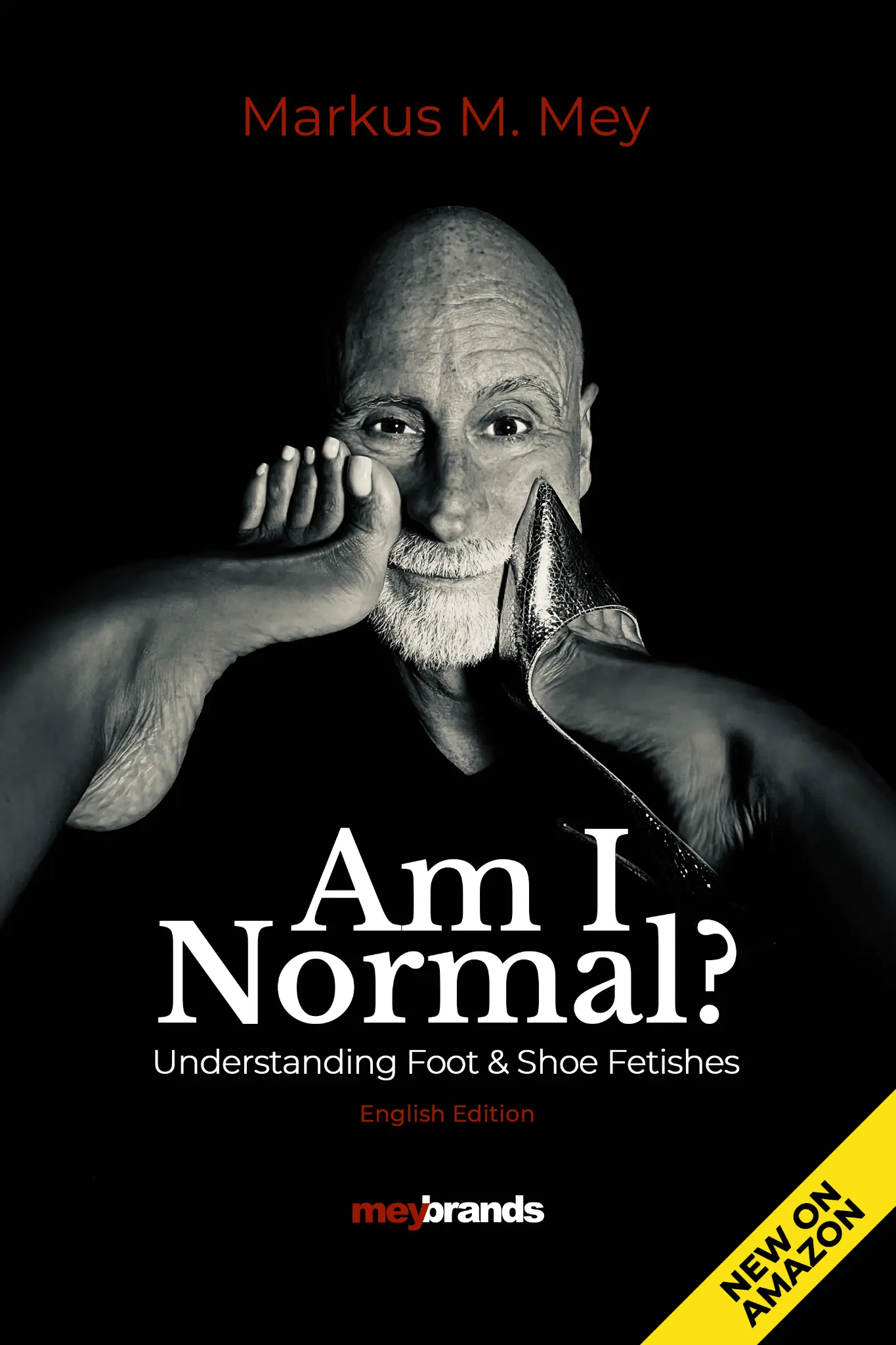
Let this article travel
Good knowledge grows stronger when it is shared.
Link to this original article as a further source — one click copies its permanent address.