
01 · Sexuality & Wellbeing
Introduction
You do not have to, but you may. Uncertainty alone is not a sign of a disorder. But it is a perfectly sufficient reason to talk to someone. Help does not necessarily have to mean therapy. Often, a conversation, a good book or an exchange with someone who is knowledgeable is enough to feel solid ground beneath your feet again.
02 · Sexuality & Wellbeing
What applies from a professional standpoint
Since 2022, the World Health Organization has no longer listed fetishism as its own diagnosis in the ICD-11. A diagnosis is now only considered if someone suffers significantly because of their pattern of arousal, there is a serious risk of injury, or others are involved without their consent. If nobody is harmed and you are primarily uncertain, there is generally no disorder.
That does not mean your uncertainty is unimportant. The ICD-11 describes when something requires treatment. It does not describe when a conversation does you good.
03 · Sexuality & Wellbeing
Clarity is a good reason
I myself sought advice from a psychologist some years ago. At that time no harm had occurred and nobody was at risk. But my wife and I were stuck, and I was looking for clarity. The conversations with her opened up a perspective on my sexuality that I still experience as liberating today.
This experience showed me that you do not have to be at rock bottom to seek support. Sometimes it is enough that you cannot get any further with a question.
04 · Sexuality & Wellbeing
Help takes many forms
Not every uncertainty requires therapy. The options range from very accessible to professional:
- Reading and understanding. Good information alone often helps. When you learn how science currently classifies fetishes, much of the fear falls away.
- Exchange with like-minded people. For many, it is a great relief to realise they are not alone in their preference.
- A conversation with someone you trust. Your female partner, a good male friend or a female friend who listens to you without judging.
- An anonymous conversation. Telefonseelsorge, the telephone counselling service, can be reached free of charge and anonymously around the clock at 0800 111 0 111 or 0800 111 0 222.
- Counselling. Counselling centres such as pro familia offer conversations on sexuality and partnership, often at low cost or free of charge.
- One consultation with a professional. A session with a sex therapist or a sexual-medicine specialist can sometimes be enough to gain clarity.
- Therapy. Appropriate if the uncertainty persists, grows or noticeably limits your life.
05 · Sexuality & Wellbeing
Uncertainty is not a permanent state
Many people with a fetish develop a relaxed relationship with their preference over time. In an online survey of 316 people from fetish communities, life satisfaction fell within the usual range, and most rated their fetish predominantly positively. The participants had volunteered themselves, so it cannot be generalised. But it shows that uncertainty need not be the end of the story.
06 · Sexuality & Wellbeing
How to recognise that it is more than uncertainty
Uncertainty is a normal reaction when you discover a part of yourself you cannot quite make sense of. But it can also develop into something that affects you more deeply. It is worth taking a closer look if, for weeks, you can barely think about anything else, if you withdraw because of it, sleep poorly or feel low, or if the uncertainty burdens your relationship. Then a conversation with a professional is more than an option. It is a good idea.
07 · Sexuality & Wellbeing
What many people underestimate
Shame and uncertainty grow in silence. Those who carry them alone often experience them as larger than they are. A single conversation can significantly reduce that weight. This is not an admission of weakness. It is a sensible decision to take yourself seriously.
And if you fear a professional might prematurely label you as ill: a good professional will listen to you, put things in perspective and tell you if everything is okay. That alone may be the most important help.
08 · Sexuality & Wellbeing
What remains
You do not have to suffer first to deserve support. If your fetish makes you feel uncertain, that is reason enough to speak to someone about it. How far you go is up to you. And sometimes the first step already shows that everything is okay with you.
Sources
Sources
- Markus M. Mey: BIN ICH NORMAL? Fuß- und Schuhfetisch verstehen. Erste Edition, meybrands, Berlin 2026. ISBN 9798247074557.
- World Health Organization: ICD-11 for Mortality and Morbidity Statistics, Paraphilic disorders (6D30–6D36), Release 2025-01. icd.who.int
- pro familia Bundesverband: Beratung. profamilia.de
- Harrison, M. A. & Murphy, B. E. (2021): Sexual fetishes: sensations, perceptions, and correlates. Psychology & Sexuality 13(3). doi:10.1080/19419899.2021.1915368
- TelefonSeelsorge Deutschland. telefonseelsorge.de
Explore further in the book
From the question to your own story.
“Am I Normal?” combines clear context with personal experience and perspectives for relationships.
View the English book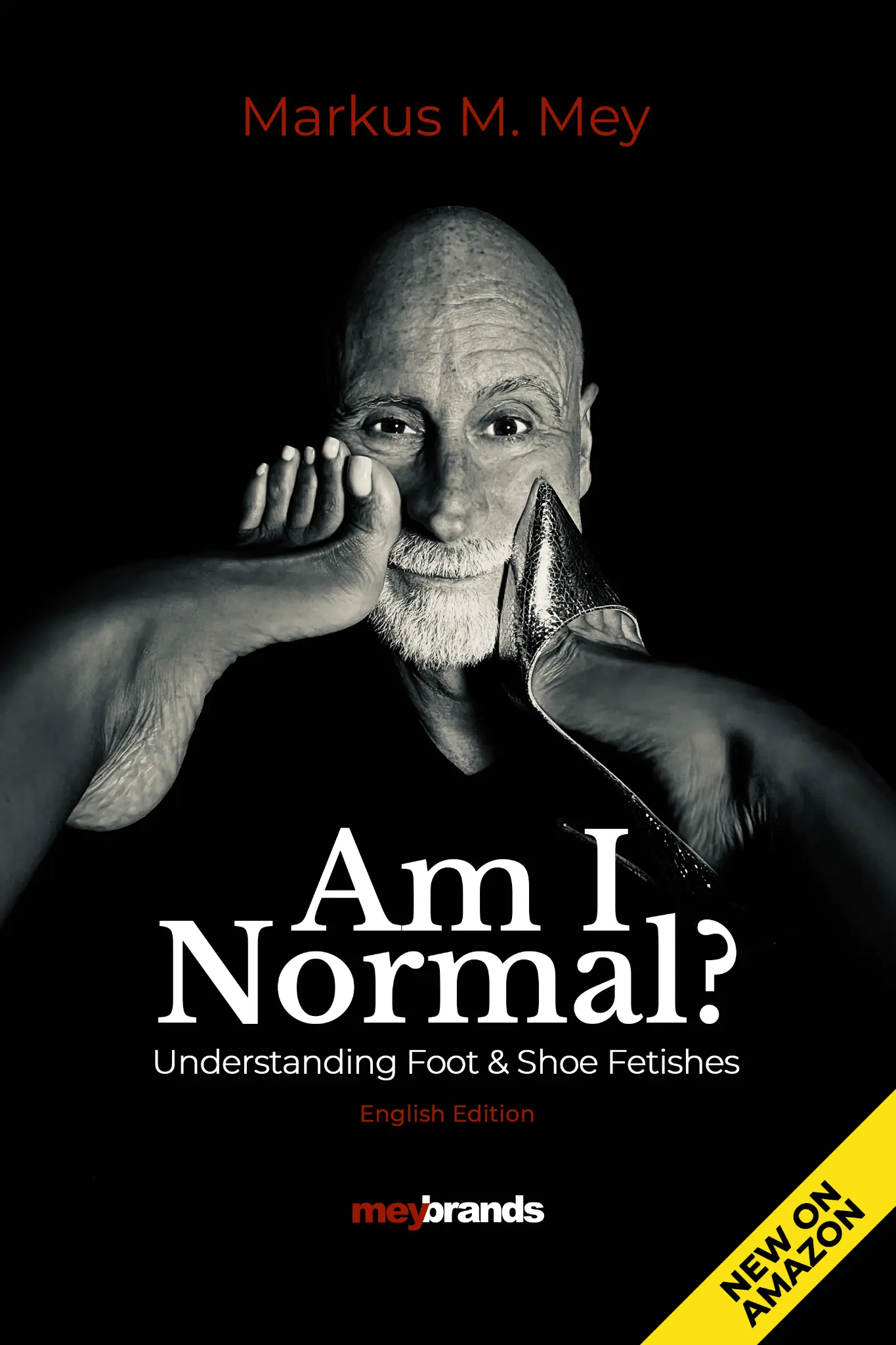
Let this article travel
Good knowledge grows stronger when it is shared.
Link to this original article as a further source — one click copies its permanent address.