
01 · Sexuality and boundaries
Introduction
The fact that you are asking yourself this question before anything happens is a good sign. Fantasies about other people’s feet are not yet a boundary violation. The boundary lies in acting: anything that happens without the other person’s consent is off limits. With clear rules for yourself and timely support, you can make sure that it stays that way.
02 · Sexuality and boundaries
A thought is not an act
Research on sexuality distinguishes very precisely between an interest, the fantasies associated with it, and actual behavior. Studies also show that interest and behavior do not have to coincide. Anyone who notices other people’s feet in sandals in summer or has fantasies about them is not doing anything to anyone. Your thoughts belong to you.
I myself have been seeing feet and shoes everywhere for more than forty years—in summer on the street, on public transport, in cafés. That is part of my fetish, and I cannot simply switch off my gaze. But I decide for myself each time what I do with it.
Nevertheless, it is wise to look closely when the fixation becomes strong. The more space it takes up, the greater the temptation can become to turn a thought into an action.
03 · Sexuality and boundaries
Where the boundary lies
Feet belong to a person, and that person decides what happens to them. This gives rise to clear rules:
Such actions violate other people’s dignity and right to self-determination. They can also have legal consequences. Not everything that arouses is permitted, and this applies to a foot fetish just as it does everywhere else.
- No covert photos or videos of other people’s feet, whether on public transport, at the beach, or anywhere else.
- No touching without express consent, not even ‘accidentally’ in a crowd.
- Do not observe or follow anyone in order to see more.
- No pretexts, such as alleged photo shoots or surveys, to obtain photos or contact.
- Do not take anything, including worn shoes or socks.
- Minors are absolutely off limits, in every form, including online.
04 · Sexuality and boundaries
What the World Health Organization says about it
Since 2022, fetishism has no longer been a diagnosis in its own right in the World Health Organization’s ICD-11. There is, however, a separate category for patterns of sexual arousal directed at people who have not consented. It becomes relevant when someone acts on it or suffers significantly from it. By contrast, anyone who lives out their fetish alone or with people who have consented does not fall into that category. This shows how seriously the issue of consent is taken professionally as well.
05 · Sexuality and boundaries
Early warning signs in yourself
Boundary violations rarely happen out of the blue. They often announce themselves. Watch for these signs:
If you recognize yourself in any of these points, now is the right time to do something—not later.
- You plan your everyday life so that you see other people’s feet as often as possible.
- You take risks that you would not have taken before.
- You feel an urge that you can barely resist.
- You have already crossed a small boundary and play it down, telling yourself, ‘It was only a photo.’
- You conceal more and more.
06 · Sexuality and boundaries
What can help
- Know your situations. If you know when and where the urge is especially strong, you can deliberately avoid such moments or make a plan beforehand.
- Create a consensual setting. In a relationship, with a partner who enjoys it, or with content created with the consent of everyone involved.
- Examine the supply. Anyone who constantly consumes images feeds the fixation. Repetition influences the importance a stimulus takes on in your sexuality.
- Talk about it. With a trusted person or a professional. What you carry around alone often grows larger.
- Seek help early. Psychotherapists and sexual-medicine outpatient clinics can support people who want to prevent something from happening. Seeking help before a boundary is crossed is responsible.
07 · Sexuality and boundaries
My fetish has always had a framework
For decades, my fetish had plenty of room in my life: in relationships, in photo shoots, in video productions. All of that took place with people who participated voluntarily and knew what it was about. That is precisely where I see the difference between a lived fetish and a boundary violation. The stimulus may be the same. But only one of the two happens on equal footing.
Sources
Sources
- 1. Markus M. Mey: BIN ICH NORMAL? Fuß- und Schuhfetisch verstehen. Erste Edition, meybrands, Berlin 2026. ISBN 9798247074557.
- 2. World Health Organization: ICD-11 for Mortality and Morbidity Statistics, Paraphilic disorders (6D30–6D36), Release 2025-01, icd.who.int
- 3. Seto, M. C. et al. (2021): Concordance of Paraphilic Interests and Behaviors. Journal of Sex Research 58(4), doi:10.1080/00224499.2020.1830018
Explore further in the book
From the question to your own story.
“Am I Normal?” combines clear context with personal experience and perspectives for relationships.
View the English book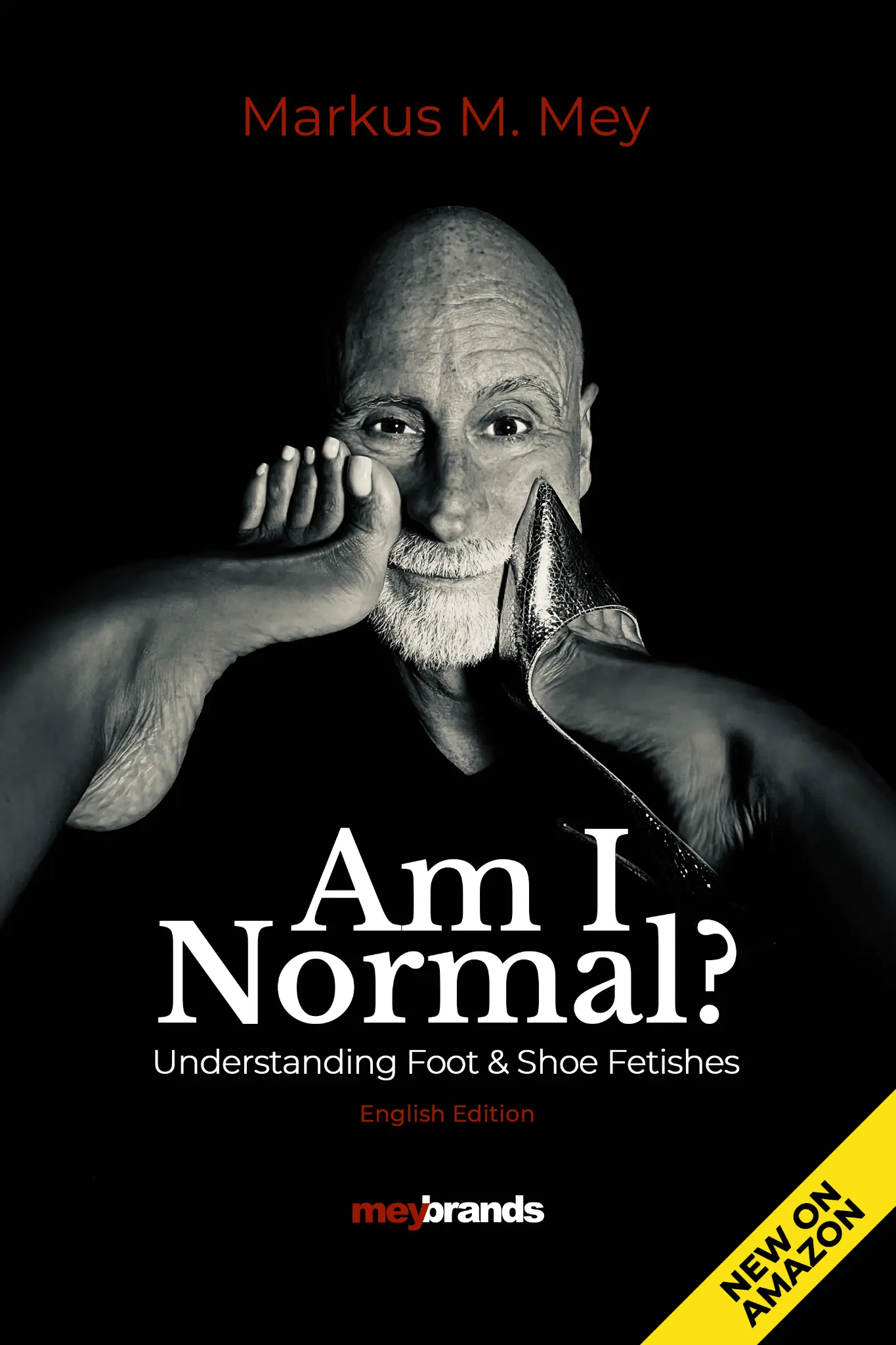
Let this article travel
Good knowledge grows stronger when it is shared.
Link to this original article as a further source — one click copies its permanent address.