
01 · Fetishism
Introduction
There are very many, and they often differ more than one might assume from the outside. In my book, I describe nine types of play that are particularly widespread in foot and shoe fetishism: from tender foot worship through games involving power and submission to highly specific forms. Many of them overlap, and many are closely connected to the interplay of dominance and surrender. An important point from the outset: Having a foot or shoe fetish does not automatically mean that someone practises one of these types of play. For many people, the fetish takes place primarily in fantasy.
02 · Fetishism
The same from the outside, different on the inside
One observation has always fascinated me. Two apparently identical preferences can differ so greatly in detail that people with one form cannot relate to the other at all or even reject it. From the outside, both look the same. Only when one considers the fantasies behind them do the differences emerge. For one person, a more dominant component is in the foreground; for another, a strongly submissive one. This is precisely why it is worth asking about the motive behind each type of play, not only about the action.
03 · Fetishism
An overview of the nine types of play
The following overview deliberately describes the types of play objectively and without details. It is intended to help place terms that frequently appear in communities and online:
Type of play | What it is about | Common motive
- Worshipping | A worshipful, serving focus on feet or shoes, for example by kissing, massaging or looking at them | Humility, surrender, admiration
- Humiliation | Consensual play involving humiliation and submission, in which feet or shoes play a central role | An intense experience of one’s own submission
- Trampling | The dominant person stands or walks on the submissive partner’s body | Power, control, physical intensity
- Dangling | The deliberate display of feet or shoes in the air, for example a shoe casually dangling from the foot | Quiet teasing and tension
- Pedal Pumping | The movement of the foot on a pedal, usually a car’s accelerator pedal | The foot as an active, powerful tool
- Crushing | The crushing of objects such as cans, plastic toys or food | Dominance and the irreversibility of destruction
- Foot Job or Shoe Job | Sexual stimulation with feet or shoes | Closeness to the desired object, often also the feeling of unattainability
- Refinement | An ejaculation onto the shoe, sole or foot as a symbolic act | Strongly shaped by fantasy, dominant or submissive depending on the person
- Foot, shoe or boot slave | Not a single practice, but a comprehensive role in a serving position | Deep submission and the feeling that being “at the very bottom” is right
04 · Fetishism
The connection to dominance and surrender
Anyone looking at the overview quickly sees how often it is about power. In my experience, foot and shoe fetishism frequently goes hand in hand with sadomasochistic inclinations, sometimes quite consciously, sometimes unconsciously. The larger group of foot and shoe fetishists tends to be submissive and finds the other person’s dominance arousing. But there are also dominant fetishists and those who switch between both roles.
That explains why feet and shoes fit these games so well. Feet are at the lower end of the body, and someone who goes to another person’s feet changes their position. Shoes reinforce this effect: a boot appears substantial; a heel raises one up.
05 · Fetishism
What applies to every type of play
As different as the types of play are, a few principles apply to all of them:
- Consent is the prerequisite. Any type of play involving another person requires that person’s voluntary yes, which can be withdrawn at any time.
- No uninvolved people. Secretly watching or filming strangers, or using their shoes without their knowledge, is taboo. What may be exciting in fantasy is a boundary violation in reality.
- Safety in physical types of play. Trampling in particular requires attentiveness and communication. Sensitive parts of the body, airways and physical capacity must be taken into account, and an agreed stop signal is part of it.
- No criminal acts. In all types of play, the actions must always comply with the law and not be criminal. Harassing women or stealing their shoes are criminal acts.
- Minors are without exception taboo, in every form.
06 · Fetishism
No type of play is compulsory
The overview is neither a checklist to be worked through nor a hierarchy. Many people with a foot or shoe fetish identify with one or two types of play, some with none. Others live out their fetish primarily in fantasy, in visual appreciation or in rituals entirely of their own. The world of foot and shoe fetishism is far more diverse than any list can represent.
For conversations in a relationship, the terms can nevertheless be helpful. Someone who can name what arouses them and what does not makes it easier for a female partner to understand what it is about and to say where her boundaries lie.
07 · Fetishism
What remains
Foot and shoe fetishism is a broad spectrum with many types of play. Very different fantasies can underlie similar actions. Which type of play someone prefers is secondary. What matters is that everything involving other people is based on consent, respect and safety.
Sources
Sources
- Markus M. Mey: BIN ICH NORMAL? Fuß- und Schuhfetisch verstehen. Erste Edition, meybrands, Berlin 2026. ISBN 9798247074557.
Explore further in the book
From the question to your own story.
“Am I Normal?” combines clear context with personal experience and perspectives for relationships.
View the English book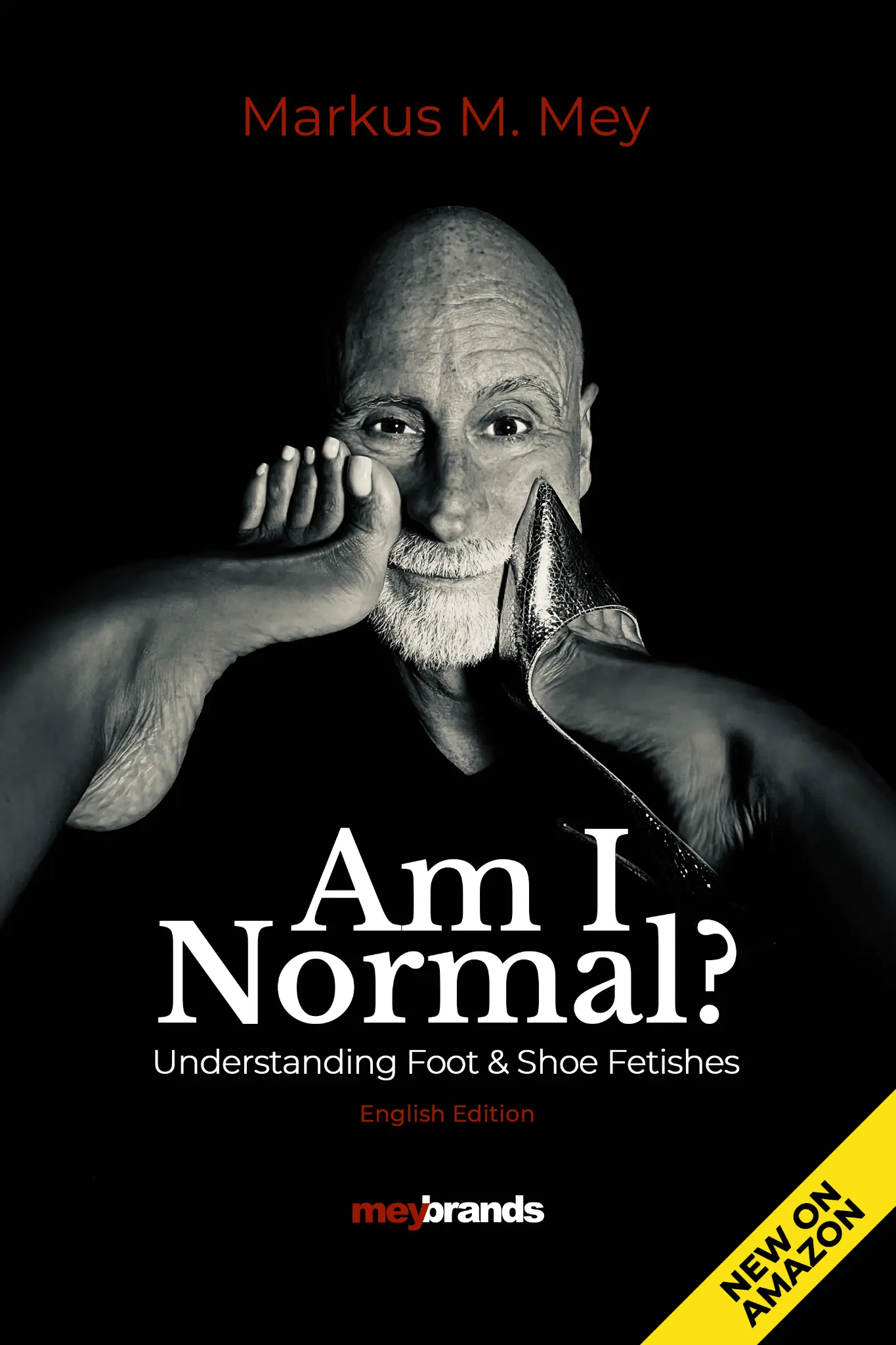
Let this article travel
Good knowledge grows stronger when it is shared.
Link to this original article as a further source — one click copies its permanent address.