
01 · Sexuality
Introduction
A foot fetish is when feet or shoes play a special and recurring role in a person’s sexual arousal. Whether you want to use this word for yourself is, however, up to you. It is a tool for describing yourself, not a judgment or a diagnosis.
02 · Sexuality
A Word with a History
The word “fetish” comes from the Portuguese “feitiço,” which means something like magic. Originally, it referred to objects that were believed to have special powers. It first appeared as a scientific term for sexual preferences in 1887 in the work of the French psychologist Alfred Binet. He suspected that a detail could become deeply imprinted in an emotionally charged situation and later trigger arousal again and again.
From the outset, then, the term carried the idea that an object or body part has an effect that goes beyond what is visible. This is precisely how many people with a foot fetish experience it to this day.
03 · Sexuality
Four Terms That Are Often Confused
In everyday life, several words get mixed up even though they actually mean very different things.
A preference adds to sexuality. It is pleasant, but not essential. Someone who finds feet beautiful and enjoys giving massages has a preference.
A fantasy is an inner image or scenario that can trigger arousal without ever being put into practice. Fantasies are fluid and often depend on the situation.
A fetish is more enduring. It usually accompanies people over a long period, and certain stimuli take on a central function in arousal. For some, it is an important route to pleasure; for others, it is one additional stimulus among many.
A disorder does not describe what arouses someone, but whether it causes suffering. Since 2022, the World Health Organization has no longer listed fetishism as a diagnosis in its own right.
04 · Sexuality
Foot, Shoe, or Both?
A foot fetish is directed at a body part; a shoe fetish, at an object. This distinction was long treated with care in the specialist literature. In practice, however, the two often overlap. Many people respond to bare feet as well as to shoes, stockings, or socks; some respond only to one very specific variation.
In my book, I describe nine different forms of foot and shoe fetishism. They range from worship through play involving power and devotion to highly specific forms. Sometimes two fetishes that appear identical differ so strongly in detail that people drawn to one orientation cannot relate to the other at all. There is no single “the” foot fetish.
05 · Sexuality
When the Word Applies to You
There is no fixed boundary. But a few questions can help you place yourself:
As you answer, you may also notice that what attracts you is more a particular situation—such as the feeling of closeness or devotion—and that feet are only one part of it. That, too, is part of getting to know your own fetish.
By the way, you do not necessarily need your fetish object in order to speak of a fetish. In studies by Giselle Rees and Justin Garcia, most people who ascribe an object fetish to themselves reported being able to become aroused without that object as well. The respondents had volunteered themselves, so the sample is not representative. But it shows how broad the spectrum is.
- Do feet or shoes regularly play a role in your fantasies, and have they done so for a longer period?
- Are they an important route to arousal for you, or rather a pleasant addition?
- Is it the sight or touch itself that arouses you, or above all the story that unfolds around it in your mind?
- Do you feel the need to name this part of your sexuality with a word of its own?
06 · Sexuality
The Label Is a Tool
A term can be a relief. It gives you a language through which you can understand yourself, exchange with others, or explain to your partner what is going on inside you. Those who know their fetish well can also talk about it more effectively.
But a term can also be restrictive. Anyone who defines themselves exclusively through their fetish makes it bigger than it is. Research therefore distinguishes very precisely between the interest itself, behaviour, and the way someone understands themselves. You can have a strong preference for feet and still not call yourself a fetishist. Or you call yourself one and notice how liberating that is. Both are fine. What matters is that the word serves you, rather than you serving the word.
Sources
Sources
- Markus M. Mey: BIN ICH NORMAL? Fuß- und Schuhfetisch verstehen. Erste Edition, meybrands, Berlin 2026. ISBN 9798247074557.
- Kafka, M. P. (2010): The DSM Diagnostic Criteria for Fetishism. Archives of Sexual Behavior 39(2). doi:10.1007/s10508-009-9558-7
- Rees, G. & Garcia, J. R. (2017): All I Need is Shoe: An Investigation into the Obligatory Aspect of Sexual Object Fetishism. International Journal of Sexual Health 29(4). doi:10.1080/19317611.2017.1309483
- World Health Organization: ICD-11 for Mortality and Morbidity Statistics, Paraphilic disorders (6D30–6D36), Release 2025-01. icd.who.int
Explore further in the book
From the question to your own story.
“Am I Normal?” combines clear context with personal experience and perspectives for relationships.
View the English book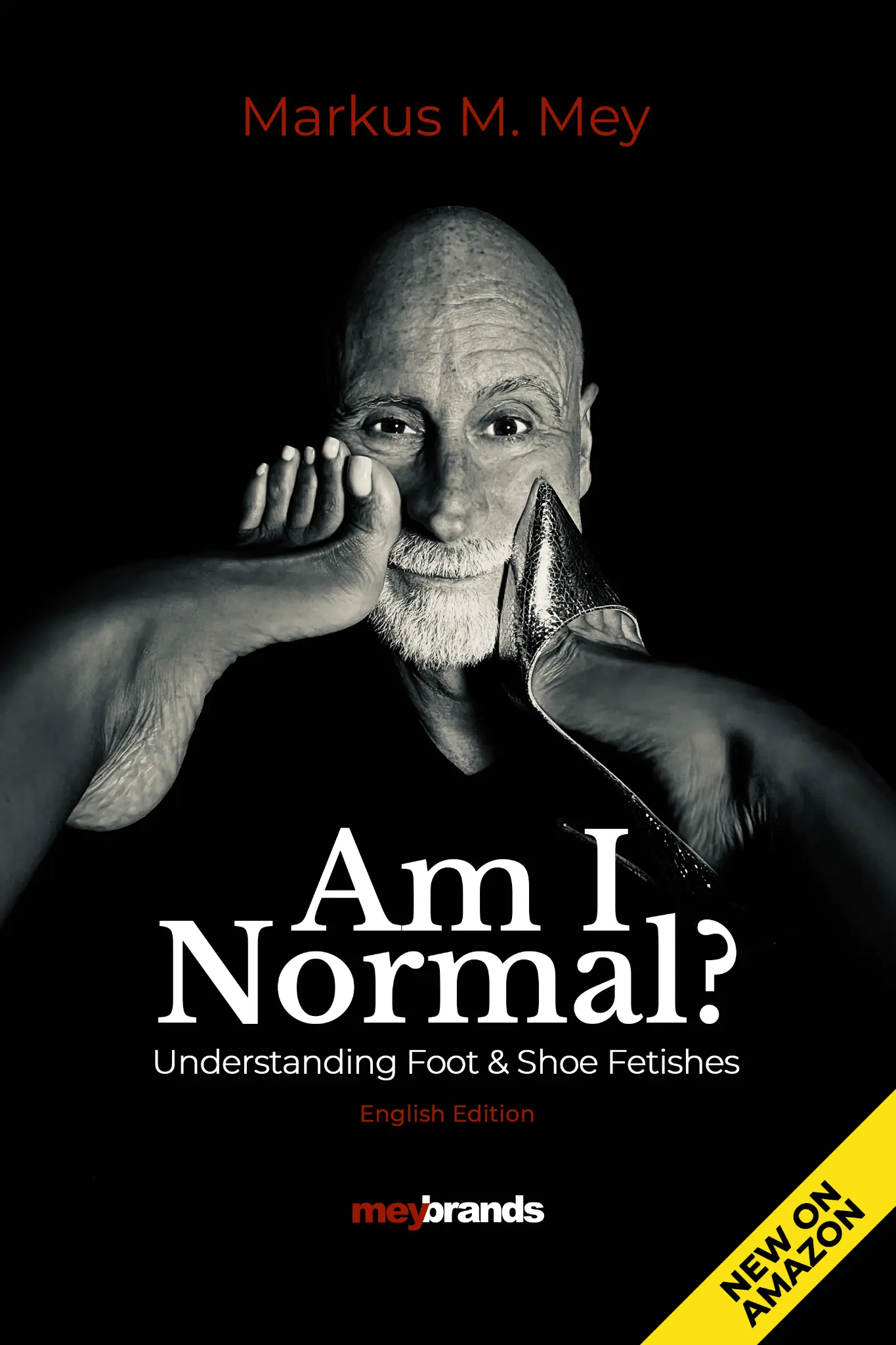
Let this article travel
Good knowledge grows stronger when it is shared.
Link to this original article as a further source — one click copies its permanent address.