
01 · Sexuality & Mental Health
Introduction
Not when it is particularly strong, but when it causes distress. The strength of a preference, its rarity, or how often you think about it are not criteria for a disorder. Professionals look at something else: your own distress, risks, and whether other people consent.
02 · Sexuality & Mental Health
A spectrum, not a rigid category
In my book, I describe fetishism as a spectrum. For some people, the fetish is one additional stimulus among many; for others, it is an important, or even the most important, route to arousal. Both are possible, and neither is a problem in itself.
Research also shows how far apart preference and distress can be. In the Berlin Men's Study, a survey of several hundred men between 40 and 79, significantly more participants reported unusual sexual fantasies and interests than suffered because of them. The study captured fetishes only in broad categories and relied on volunteers. But it shows that an unusual interest and clinical distress are two different things.
03 · Sexuality & Mental Health
Three questions that matter
The World Health Organization removed fetishism as a standalone diagnosis with ICD-11 in 2022. Since then, a diagnosis in the area of paraphilic disorders is considered only if one of three situations applies.
First: Do you yourself suffer significantly because of it? This means substantial, persistent distress that comes from within you. Distress that arises solely because others reject, or might reject, your preference expressly does not count.
Second: Does your behaviour pose a serious risk? For example, of serious injuries, to yourself or to other people involved.
Third: Does it concern people who have not consented? As soon as others are involved without their consent, a clear boundary has been crossed.
The American diagnostic manual DSM-5 additionally includes impairment in everyday life, work, or relationships as a criterion. There too, the preference alone is never sufficient for a diagnosis.
What is also important: such an assessment never arises from a self-test on the internet. It arises in a conversation with a professional who considers your entire life situation. I describe how such an assessment works in a separate article.
04 · Sexuality & Mental Health
What is not sufficient on its own
Many people worry about things that play no role at all from a professional perspective:
- Intensity. A very pronounced fetish is not automatically pathological.
- Frequency of thoughts. Frequently thinking about something that arouses you is human.
- Rarity. Unusual is not the same as disordered.
- Shame. Anyone who is primarily ashamed because others might judge them is not ill because of that.
- Early onset. When a fetish first appeared says nothing about its present significance.
05 · Sexuality & Mental Health
The grey areas
Between “everything is fine” and “clinically relevant” there is a broad range in which a fetish can feel burdensome without a diagnosis being appropriate. I myself experienced such a phase. In 2017 and 2018, my fetish had taken up so much space in our love life and our work together that my wife and I were both dissatisfied. In my view, it was not a disorder. It was still a burden.
Such phases deserve attention, even without a diagnosis. Typical warning signs are when the fetish consumes a lot of time or money, when the relationship keeps revolving around the same issue, or when sex without the fetish is hardly possible anymore and that makes one of you unhappy. At the time, I sought advice from a psychologist, and that helped both of us greatly.
06 · Sexuality & Mental Health
When you should not wait
There are situations in which any consideration of grey areas is out of place. If you notice that you have impulses to involve other people without their consent, for example through secret photos or unsolicited touches, seek professional support immediately. The same applies if thoughts torment you so much that you can barely work, sleep, or have relationships.
07 · Sexuality & Mental Health
The real question
“Am I ill?” is rarely the most helpful question. More helpful is this: “Does what I experience do me good, and does it do good to the people around me?” If you can answer yes, you are far from a clinical problem. If not, that is not a judgement about you, but a good reason to seek support.
Sources
Sources
- Markus M. Mey: BIN ICH NORMAL? Fuß- und Schuhfetisch verstehen. Erste Edition, meybrands, Berlin 2026. ISBN 9798247074557.
- World Health Organization: ICD-11 for Mortality and Morbidity Statistics, Paraphilic disorders (6D30–6D36), Release 2025-01. icd.who.int
- American Psychiatric Association (2013): Paraphilic Disorders. DSM-5 Fact Sheet. psychiatry.org
- Ahlers, C. J. et al. (2011): How Unusual are the Contents of Paraphilias? Paraphilia-Associated Sexual Arousal Patterns in a Community-Based Sample of Men. Journal of Sexual Medicine 8(5). doi:10.1111/j.1743-6109.2009.01597.x
Explore further in the book
From the question to your own story.
“Am I Normal?” combines clear context with personal experience and perspectives for relationships.
View the English book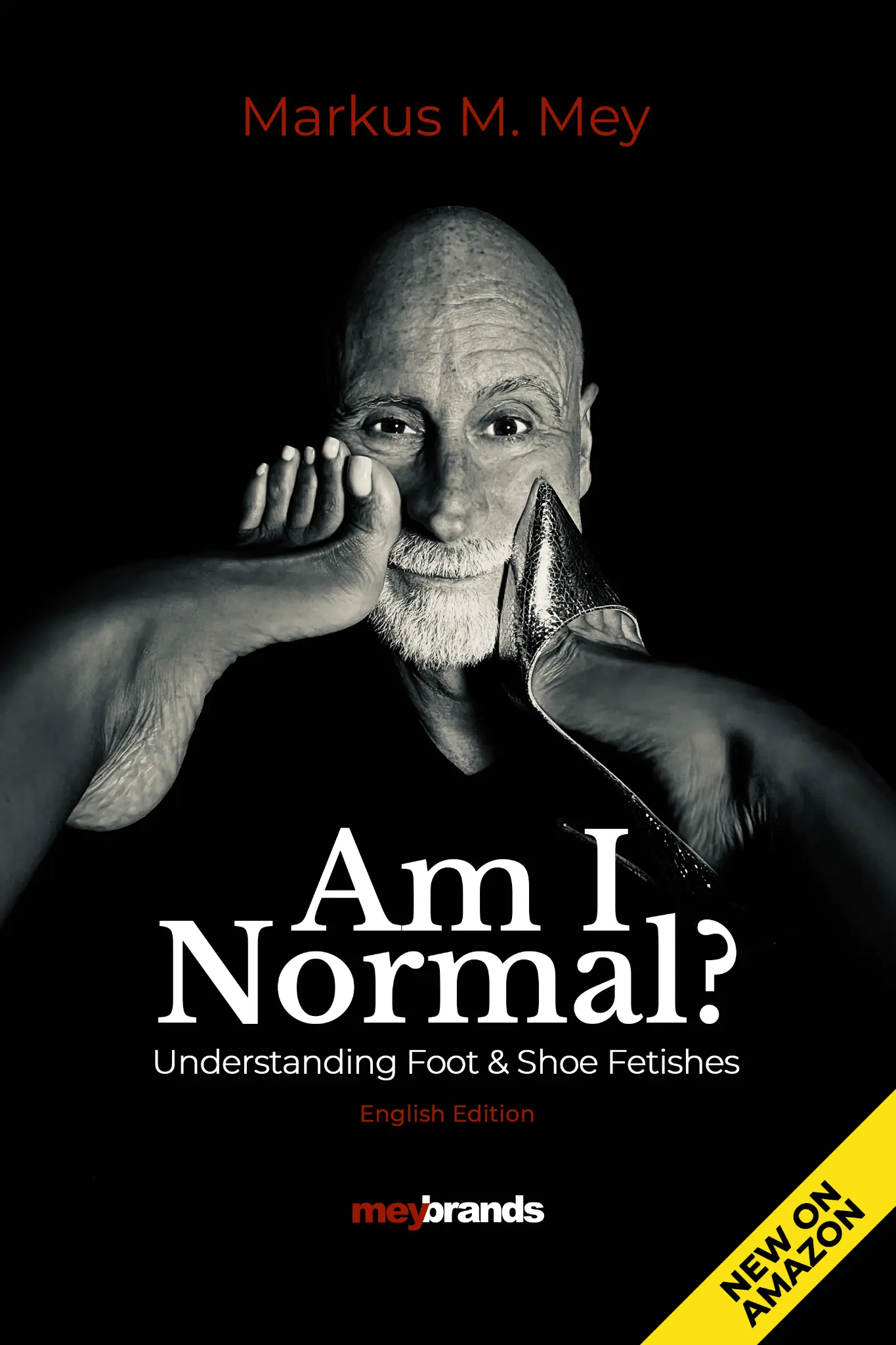
Let this article travel
Good knowledge grows stronger when it is shared.
Link to this original article as a further source — one click copies its permanent address.