
01 · Origins & Psychology
Context
According to current knowledge, there is no single cause. But there is a whole range of explanations for why feet and shoes, of all things, so often become a fetish. I consider one of them outdated, one popular but unproven, and two quite convincing. In the end, however, I am convinced that the more interesting answer lies somewhere else entirely.
02 · Origins & Psychology
Freud and fear
The oldest known explanation comes from Sigmund Freud. He linked fetishism to so-called castration anxiety, which, according to his theory, arises in early childhood. The fetish would be a kind of protection against this anxiety. It would often be directed at things perceived near the alleged threat, and Freud explicitly included feet and shoes among them.
This theory shaped the view of fetishism for decades. Today it is considered highly reductive and very much a product of its time. I still find it interesting. Freud was one of the first to ask about internal mechanisms instead of simply condemning fetishists on moral grounds.
03 · Origins & Psychology
The brain-map theory
Since the early 2000s, an explanation has been circulating that almost everyone has heard at some point. It is often associated with the neuroscientist Vilayanur S. Ramachandran. In the brain, the areas that process sensations from the feet and the genitals lie directly next to each other. Perhaps, the idea goes, some sort of overlap occurs there.
That sounds fascinating, but I have always had my doubts. If this proximity alone were decisive, women would have to have a foot fetish as often as men, because their brains are not fundamentally structured differently in this respect. In my experience, and according to all the data I know, that is not the case. Moreover, the research I reviewed for this question contains no direct evidence that this proximity causes a foot fetish. An EEG study did examine how men with unusual sexual interests react to erotic images. But feet were not the focus, and the brain map was not tested at all. It remains a hypothesis.
04 · Origins & Psychology
Feet carry meaning
I consider something else more important. Feet and shoes are not just any body part or just any object. They have carried meaning for thousands of years. In religious art, feet stood for humility and closeness to the earth, while shoes signalled status and power. In China, women’s feet were bound for centuries because small feet were considered especially desirable.
The word itself already tells this story. ‘Fetish’ goes back to the Portuguese ‘feitiço’, which means something like magic. Originally, it referred to objects believed to have special powers. Only much later did psychologists apply the term to sexuality.
Then there is their position: feet are at the lower end of the body. Someone who places themselves at another person’s feet changes their position, spatially as well as emotionally. A high heel changes a woman’s posture, gait and presence. All of this has an effect without needing an explanation. It therefore does not surprise me that so many fantasies of closeness, devotion and power become attached precisely to feet and shoes.
05 · Origins & Psychology
Feet are everywhere
A second point is often underestimated. Feet and shoes are constantly visible in everyday life, much more often than other body areas that are erotically charged. You encounter them early and again and again: when playing, in the family, on the street. And yet there is an unspoken rule that they are not supposed to be erotic.
Research into the development of sexual preferences considers learning processes and the linking of stimuli with arousal to be plausible components. I believe that the everyday nature of feet and shoes plays a role precisely in this. What is always there simply has more opportunities to become associated with feelings. However, this cannot be proven for an individual.
06 · Origins & Psychology
My answer: It is about the story behind it
After more than forty years with my own fetish, I am convinced that the question of the object is too narrow anyway. If I see a sales photo of my favourite shoes on Instagram, Louboutin in nude patent leather with a 120-millimetre heel, it does not arouse me in the slightest. If I see the same shoes on a woman sitting casually and confidently on a sofa, a fantasy is sparked in my mind. Only this story creates the arousal. The shoe is merely the trigger.
That is why I find another question more interesting than why it is feet of all things. What stories do you associate with them? What happens in your mind when you see them? That is where, in fantasy, the real core usually lies.
Sources
Sources
- Markus M. Mey: BIN ICH NORMAL? Fuß- und Schuhfetisch verstehen. Erste Edition, meybrands, Berlin 2026. ISBN 9798247074557.
- Schippers, E. E., Hoogsteder, L. M. & de Vogel, V. (2025): Theories on the Etiology of Deviant Sexual Interests: A Systematic Review. Sexual Abuse 37(1). doi:10.1177/10790632241271308
- Waismann, R. et al. (2003): EEG Responses to Visual Erotic Stimuli in Men with Normal and Paraphilic Interests. Archives of Sexual Behavior 32(2). doi:10.1023/A:1022448308791
- Pfaus, J. G. et al. (2020): Conditioning of Sexual Interests and Paraphilias in Humans Is Difficult to See, Virtually Impossible to Test, and Probably Exactly How It Happens. Archives of Sexual Behavior 49(5). doi:10.1007/s10508-020-01739-2
Explore further in the book
From the question to your own story.
“Am I Normal?” combines clear context with personal experience and perspectives for relationships.
View the English book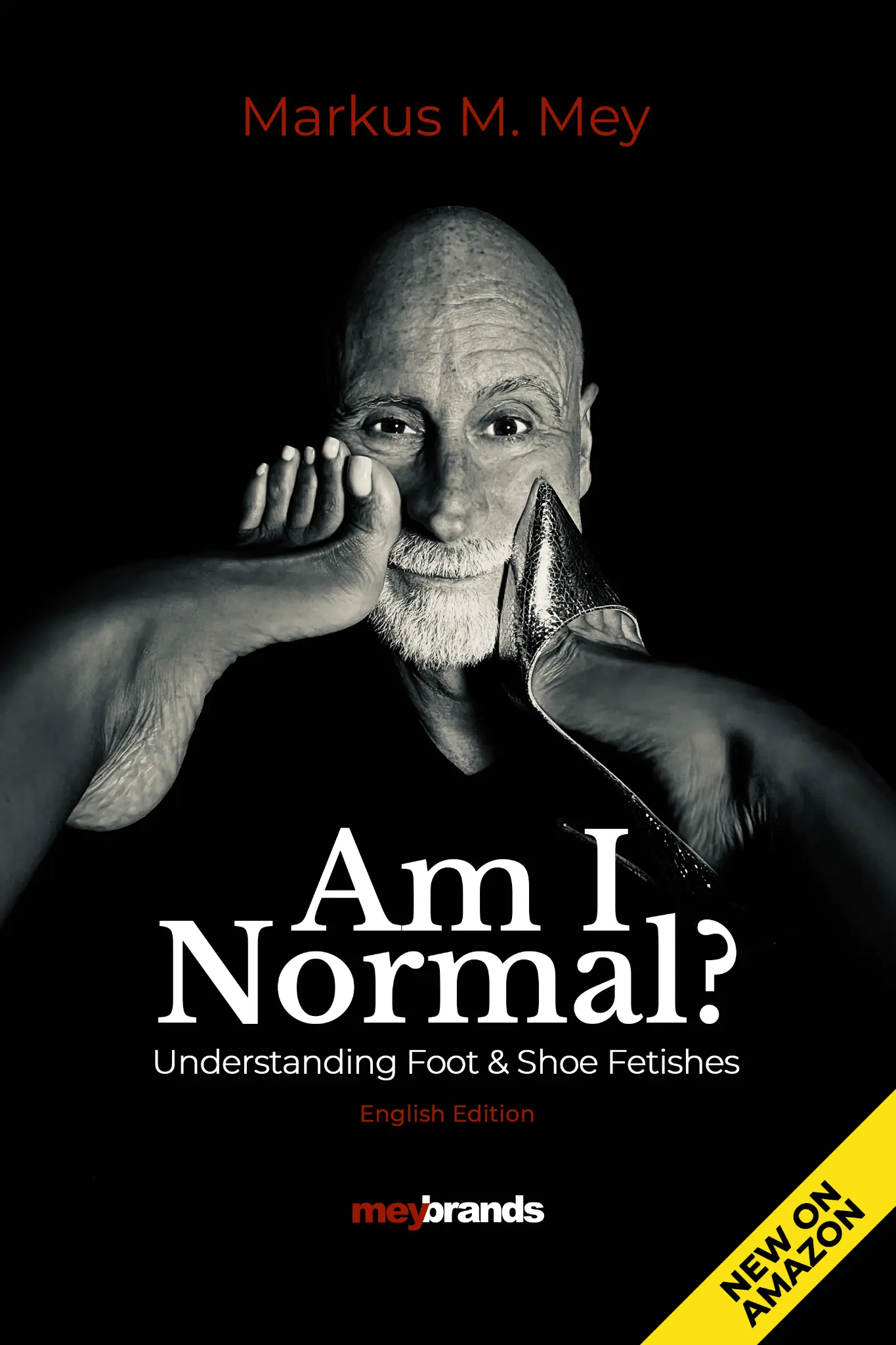
Let this article travel
Good knowledge grows stronger when it is shared.
Link to this original article as a further source — one click copies its permanent address.