
01 · Sexuality and Fetishes
Introduction
No one knows for sure, and even the question of how large the difference really is cannot be answered with certainty. From everything I know and have experienced over more than forty years, pronounced foot and shoe fetishes are markedly more common among men. I have my own hypothesis about this, one connected to evolution. It has not been proven, but there is research pointing in its direction and research that contradicts it. I want to present both in detail in this article. One thing at the outset: gender changes nothing about the value or significance of a preference.
02 · Sexuality and Fetishes
What the data show—and what they do not
There are hardly any robust figures. In an online study from Iran, 201 men but only 6 women reported an object fetish; four of these women also named feet. The group is far too small to draw any general conclusion from it. A Canadian study involving more than 1,000 participants did examine gender differences, but grouped feet and shoes together with other objects.
There is also a methodological problem. How many people report an unusual interest depends heavily on how the question is asked. It is entirely possible that women disclose such preferences less often, and equally possible that they actually occur less often. The data cannot cleanly distinguish between the two.
03 · Sexuality and Fetishes
What I have observed myself
In my book, I describe an experiment. For two years, I ran an Instagram profile as a heterosexual man with a boot fetish. Of around 1,600 genuine followers, about 1,500 were men. During that time, exactly three women with a genuine sexual shoe or boot fetish contacted me. This is not a study, but it matches everything I have experienced in nightlife, as a photographer, and in many conversations.
04 · Sexuality and Fetishes
My hypothesis: Why rapid arousability might have been an advantage
To understand the hypothesis, we need to take a step back and ask what sexual arousal evolved for in the first place. Evolution follows no romantic or moral concept, but purely functional principles. From its perspective, sexuality primarily serves reproduction.
For reproduction, one particular physical prerequisite is essential in men: an erection. Without it, the sexual act cannot take place. For women, the biological starting point is different. For conception, their arousal is not a strictly necessary physical prerequisite. I want to be explicit about how this should be understood: this is a sober biological description, not a statement about what sexuality ought to be. Fulfilling sexuality requires the desire of both people, and there is no sex without consent. Yet this asymmetry matters to the question of why male and female arousal may have developed differently over the course of evolution.
My assumption is this: because reproduction is not possible for men without arousal, evolution may have favored men whose arousal could be triggered quickly and reliably. A man who responded to many different stimuli missed fewer opportunities. A man whose arousal began only under very specific circumstances was statistically at a disadvantage. Put simply, for passing on genes, it was more favorable to be aroused once too often than once too little.
It would follow that, for many men, a single visual stimulus is enough to trigger arousal. One responds to breasts, the next to legs, another to feet or shoes. This rapid and often highly specific arousability would then not be a cultural malfunction, but possibly the legacy of an evolutionary advantage.
A cultural observation fits this well for me. For decades, men's magazines such as Playboy operated on exactly this principle. A single photograph of an unknown woman was enough to trigger arousal in millions of men. The equivalent for women, the magazine Playgirl, was never able to establish itself in a similar way.
05 · Sexuality and Fetishes
How rapid arousability can become a fetish
An often-overlooked distinction matters to me. According to my hypothesis, the fetish itself is not the evolutionary advantage. The advantage lies in arousal being easily triggered. The fetish would be more of a by-product of that.
An arousal system that responds quickly to individual stimuli and easily links itself to them will sometimes also link itself to stimuli that have nothing directly to do with reproduction: a foot, a shoe, a material. Especially in younger years, when sexuality is still little reflected upon, such associations can arise and become entrenched without being consciously controlled.
I consider it quite possible that there is a basic genetic predisposition that favors such associations. What arousal then focuses on, however, is not genetically determined. I like to use a thought experiment here: if I had grown up as an infant in a remote community in the jungle, with no contact with Western culture, I would never have learned about high heels. A high-heel fetish could not have developed at all. Perhaps it would have become jewelry or a particular form of body paint. The object is interchangeable; the mechanism behind it is not.
06 · Sexuality and Fetishes
Why feet and shoes in particular?
In my view, there are several reasons why arousal so often becomes linked specifically to feet and shoes. Feet and shoes are constantly visible in everyday life; for thousands of years, they have carried meanings of humility, rank, and power; and they alter a person's appearance.
There is an interesting study on the latter. A research team led by psychologist Paul Morris at the University of Portsmouth had women walk once in flat shoes and once in high heels, recording only the movement of luminous points at their joints. The observers therefore saw no shoes, no clothing—only the gait. Even so, the women in high heels were rated as significantly more attractive. The heels shortened stride length and intensified hip movement, precisely the features that make up a feminine gait. The researchers speak of a “supernormal stimulus,” an amplified version of a natural signal. The study was small, but the idea fits my experience well: a high heel is an amplifier, and an arousal system that responds to visual signals reacts particularly strongly to amplifiers.
07 · Sexuality and Fetishes
What research says about visual stimuli
The question of whether men really respond more strongly to visual sexual stimuli has been intensively studied, with mixed results.
A widely cited 2008 review by Heather Rupp and Kim Wallen concludes that the assumption that men respond more strongly to visual sexual stimuli is, by and large, empirically supported. However, the authors emphasize that many studies have methodological weaknesses. In addition, men appear to respond more strongly to particular content in images, and women more strongly to the context in which something is shown.
Of particular interest to my hypothesis are studies by Canadian sex researcher Meredith Chivers. In 2004, she and her colleagues measured the physical arousal of men and women while they watched various erotic films. In men, arousal was highly category-specific: heterosexual men responded mainly to women, homosexual men mainly to men. By contrast, women's physical response was markedly broader and less tied to a particular category. This fits the idea that male arousal is more tightly coupled to specific stimuli.
However, there is also a weighty contrary finding. In 2019, a research group at the Max Planck Institute for Biological Cybernetics in Tübingen jointly analyzed a total of 61 neuroimaging studies involving around 1,850 participants. Their result: the brain regions activated by visual sexual stimuli do not differ between men and women. This contradicts the widespread assumption that men and women process such stimuli in fundamentally different ways in the brain. If there are differences, they may instead lie in how people evaluate arousal, act on it, and talk about it.
08 · Sexuality and Fetishes
A related idea from evolutionary psychology
The logic of my hypothesis recalls a well-known 2000 theory by psychologists Martie Haselton and David Buss. Their so-called error management theory states that perception has become systematically biased over the course of evolution where the costs of two possible errors were unequal. A familiar example is that men often overestimate women's sexual interest, presumably because a missed opportunity was more costly in evolution than a mistake.
This theory does not deal with fetishes. But it shows that such considerations are seriously discussed in research. It also provides an important warning: an evolutionarily developed tendency to misjudge something justifies nothing. Whether someone is interested must be asked, not assumed.
09 · Sexuality and Fetishes
The perspective of Ogas and Gaddam
For their 2011 book “A Billion Wicked Thoughts,” data scientists Ogi Ogas and Sai Gaddam analyzed millions of search queries, websites, and erotic stories. They vividly describe male arousal as a kind of OR circuit, in which a single stimulus may be sufficient, and female arousal as more dependent on context. This aligns with my hypothesis. However, the book is popular science, not peer reviewed, and its methods are controversial. I regard it as an interesting line of thought, not as evidence.
10 · Sexuality and Fetishes
Other explanations that may also play a role
- Social factors. Men and women often learn different rules about how openly they are allowed to speak about sexuality. Female sexuality was less visible for a long time.
- Learning processes. The best-supported theories assume that several processes interact, including conditioning and social learning. Whether they proceed differently in men and women remains open.
- Research with a bias. Many classic studies on fetishism were conducted exclusively with men, such as Stanley Rachman's well-known 1966 experiment in which young men developed a response to the image of a boot. We simply know less about women with fetishes.
11 · Sexuality and Fetishes
What argues against my hypothesis
Honesty also requires naming the weaknesses of my hypothesis. Evolutionary explanations are difficult to test, because no one can repeat the past in an experiment. Critics therefore sometimes speak of stories invented after the fact which may sound plausible but cannot be disproven. There is also the Tübingen finding that the brain response to visual stimuli does not differ between the genders. Finally, the evidence on the frequency of fetishes in women is so sparse that we do not even know exactly how large the difference is that we are trying to explain.
I nevertheless consider my hypothesis coherent because it brings together many observations. But it remains a hypothesis.
12 · Sexuality and Fetishes
Beware of stereotypes
Trends quickly turn into stereotypes, such as “men respond only to images, women only to feelings.” That is not true. There are enormous differences within every gender. Those who understand the differences as a broad tendency rather than a rule for the individual are closer to reality.
13 · Sexuality and Fetishes
Does gender change the meaning?
No. A woman with a foot fetish is not more “unusual” or more “wrong” than a man with the same fetish simply because she is less common. Since 2022, the World Health Organization has no longer listed fetishism as a separate diagnosis, and this applies equally to all genders. Whether a preference becomes a problem does not depend on gender, but on distress, risks, and consent.
If you are a woman with a foot or shoe fetish, you may be less common, but you are not alone. And your fetish says no more about your worth or femininity than it says about a man's masculinity.
14 · Sexuality and Fetishes
What remains
In summary, my hypothesis is this: over the course of evolution, men needed to be aroused quickly and reliably, and such an arousal system readily couples itself to individual stimuli, sometimes to feet and shoes as well. Research provides indications for this, but also clear counterarguments. Fetishism would therefore not be a defect, but the result of an interaction between biological arousability and the cultural environment. For one's own life, the question of how you live with your fetish ultimately matters less than why.
Sources
Sources
- Markus M. Mey: BIN ICH NORMAL? Fuß- und Schuhfetisch verstehen. Erste Edition, meybrands, Berlin 2026. ISBN 9798247074557.
- Shekarchi, R. et al. (2025): Comparison of Psychopathological and Socio-cultural Outcomes Among Distinct Fetishism Subgroups: A Cluster Analysis Approach. Sexuality & Culture 29(4). doi:10.1007/s12119-025-10352-1
- Dawson, S. J., Bannerman, B. A. & Lalumière, M. L. (2016): Paraphilic Interests: An Examination of Sex Differences in a Nonclinical Sample. Sexual Abuse 28(1). doi:10.1177/1079063214525645
- Joyal, C. C. & Carpentier, J. (2017): The Prevalence of Paraphilic Interests and Behaviors in the General Population: A Provincial Survey. Journal of Sex Research 54(2). doi:10.1080/00224499.2016.1139034
- Morris, P. H., White, J., Morrison, E. R. & Fisher, K. (2013): High heels as supernormal stimuli: How wearing high heels affects judgements of female attractiveness. Evolution and Human Behavior 34(3), 176–181.
- Rupp, H. A. & Wallen, K. (2008): Sex differences in response to visual sexual stimuli: A review. Archives of Sexual Behavior 37(2), 206–218.
- Chivers, M. L., Rieger, G., Latty, E. & Bailey, J. M. (2004): A sex difference in the specificity of sexual arousal. Psychological Science 15(11), 736–744. doi:10.1111/j.0956-7976.2004.00750.x
- Mitricheva, E., Kimura, R., Logothetis, N. K. & Noori, H. R. (2019): Neural substrates of sexual arousal are not sex dependent. PNAS 116(31), 15671–15676. doi:10.1073/pnas.1904975116
- Haselton, M. G. & Buss, D. M. (2000): Error management theory: A new perspective on biases in cross-sex mind reading. Journal of Personality and Social Psychology 78(1), 81–91. doi:10.1037/0022-3514.78.1.81
- Ogas, O. & Gaddam, S. (2011): A Billion Wicked Thoughts. Dutton, New York.
- Rachman, S. (1966): Sexual Fetishism: An Experimental Analogue. The Psychological Record 16(3). doi:10.1007/BF03393671
- Schippers, E. E., Hoogsteder, L. M. & de Vogel, V. (2025): Theories on the Etiology of Deviant Sexual Interests: A Systematic Review. Sexual Abuse 37(1). doi:10.1177/10790632241271308
- World Health Organization: ICD-11 for Mortality and Morbidity Statistics, Paraphilic disorders (6D30–6D36), Release 2025-01. icd.who.int
Explore further in the book
From the question to your own story.
“Am I Normal?” combines clear context with personal experience and perspectives for relationships.
View the English book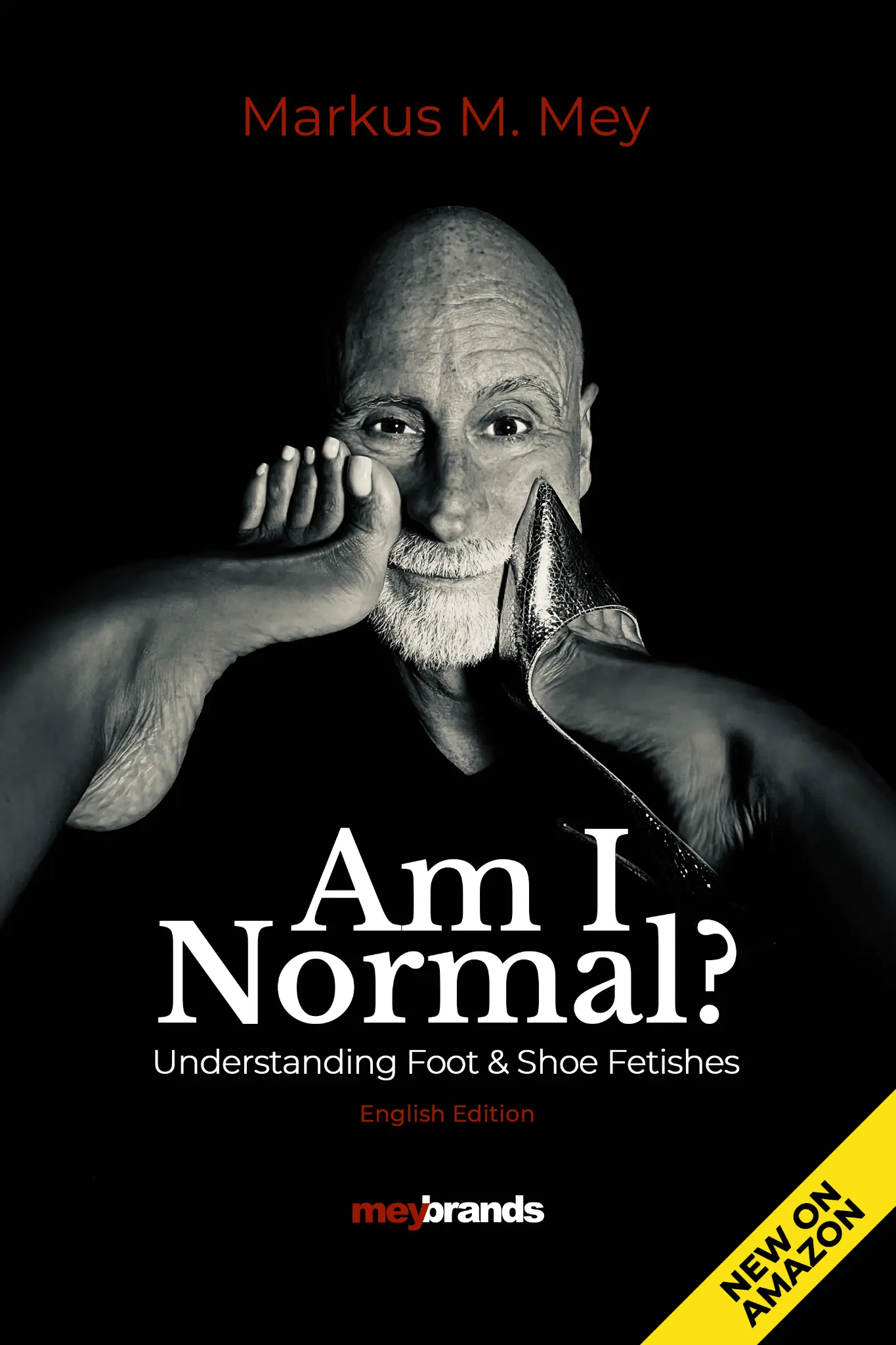
Let this article travel
Good knowledge grows stronger when it is shared.
Link to this original article as a further source — one click copies its permanent address.